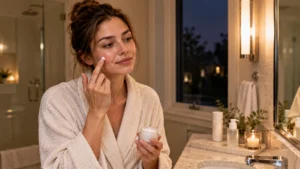
Vitamin C is one of the most recommended ingredients in skincare, and also one of the most oversimplified. Search around for it and you’ll find confident, specific-sounding rules — use exactly this many drops, wait exactly this many seconds, never go above this percentage, never combine it with that ingredient — repeated across dozens of sites with no study behind any of them. Underneath the folklore, there’s a real and reasonably well-studied ingredient, but the evidence is more specific, more conditional, and more form-dependent than most of that advice suggests.
This guide focuses specifically on topical (applied-to-skin) vitamin C as used in over-the-counter cosmetic products — not oral vitamin C supplementation, and not any single brand’s patented formulation, even though some of the strongest research involves one. It’s written to separate what the evidence actually supports from what’s simply repeated often enough to sound established.
Topical vitamin C has real, if more modest and more form-specific, evidence behind it: antioxidant protection against UV- and pollution-related free-radical damage, some support for improving hyperpigmentation and photoaging (most of it involving L-ascorbic acid specifically), and a generally good safety profile with mild, expected irritation for some people. It does not replace sunscreen, it doesn’t “boost” your SPF, and most of the precise rules you’ll see online — exact drop counts, exact wait times, an across-the-board “8% minimum,” damp skin being required or forbidden — aren’t backed by the clinical research reviewed for this guide (the oft-cited “20% is enough” figure is a partial exception — see What Percentage Should You Use? below for what that evidence actually shows and doesn’t). The most reliable approach is to pick a well-formulated product, follow its own directions, pair it with daily sunscreen, and not expect a single fixed timeline for results.
What Is Topical Vitamin C?
“Vitamin C” in skincare almost always refers to L-ascorbic acid (also just called ascorbic acid) or one of several chemically related derivatives — sodium ascorbyl phosphate, magnesium ascorbyl phosphate, ascorbyl glucoside, 3-O-ethyl ascorbic acid, and tetrahexyldecyl ascorbate, among others. These aren’t interchangeable versions of the same tested ingredient; they’re chemically distinct compounds with different stability, different pH requirements, and — importantly — very different amounts of actual clinical research behind them. Treating “vitamin C” as one uniform ingredient is one of the more common oversimplifications this guide tries to avoid.
What Does Vitamin C Actually Do for Skin?
Antioxidant support
Vitamin C’s core mechanism is as an antioxidant: it donates electrons to neutralize reactive oxygen species (free radicals) generated by UV exposure and environmental pollution, and it helps regenerate oxidized vitamin E so that antioxidant can keep working too. This is a biochemical mechanism, not a physical barrier — vitamin C doesn’t “shield” skin the way a sunscreen filter does; it helps mop up some of the oxidative damage that happens after exposure.
Photoaging and collagen-related evidence
Some of the most cited vitamin C research comes from a specific combination: 15% L-ascorbic acid, 1% vitamin E, and 0.5% ferulic acid at a low pH (at or below 3.5). In that exact formulation, ferulic acid chemically stabilizes the vitamin C and vitamin E, and in an animal-skin model (pig skin, not human), the combination provided roughly eight-fold photoprotection against UV-induced damage compared to about four-fold for vitamin C and E alone. Human follow-up studies using a similar antioxidant-combination approach have found protective effects against UV-induced skin damage as well. It’s worth being direct about the limits of this evidence: the dramatic “doubles protection” figure comes from a pig-skin study of one specific, low-pH, three-ingredient formulation — it is not evidence that any vitamin C serum, at any concentration or pH, provides that same degree of protection.
Separately, small human trials have found that L-ascorbic acid applied topically — generally in the 5–10% range, over weeks to months — can increase markers of collagen production (collagen gene expression, in some studies measured as mRNA) and modestly improve the appearance of fine lines and photodamage. The evidence here is real but limited: some studies found increased collagen-related gene activity without a matching increase in measured collagen protein, and the researchers behind a recent review of this literature explicitly noted the number of human studies isn’t yet sufficient to fully confirm the effect. Treat “vitamin C boosts collagen” as a genuine but still-developing area of evidence, not a settled, dramatic transformation.
Hyperpigmentation and uneven tone
Vitamin C is thought to reduce excess pigment production partly by interfering with tyrosinase, an enzyme melanin-producing cells need. For melasma specifically, a double-blind randomized trial compared 5% ascorbic acid against 4% hydroquinone (a stronger, prescription-strength lightening ingredient) and found hydroquinone was more effective, though the vitamin C was better tolerated with fewer side effects. That’s a useful, honest baseline: vitamin C is a gentler option with real but more modest pigment-fading potential, not a replacement for stronger treatments when those are appropriate and accessible.
A frequently cited “73% improvement in hyperpigmentation” statistic needs an important caveat: it comes from a study that didn’t test a standalone serum. It used vitamin C delivered via an in-office and at-home iontophoresis (electrical-current) device, combined with a mandelic/malic acid exfoliation regimen and strict sun protection, over an average of more than two years of follow-up. That’s a meaningfully different, multi-part intervention — not evidence that applying a vitamin C serum alone produces a 73% improvement in dark spots.
Vitamin C does not promise removal of all dark spots, a melasma cure, or permanent pigment removal, and ongoing sun exposure can undo pigmentation progress regardless of what’s in your routine. If dark spots or an uneven tone are your main concern, vitamin C is one piece of a broader approach — see our skincare routine for dark spots and skincare routine for uneven skin tone guides for how it fits alongside sunscreen, exfoliation, and other brightening ingredients.
Skin texture and radiance
Some of the same photoaging research discussed above also measured skin texture and surface smoothness as secondary outcomes, with modest improvements reported alongside the fine-line and tone changes. “Radiance” or “glow” is largely a subjective, visual-assessment outcome in these studies rather than a separately validated clinical measurement, so it’s reasonable to expect some improvement in how skin looks and feels with consistent use, without treating “brightening” as a distinct, independently proven effect separate from the antioxidant and pigmentation mechanisms already described. If dullness specifically is your main concern, our skincare routine for dull skin guide covers the fuller picture, including where vitamin C fits alongside exfoliation and hydration.
Acne and post-acne marks
This is an area where the evidence is thinner than marketing claims suggest, and where it matters to be precise about what “acne” actually means. The clearest evidence for vitamin C and active acne involves a specific derivative — sodium ascorbyl phosphate (SAP) — not L-ascorbic acid. An open (non-blinded, no placebo arm) 12-week study of 60 participants using a 5% SAP lotion alone rated results “excellent” or “good” in 76.9% of cases, performing favorably against a comparison acne treatment; a separate randomized trial found SAP effective both on its own and in combination with retinol. Because the larger of these studies used an open design rather than a blinded, controlled one, its 76.9% figure is a meaningful but less rigorous signal than a blinded trial would provide, and no funding or industry-affiliation disclosure could be independently verified for it during this research. None of this evidence involves L-ascorbic acid or any derivative other than SAP, and it shouldn’t be assumed to apply to L-ascorbic acid serums generally.
Separately, vitamin C’s pigment-fading mechanism is relevant to post-inflammatory hyperpigmentation — the flat, brown marks acne can leave behind — which is different from active breakouts, redness (post-inflammatory erythema), and textured or atrophic scarring. Vitamin C is not well-evidenced as a treatment for active inflammatory acne, redness, or true scarring; its more plausible, evidence-consistent role is helping fade the brown marks left after a blemish has healed, not treating the blemish itself or reversing scar tissue.
Vitamin C Forms Explained
Form
What it is
Evidence strength
Notes
L-ascorbic acid (LAA / ascorbic acid)
The direct, unmodified form
Strongest — the only form with a substantial body of direct human clinical trial evidence
Requires a low pH (≈3.5 or below) to penetrate skin effectively; most prone to oxidation
Sodium ascorbyl phosphate (SAP)
A phosphate derivative
Has human trial data specifically for active acne — tested both alone and combined with retinol — but not for photoaging
More stable at near-neutral pH; evidence doesn’t transfer to anti-aging claims
Magnesium ascorbyl phosphate (MAP)
A phosphate derivative
Mostly in vitro/animal-model evidence; no large human RCT isolating its effect found
Stable at neutral pH; cosmetic-industry safety data report a current typical use concentration at or below 0.5%, though formulations up to roughly 3% have historically been reported depending on product category
Ascorbyl glucoside
A glucose-bound derivative
Limited direct human evidence located; one newer study on pigmentation looks relevant but wasn’t independently verifiable for this guide
Enzymatically converted toward ascorbic acid in skin, but how much reaches meaningful levels isn’t well established
3-O-ethyl ascorbic acid
An ether derivative
Limited efficacy evidence; most available published research is safety-related
Documented, if uncommon, cause of allergic contact dermatitis in published case reports — a different issue from ordinary irritation
Tetrahexyldecyl ascorbate (THD ascorbate)
A fat-soluble (lipid) derivative
Human trial evidence exists, but only in combination with L-ascorbic acid, not tested alone
Combination study (with 10% LAA) showed improvement, but doesn’t isolate THD ascorbate’s standalone effect
Whether “derivatives convert to ascorbic acid in skin” is established science or mostly a marketing assumption: it’s genuinely mixed. Some lab and animal-model evidence supports enzymatic conversion for forms like magnesium ascorbyl phosphate and ascorbyl glucoside, but at least one study found that applying several ascorbic acid derivatives did not measurably increase ascorbic acid levels in skin. Treat the claim that any derivative “works just like” L-ascorbic acid once absorbed as plausible but not well-proven — not an established fact you should rely on.
L-Ascorbic Acid vs. Vitamin C Derivatives
L-ascorbic acid has the deepest body of direct clinical evidence of any vitamin C form, including most of the photoaging, collagen, and pigmentation research referenced above. That evidence comes with a tradeoff: LAA needs a low pH to penetrate skin effectively, and that same low pH is a major reason L-ascorbic acid products tend to be more irritating and less chemically stable (prone to oxidizing) than derivative formulas.
Derivatives — sodium ascorbyl phosphate, magnesium ascorbyl phosphate, ascorbyl glucoside, and others — are generally more stable and better tolerated, formulated at a near-neutral pH, which also makes them easier to combine with ingredients like niacinamide without pH-related concerns. The tradeoff runs the other way: most derivatives have a thinner, more narrowly scoped evidence base than L-ascorbic acid, often limited to a specific use case (like sodium ascorbyl phosphate’s acne-combination data) rather than the broader photoaging and pigmentation evidence LAA has.
Neither is objectively “better” in every case. LAA has stronger, broader evidence but is harder to tolerate and formulate; derivatives are generally gentler and more stable but with less — and more narrowly scoped — direct proof of effect. For sensitive skin, or for layering alongside actives like niacinamide, a derivative is a reasonable, evidence-consistent choice even though it isn’t “proven” to the same degree as L-ascorbic acid for broad anti-aging claims.
Vitamin C Product Examples
AvaFitCare has not independently tested any of the products below, run a panel trial, or measured their effects on skin — none were “tested” by our team, and nothing here is a ranking, a “best vitamin C serum” list, or a claim that one product outperforms another. These three products are included because each illustrates a different formulation approach discussed above: a straightforward L-ascorbic acid serum at a commonly used concentration, a derivative formulated for sensitive skin, and a higher-concentration L-ascorbic acid serum combined with vitamin E and ferulic acid. Formulation details below were checked against each brand’s own official U.S. product information, not retailer or marketing copy; where a claim is the manufacturer’s own (not independently verified clinical evidence), it’s labeled as such.
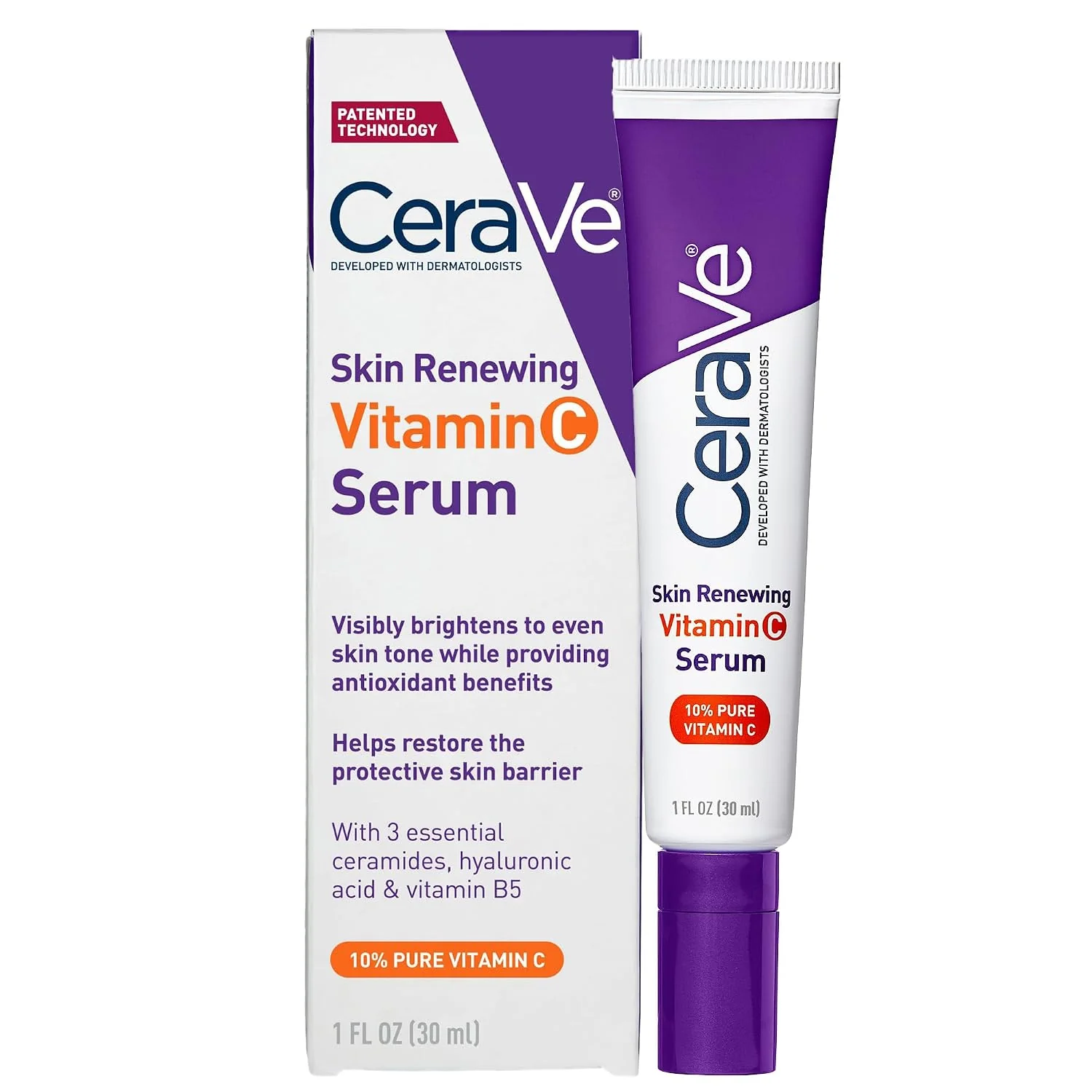
CeraVe Skin Renewing Vitamin C Serum — 10% L-Ascorbic Acid Example
Formulation: 10% L-ascorbic acid, per CeraVe’s official product information, along with hyaluronic acid, vitamin B5 (panthenol), and ceramides.
Why it fits this guide: This is a straightforward example of an L-ascorbic acid serum at a concentration that appears frequently in the clinical literature reviewed for this guide (see What Percentage Should You Use? above) — useful as a reference point for what a 10% LAA product looks like in practice, not as proof that 10% is clinically established as the optimal beginner concentration.
Worth knowing: CeraVe markets this serum as suitable for all skin types, including sensitive skin, and describes it as formulated to help visibly brighten the complexion — brand positioning, not an independent clinical finding, and not evidence that this specific product reproduces the photoprotection or collagen-related outcomes discussed earlier in this guide.
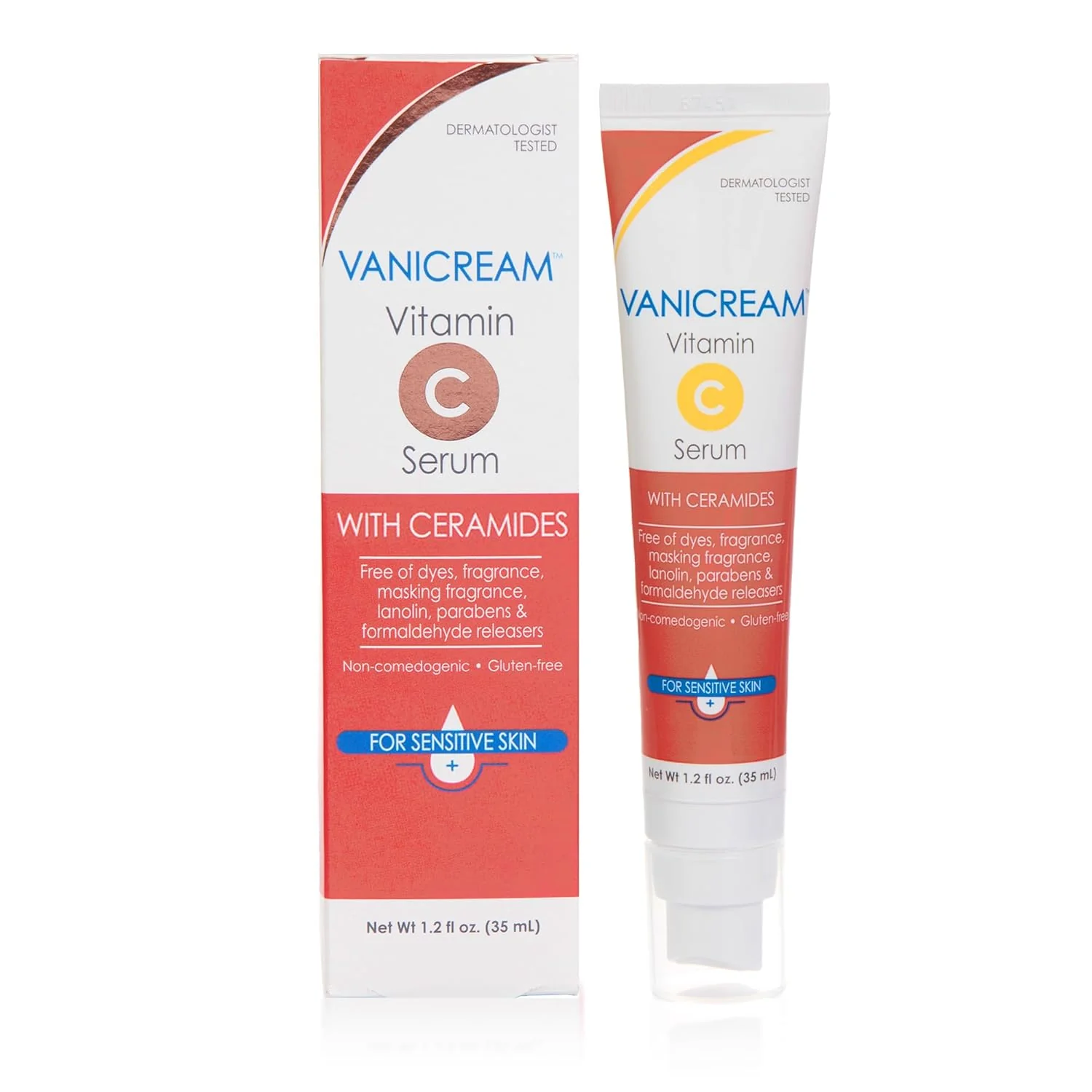
Vanicream Vitamin C Serum — Vitamin C Derivative Example
Formulation: Tetrahexyldecyl ascorbate (THD ascorbate), a fat-soluble vitamin C derivative, per Vanicream’s official product information. The brand states the formula is made without dyes, fragrance, masking fragrance, lanolin, parabens, formaldehyde releasers, or botanical extracts/essential oils, and describes it as non-comedogenic and dermatologist tested.
Why it fits this guide: This is an example of a derivative-based serum of the kind discussed in L-Ascorbic Acid vs. Vitamin C Derivatives above. As that section explains, THD ascorbate’s own human trial evidence (where it’s been studied at all) comes from a combination formulation with L-ascorbic acid rather than as a standalone-tested ingredient — so this product is included as a formulation example, not as a product with the same clinical evidence base as an L-ascorbic acid serum, and not as proof that a derivative is inherently gentler or weaker than L-ascorbic acid in every case.
Worth knowing: Vanicream positions this formula around minimizing common irritants, which is a manufacturer formulation feature worth noting for readers considering a derivative specifically because of sensitive or reactive skin (see Who Should Be More Cautious? above) — not an independent clinical claim that this specific product is proven superior for sensitive skin.
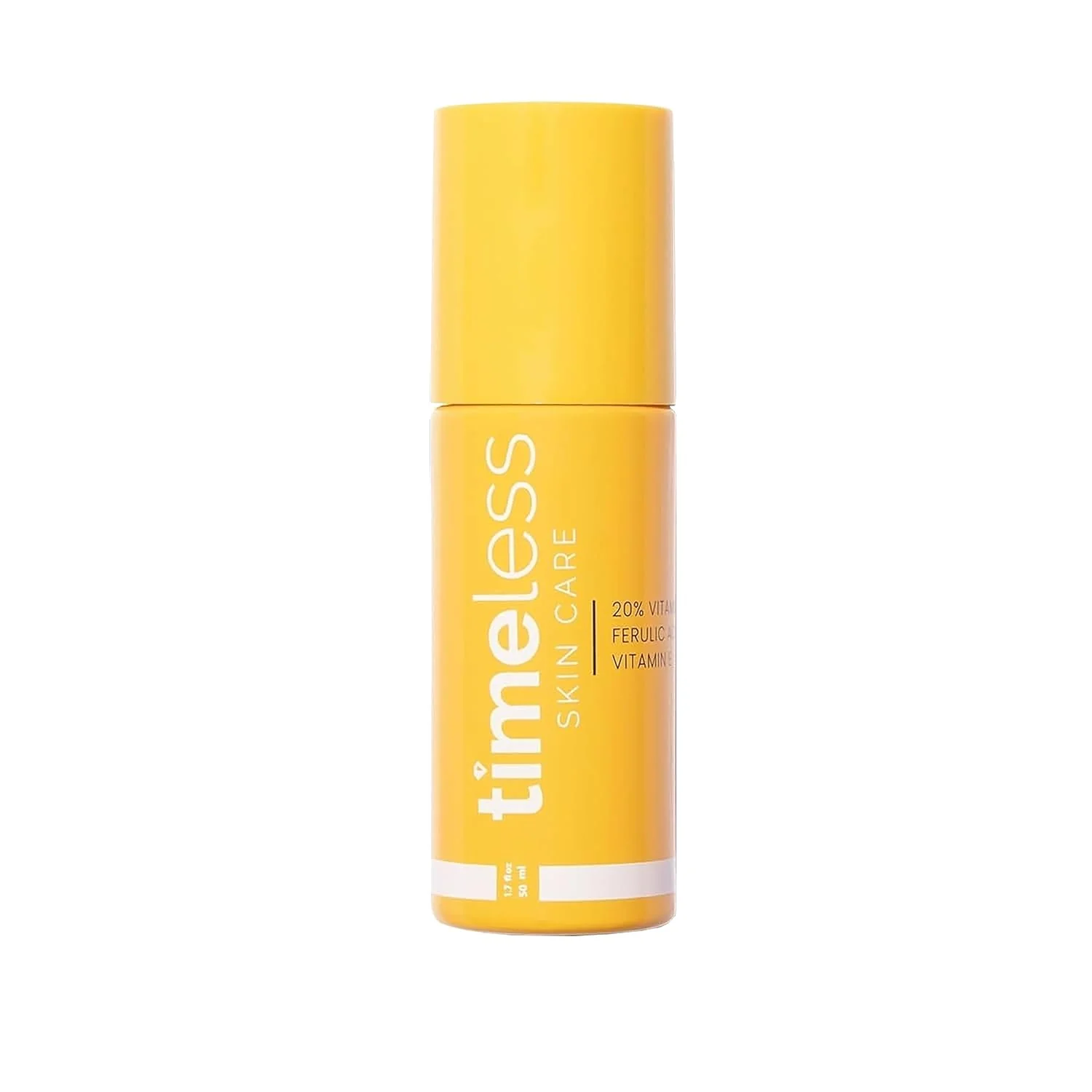
Timeless 20% Vitamin C + E Ferulic Acid Serum — 20% L-Ascorbic Acid + Vitamin E/Ferulic Acid Example
Formulation: 20% L-ascorbic acid combined with vitamin E (alpha tocopherol) and ferulic acid, along with sodium hyaluronate and panthenol, per the brand’s official product information. The brand does not publish the exact percentages of vitamin E and ferulic acid, or the formula’s pH, on its official product page.
Why it fits this guide: This is an example of a higher-concentration L-ascorbic acid serum formulated with the same three ingredient categories — vitamin C, vitamin E, and ferulic acid — discussed in the Photoaging and Collagen-Related Evidence and pH and Formulation sections above. It is important to be precise about what this product is and isn’t: the research discussed in this guide (Lin et al. 2005) studied one specific formulation — 15% L-ascorbic acid, 1% vitamin E, and 0.5% ferulic acid at a low pH (≤3.5) — in a pig-skin model. This commercial product uses a different L-ascorbic acid concentration (20%, not 15%), does not publicly disclose its vitamin E or ferulic acid percentages or its pH, and has not been shown in this research to be the formulation tested in that study or to reproduce its specific photoprotection findings. It’s included as an example of the general formulation category, not as a product proven to match that study’s results.
Worth knowing: As covered in What Percentage Should You Use? above, the frequently cited 20% figure traces to a specific pig-skin percutaneous-absorption study, not to a finding that a 20% consumer serum produces better clinical outcomes than a 10% or 15% product — higher concentration is not established as reliably better, and a higher-percentage product may also be more likely to cause irritation for some people.
No product above has been independently tested, rated, or ranked by AvaFitCare. These are formulation examples tied to the forms and concentration categories discussed in this guide, not a “best vitamin C serums” roundup.
What Percentage Should You Use?
Percentage claims around vitamin C are some of the most repeated, least-sourced numbers in skincare, and they deserve more scrutiny than they usually get. The “20% plateau” idea does trace to real, locatable research: a pig-skin percutaneous-absorption study testing L-ascorbic acid concentrations from 5% to 30%, all formulated at pH 3.2, found that skin tissue levels of L-ascorbic acid rose with concentration and were highest at 20%, then declined at higher concentrations. That makes 20% a genuine, study-identified ceiling in that specific model — not an arbitrary number — though it comes from pig skin, not human skin, at one specific pH. The companion claim that roughly 8% is a minimum threshold for meaningful effect is far less well-documented: it’s widely repeated across secondary sources and blogs, but this guide could not independently trace it to a specific concentration-response finding in the primary absorption literature. Treat the 20% figure as reasonably well-sourced with the caveats above, and treat the “8% minimum” figure as a widely repeated convention rather than an independently verified finding.
There isn’t strong evidence for one single “optimal” concentration that applies universally. Ten percent appears frequently among the clinical studies reviewed for this guide, which may be part of why it’s so often recommended as a starting point — but this guide did not conduct a systematic count of every published vitamin C trial, so that observation should be read as “common in the literature reviewed here,” not as a dedicated finding that 10% is specifically better for beginners than 8% or 15%. Higher concentration doesn’t reliably mean better results: delivery depends on formulation and pH at least as much as the percentage on the label, and irritation risk tends to rise with concentration without a clearly matching rise in benefit once you’re already in the well-studied range.
Percentage rules also don’t transfer across forms. The concentration research discussed above is specific to L-ascorbic acid; it isn’t established for derivatives, which are often formulated at very different (frequently lower) percentages because they work differently.
pH and Formulation (Why the Label’s Percentage Isn’t the Whole Story)
For L-ascorbic acid, penetration into skin depends heavily on formulation pH — generally needing to be at or below about 3.5 so the molecule stays in an uncharged form that can cross the skin barrier. The pig-skin absorption study referenced above tested its concentration series at pH 3.2, consistent with this low-pH requirement. A 20% L-ascorbic acid serum at a poorly optimized, higher pH can deliver meaningfully less active ingredient into skin than a well-formulated 10–15% serum at a properly low pH. In practice, this means the percentage printed on a bottle is not, by itself, a reliable predictor of how well a product will actually work.
L-ascorbic acid is also prone to oxidation from light, heat, air exposure, and trace metal contamination, which is why many effective formulations use stabilizing antioxidant combinations (like vitamin E and ferulic acid) or anhydrous (water-free) delivery systems rather than a simple water-based solution. The vitamin C + vitamin E + ferulic acid research discussed above is specific to one particular low-pH, defined-ratio formulation; it supports that combination (as studied) being both more stable and more protective, but it is not evidence that any serum containing some vitamin E and some ferulic acid, in any ratio or pH, will reproduce the same results.
How to Use Vitamin C Serum
Cleanse first, apply vitamin C to clean skin, then follow with moisturizer and (in the morning) sunscreen. Beyond that general order, the research reviewed for this guide did not identify clinical evidence supporting many of the specific numbers that circulate online — an exact number of drops, a specific wait time before the next step, or a requirement that skin be fully dry versus slightly damp. Every clinical trial located for this guide specified concentration and how long the overall regimen was used (weeks to months); none specified within-application details like drop count or wait time. Those specifics appear to be practical conventions repeated across brand and blog content, not findings from research.
The more reliable approach: use enough product to thinly and evenly cover the area you’re treating, let it absorb for a short period before applying the next step (there’s no evidence a precise number of seconds or minutes matters), and follow your specific product’s own directions where they’re given — different formulations (a thin liquid vs. a thicker serum, a low-pH L-ascorbic acid vs. a near-neutral derivative) reasonably call for somewhat different handling, and no universal rule was found to override product-specific instructions. For where vitamin C fits relative to your other products step by step, see our general guide on how to layer skincare products.
Damp or Dry Skin?
This is a genuinely unsettled question, and current online guidance is contradictory for good reason: no clinical evidence was located either confirming that damp skin improves absorption or confirming that water “deactivates” L-ascorbic acid at the moment of application. The real, well-documented water-sensitivity issue with vitamin C is about long-term formulation stability — why water-based serums tend to degrade faster over the life of the product and why oil- or silicone-based (anhydrous) formulations were developed — not about what happens if you apply the product to skin that’s still slightly damp from cleansing. Where no universal evidence exists, the reasonable approach is to follow your specific product’s own directions rather than a confident-sounding internet rule in either direction.
Morning or Night?
No clinical trial located for this guide directly compared morning-only against night-only vitamin C use. The common recommendation to use it in the morning is a reasonable, mechanistically-motivated practice — pairing an antioxidant with the part of the day when skin is exposed to UV and environmental pollution, and layering it under sunscreen — rather than a proven requirement. There’s no evidence that using vitamin C at night “wastes” it or makes it ineffective; nighttime use is a legitimate choice, particularly for people who find a low-pH L-ascorbic acid easier to tolerate without added daytime sun exposure, or who simply prefer to simplify their morning routine. If you’re still building out a morning routine generally, our morning skincare routine for beginners guide covers where an antioxidant step like this fits alongside cleanser, moisturizer, and sunscreen.
Vitamin C and Sunscreen
Vitamin C does not replace sunscreen, and it does not increase a sunscreen’s actual SPF number. SPF is a specific, measured rating of how well a product filters UV radiation before it reaches skin; vitamin C works through a different mechanism, neutralizing some of the free-radical damage that occurs after UV exposure, including some damage that persists even when a sunscreen’s UV filters are doing their job. The research behind “antioxidant protection” and sunscreen is about these two mechanisms working alongside each other, not about vitamin C amplifying a sunscreen’s own filtering power. Marketing language that frames vitamin C as “boosting your SPF” overstates what the evidence supports — treat that phrasing skeptically wherever you see it. Daily broad-spectrum sunscreen remains the primary, non-optional photoprotection step; vitamin C is a reasonable complement to it, not a substitute. For help choosing a daily sunscreen, see our best sunscreens for beginners guide and our breakdown of how much sunscreen you actually need on your face.
What Can You Use With Vitamin C?
Ingredient
Can they coexist?
Main concern
What the evidence actually shows
Retinol
Generally yes
Combined irritation potential; a commonly repeated low-pH “deactivation” concern
The clearest human trial combining a vitamin C form with retinol used sodium ascorbyl phosphate, not L-ascorbic acid — that result doesn’t generalize to LAA + retinol. No dedicated stability or efficacy trial testing LAA combined with retinol was located. An AM-vitamin-C / PM-retinol split is a reasonable, widely used convenience and tolerability strategy, not a proven chemical necessity — see also our Common Retinol Mistakes guide, which covers this pairing from retinol’s side
Niacinamide
Yes, for modern formulations
The old “they cancel each other out” claim
This traces to real pharmaceutical chemistry — niacinamide can break down into niacin (which can cause flushing) under acidic, high-heat conditions — but the laboratory conditions that produced meaningful breakdown were roughly 89°C (192°F), far above anything relevant to normal skin or product storage. For practical, real-world formulations and use, this is a myth, not a reason to avoid combining them — see our Niacinamide guide for more
Hyaluronic acid
Yes
None identified
No chemical incompatibility or clinical concern was found. Hyaluronic acid doesn’t “activate” vitamin C — there’s no evidence of that kind of synergy — but the two are routinely and safely combined
AHAs / BHAs (glycolic, salicylic acid)
Workable, with awareness of combined irritation
Additive dryness/irritation from stacking two low-pH actives
No dedicated clinical trial testing vitamin C combined with AHAs or BHAs was located. The caution here is a general, reasonable dermatologic principle (two acidic actives can add up), not a documented chemical reaction
Benzoyl peroxide
Theoretical caution, no direct evidence either way
Benzoyl peroxide is an oxidizer; vitamin C is oxidation-sensitive
This is a plausible concern based on general chemistry, but no stability or clinical study testing vitamin C combined with benzoyl peroxide was located. If using both, separating them by time of day is a reasonable, low-cost precaution rather than an evidence-mandated rule
How to Store Vitamin C Serum
L-ascorbic acid degrades with exposure to light, heat, air, and trace metal contamination — which is why effective formulations are often packaged in dark or opaque bottles and why keeping a product in a cool, dark place (not necessarily the refrigerator, unless the product directs that) helps it last longer. Derivative forms are generally more stable and less sensitive to these factors than L-ascorbic acid.
How to Tell If Vitamin C Has Oxidized
A shift toward yellow, orange, or brown is a reasonable, commonly used signal that an L-ascorbic acid product has oxidized, since oxidation produces colored breakdown compounds. But it isn’t a foolproof rule: some formulations are naturally tinted from the start — because of ferulic acid or other included ingredients — so a product that isn’t perfectly clear out of the bottle hasn’t necessarily already gone bad. The more reliable approach is to track a meaningful color change over time relative to how the product looked when new, and to follow your product’s own storage and use-by guidance, rather than assuming any colored vitamin C serum is automatically spoiled. There’s no single, universally agreed-upon day count for when a product must be replaced — how long one lasts depends on its concentration, pH, packaging, and how it’s stored, not a fixed number that applies to every product.
Potential Side Effects
Mild stinging, tingling, or temporary redness on application — especially with a low-pH L-ascorbic acid product — is a commonly reported, generally expected reaction, along with occasional dryness. This is different from allergic contact dermatitis, a true allergic reaction that’s less common and has been specifically documented in published case reports for certain derivatives, including 3-O-ethyl ascorbic acid. Significant or persistent irritation, spreading redness, swelling, or a rash is not a normal “adjustment period” and is a reasonable point to stop use and talk to a dermatologist, rather than something to push through.
Who Should Be More Cautious?
People with sensitive skin, rosacea, or a history of reacting to low-pH actives may find L-ascorbic acid products more irritating and may do better starting with a derivative formula at a near-neutral pH, introducing it gradually, and patch testing first. If you’re already using other potentially irritating actives (retinol, exfoliating acids), adding vitamin C on top is reasonable to introduce separately rather than all at once, to make it easier to tell what’s causing any irritation if it happens. If you’re new to actives generally, our skincare routine for beginners guide covers a reasonable, lower-risk order for introducing new products one at a time.
Common Vitamin C Myths
“Vitamin C serum boosts your SPF.” Not supported — see Vitamin C and Sunscreen above. Vitamin C doesn’t raise a sunscreen’s measured SPF; it works through a separate, complementary mechanism.
“Anything above 20% vitamin C is useless.” A pig-skin absorption study found skin tissue levels of L-ascorbic acid were highest at 20% and declined above that — real, locatable evidence for a 20% ceiling in that specific model. It’s not necessarily a hard rule for every human formulation, and pH matters just as much as the percentage.
“You must use exactly 3–5 drops and wait exactly 60 seconds.” No clinical evidence supports specific drop counts or wait times. These are repeated conventions, not findings from research.
“Niacinamide and vitamin C cancel each other out.” Based on real chemistry that only applies at extreme heat, not normal skin or storage conditions — a myth for practical, everyday use.
“A yellow or orange vitamin C serum is always spoiled.” Color change is a reasonable but imperfect signal; some products are naturally tinted from the start.
“Vitamin C fades every dark spot, including melasma, completely.” The clinical evidence for melasma specifically shows vitamin C is less effective than stronger options like hydroquinone, though better tolerated — it’s a gentler option with real but more modest results, not a cure.
Frequently Asked Questions
It acts mainly as an antioxidant, helping neutralize free-radical damage from UV exposure and pollution, with additional evidence (strongest for L-ascorbic acid specifically) supporting modest improvements in photoaging, fine lines, and hyperpigmentation over time.
Most people can use it daily, typically once a day, though starting with less frequent use and building up is a reasonable way to check tolerability, especially with a low-pH L-ascorbic acid product.
Morning use is a common, mechanistically reasonable choice because of its antioxidant role alongside daytime sun exposure and sunscreen, but no study directly compared morning-only to night-only use, and nighttime use isn’t “wasted.”
Generally before moisturizer, applied to clean skin — but follow your specific product’s own directions where given, since formulations differ.
Generally yes. The clearest trial evidence on combining the two used a specific derivative (sodium ascorbyl phosphate) alongside retinol, not L-ascorbic acid, so that result shouldn’t be over-generalized to LAA serums. An AM-vitamin-C / PM-retinol split is a reasonable tolerability strategy, not a proven necessity — see our Common Retinol Mistakes guide for more on this pairing.
Yes, for modern cosmetic formulations. The old “cancels out” concern is based on chemistry that only occurs at extreme heat, not normal skin or storage conditions.
Yes — no incompatibility was found, and the two are commonly and safely combined, though hyaluronic acid doesn’t “activate” vitamin C’s effects.
It can help fade some hyperpigmentation over time, with the clearest evidence in melasma showing it’s a gentler but less potent option than stronger treatments like hydroquinone. It won’t remove every spot or guarantee a specific result.
There’s real, if not fully rigorous, evidence for active acne — specifically using sodium ascorbyl phosphate (SAP), not L-ascorbic acid. A 12-week open study of 60 people using a 5% SAP lotion alone found favorable results, and a separate randomized trial found SAP effective both alone and combined with retinol. Vitamin C’s other plausible role is helping fade the brown marks acne can leave behind, not treating true scarring.
There’s no universally proven “best” percentage. A pig-skin study found 20% to be where L-ascorbic acid absorption into skin tissue peaked, which is a reasonably well-sourced reference point; the lower “8% minimum” figure often cited alongside it is much less well-documented. Ten percent appears frequently among the clinical studies reviewed for this guide, which may explain its popularity as a starting point, though it hasn’t been shown in a dedicated trial to be specifically better for beginners.
A noticeable shift toward yellow, orange, or brown compared to how the product looked when new is a reasonable signal, though some products are naturally tinted from the start, so color alone isn’t a perfect test.
Only if your specific product’s instructions say so. Cool, dark storage away from light and heat helps slow degradation generally, but refrigeration isn’t a universal requirement for every formulation.
Yes, particularly low-pH L-ascorbic acid formulas. Mild stinging or redness is common and usually not a cause for concern, but significant, spreading, or persistent irritation is a reasonable reason to stop and consider a gentler derivative formula or a dermatologist’s input.
No. Vitamin C is a complementary antioxidant, not a UV filter, and it does not substitute for daily broad-spectrum sunscreen.
Bottom Line
Topical vitamin C has real evidence behind it — antioxidant support, and modest, form-specific benefits for photoaging and hyperpigmentation — but much of what circulates online about exact percentages, exact application steps, and strict ingredient-pairing rules goes well beyond what the research actually shows. L-ascorbic acid has the strongest and broadest evidence but is also the most irritating and least stable form; derivatives are generally gentler and more stable with a narrower evidence base. Pick a well-formulated product, follow its own directions, pair it with daily sunscreen rather than expecting it to replace one, and don’t expect a dramatic transformation on a fixed timeline.
This guide was researched using peer-reviewed dermatology and cosmetic-science literature (including controlled human and animal studies on photoprotection, collagen-related changes, pigmentation, and acne), Cosmetic Ingredient Review (CIR) safety assessments, published case reports on allergic contact dermatitis, and patient-facing guidance from reputable academic medical institutions including Cleveland Clinic. Several primary research papers referenced here were identified and cited by title, journal, and identifier but could not be independently retrieved in full text due to access restrictions during research (notably the Espinal-Pérez, Oresajo, Humphrey, and Ruamrak studies); where that occurred, it’s noted so the claim can be understood as corroborated by independent secondary sources rather than independently re-verified from the original paper. The pig-skin concentration study (Pinnell et al.) and the sodium ascorbyl phosphate acne study (Klock et al.) were independently verified against quoted abstract and findings text during a dedicated fact-check pass. Where a popular online claim — a specific drop count, a hard concentration ceiling, a sunscreen-boosting effect, an ingredient “canceling out” another — lacked real supporting evidence, that claim was softened or flagged as unsupported rather than repeated as fact. This guide does not claim clinical or dermatologist review, and it is not a substitute for personalized advice from a dermatologist or other qualified healthcare professional, particularly for melasma, persistent irritation, active acne, or suspected allergic reactions.
Affiliate Disclosure
Disclosure: This article contains affiliate links. If you buy through these links, Ava Fit Care may earn a commission at no additional cost to you. Product selection and descriptions on this page are based on publicly available manufacturer information and the research discussed throughout this guide, not on affiliate relationships — affiliate participation does not influence which products are included or how they are described.
Medical Disclaimer IncludedClearly marked below — this guide is educational, not personalized medical advice.
Read our Review Policy for a plain explanation of what our review process does — and doesn't — mean for health-adjacent content.
Sources & Further Reading
Additional sources referenced in this guide that could not be independently verified with a working link, preserved here in full:
“Ascorbic Acid in Skin Health,” narrative review, Cosmetics, 2019
“Ascorbic Acid as a Cosmeceutical to Increase Dermal Collagen,” review, Antioxidants, 2022
Lin JY et al. — “Ferulic acid stabilizes a solution of vitamins C and E and doubles its photoprotection of skin,” Journal of Investigative Dermatology, 2005 (pig-skin model)
Oresajo C et al. — “Protective effects of a topical antioxidant mixture containing vitamin C, ferulic acid, and phloretin against ultraviolet-induced photodamage in human skin,” Journal of Cosmetic Dermatology, 2008
Humphrey S et al. — “A topical antioxidant solution containing vitamins C and E stabilized by ferulic acid provides protection for human skin against damage caused by ultraviolet irradiation,” Journal of the American Academy of Dermatology, 2008
Fitzpatrick RE, Rostan EF — “Double-blind, half-face study comparing topical vitamin C and vehicle for rejuvenation of photodamage,” Dermatologic Surgery, 2002
Espinal-Pérez LE et al. — “A double-blind randomized trial of 5% ascorbic acid vs. 4% hydroquinone in melasma,” International Journal of Dermatology, 2004
Taylor MB et al. — iontophoresis-assisted ascorbyl glucoside and combination regimen case series, Journal of Drugs in Dermatology
Open-label clinical trial on a combined retinol and vitamin C facial regimen for hyperpigmentation and photodamage
Yagami A et al. and related case reports — allergic contact dermatitis from 3-O-ethyl-L-ascorbic acid, Contact Dermatitis
Cleveland Clinic — “Vitamin C Serum: Will It Really Improve Your Skin?”
This article is for general informational and educational purposes only and is not a substitute for professional medical advice, diagnosis, or treatment. It does not create a doctor-patient relationship. Always seek the advice of a dermatologist, physician, or other qualified healthcare provider with any questions you may have regarding a medical condition, persistent skin irritation, or suspected allergic reaction.
Get New Guides in Your Inbox
No spam, no filler — just new articles as we publish them.