How to Prevent Acne Breakouts Without Overdoing Skincare
November 3, 2026
Quick answer: Most breakout-prevention advice comes down to consistency over intensity: wash your face gently once or twice a day (plus after sweating), follow the directions for your acne treatments, avoid introducing several new products at once, and give appropriate treatments enough time to work before switching. Avoid harsh scrubbing, and don’t pick or squeeze blemishes. Dermatologists at the American Academy of Dermatology note that many common “trying harder” habits — switching products too often, washing too much, drying out the skin — actually irritate skin and can trigger more breakouts, not fewer.
It’s a strange feeling: you’re doing more for your skin than ever, and it still won’t settle down. New cleanser, a stronger exfoliant, maybe a second or third treatment layered on top — and the breakouts keep coming anyway. For a lot of people, the problem isn’t trying too little. It’s that several well-intentioned habits are working against each other.
Yes. According to the AAD, several everyday habits — including switching acne products too frequently, washing the face too often, and using harsh or drying treatments — can irritate the skin and lead to more breakouts rather than fewer. The common thread across nearly all of these habits is irritation: over-washing, over-exfoliating, and other harsh or drying treatments aggravate skin that’s already acne-prone, leaving it redder, more sensitive, and generally uncomfortable — which tends to show up as more breakouts, not fewer.
This doesn’t mean acne-prone skin needs to be treated with kid gloves and nothing else. It means that more isn’t the same as better. A simpler, steadier routine — applied consistently for weeks, not days — tends to outperform a routine that changes every time a new breakout shows up.
Everyday Skincare Habits That Can Trigger More Breakouts
Acne-prone skin can feel oily enough that scrubbing seems like it should help. It doesn’t. The AAD states plainly that scrubbing can irritate your skin, causing acne to flare, and recommends applying cleanser lightly with your fingertips rather than a washcloth, sponge, or other tool. Mayo Clinic agrees, specifically advising against facial scrubs, astringents, and masks, since they tend to irritate skin and can worsen both acne and the side effects of acne medication.
3. Combining Acne Treatments Without a Plan
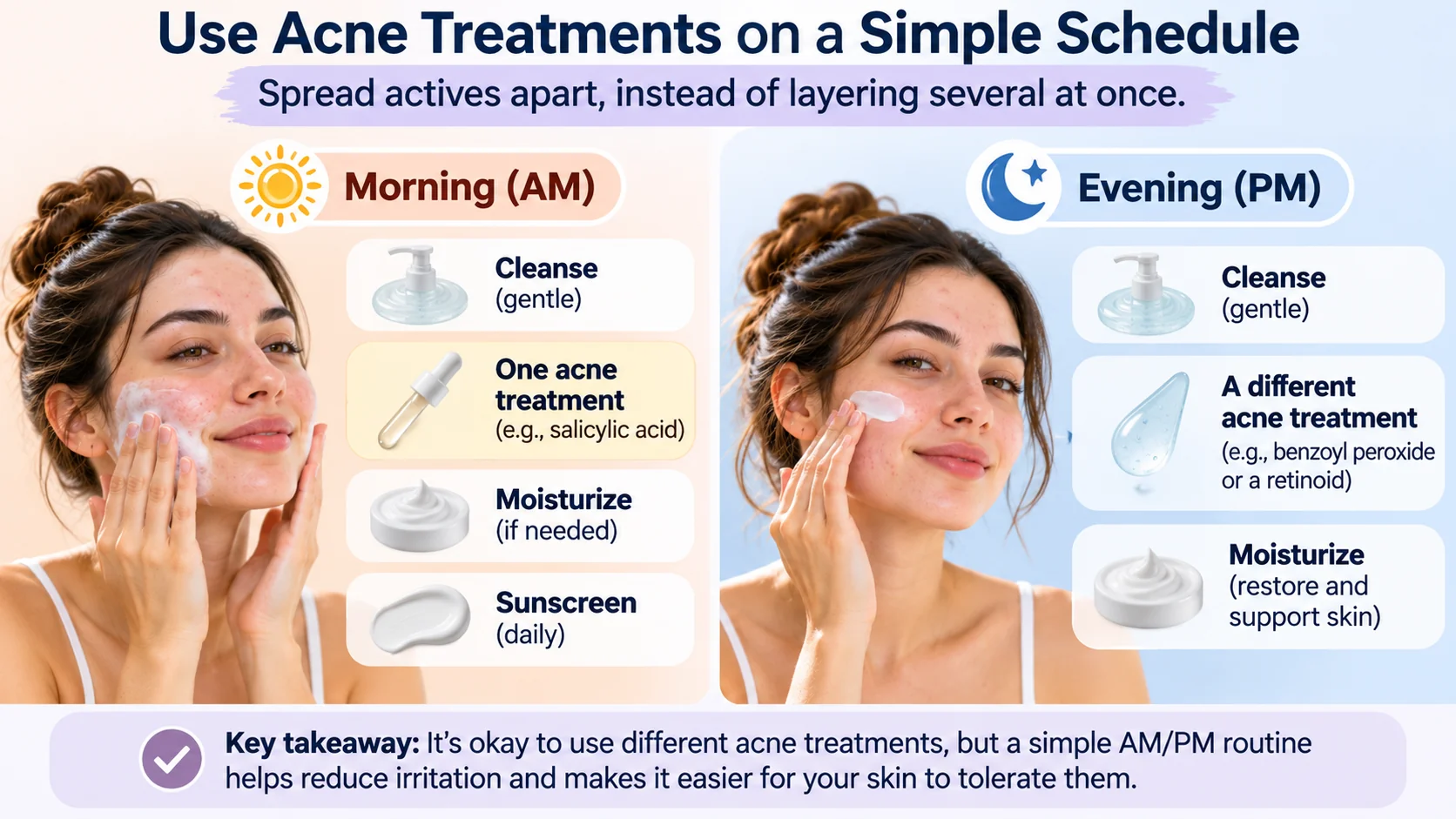
Using more than one acne treatment isn’t automatically a problem. Mayo Clinic notes that it’s reasonable to use products with different active ingredients, and dermatologists sometimes prescribe combination treatments specifically because certain actives work better together than either does alone. What tends to cause irritation is stacking several products into one application with no real plan — Mayo Clinic’s simpler approach is one product in the morning, a different one at night, spreading out the actives rather than layering them. The AAD adds a related point: apply medication as a thin, even layer over the whole acne-prone area rather than only dabbing it onto visible blemishes, which fails to prevent new breakouts forming nearby. See our salicylic acid vs. benzoyl peroxide guide for how two of the most common OTC actives compare and whether they’re safe to combine.
4. Switching Products Too Often
Trying a new product every week or so is one of the AAD’s named habits that can worsen acne: a constant rotation of new formulas is a constant rotation of new irritation. The AAD recommends using one product for 6 to 8 weeks before judging it, with complete clearing generally taking 3 to 4 months. Mayo Clinic’s timeline is similar: a few days for initial results, 2 to 3 months of daily use for the full effect — acne may even look slightly worse before it gets better. If you’re unsure how to sequence new products without overwhelming your skin, our guide to building an acne skincare routine step by step walks through the ramp-up process.
5. Drying Out Oily Skin on Purpose
It’s a common instinct: skin feels oily, so you reach for something stronger, more astringent, more drying. The AAD’s advice here is blunt: dry skin is irritated skin. Overdrying the skin doesn’t address the underlying oil production; it adds a layer of irritation on top. If your skin feels tight, flaky, or raw after your acne treatment, the AAD and MedlinePlus both recommend an oil-free, non-comedogenic moisturizer rather than skipping moisturizer altogether. The AAD frames this specifically around tolerating treatment: acne medications such as benzoyl peroxide, salicylic acid, and retinoids tend to dry and irritate the skin, and using a moisturizer every day can help skin tolerate these medications. That same source also notes that dry skin prompts the body to make more oil, and the extra oil can clog pores, which may lead to more breakouts — a reason for caution, though a moisturizer isn’t itself an acne treatment. And “non-comedogenic” is a helpful label, not a guarantee: MedlinePlus notes a product described this way might still cause acne for a particular person, so watch how your own skin actually responds.
6. Makeup and Hair Products That Clog Pores
Not all makeup and hair products suit acne-prone skin equally. The AAD warns that some contain oil or other pore-clogging ingredients, and recommends labels that say “oil-free,” “non-comedogenic,” or “won’t clog pores.” Sleeping in makeup is a separate problem: even non-comedogenic makeup can cause acne if you sleep in it, so remove it nightly, or use a non-comedogenic remover towelette on nights you’re too tired to wash properly. Sharing makeup, brushes, or applicators is also worth avoiding, since bacteria, oil, and dead skin cells from someone else’s skin can transfer into your products.
7. Oily Hair Products and Forehead Breakouts
If breakouts tend to cluster along your hairline or forehead, hair products are a reasonable place to look. The AAD points out that oil from hair can cause acne specifically on the forehead, and recommends shampooing more often if your hair runs oily, and keeping hair pulled back and away from your face.
8. Sweat, Friction, and Touching Your Face
Workouts bring their own habits worth rethinking: the AAD recommends gently patting sweat away with a clean towel rather than rubbing, which can irritate skin and lead to more breakouts. Outside the gym, the AAD points to a subtler habit — frequently touching or rubbing your face throughout the day may contribute to irritation and flare-ups, since hands carry oil and bacteria. MedlinePlus adds a related caution: avoid tight headbands, baseball caps, and other hats.
Everyday Habits That Support Acne-Prone Skin
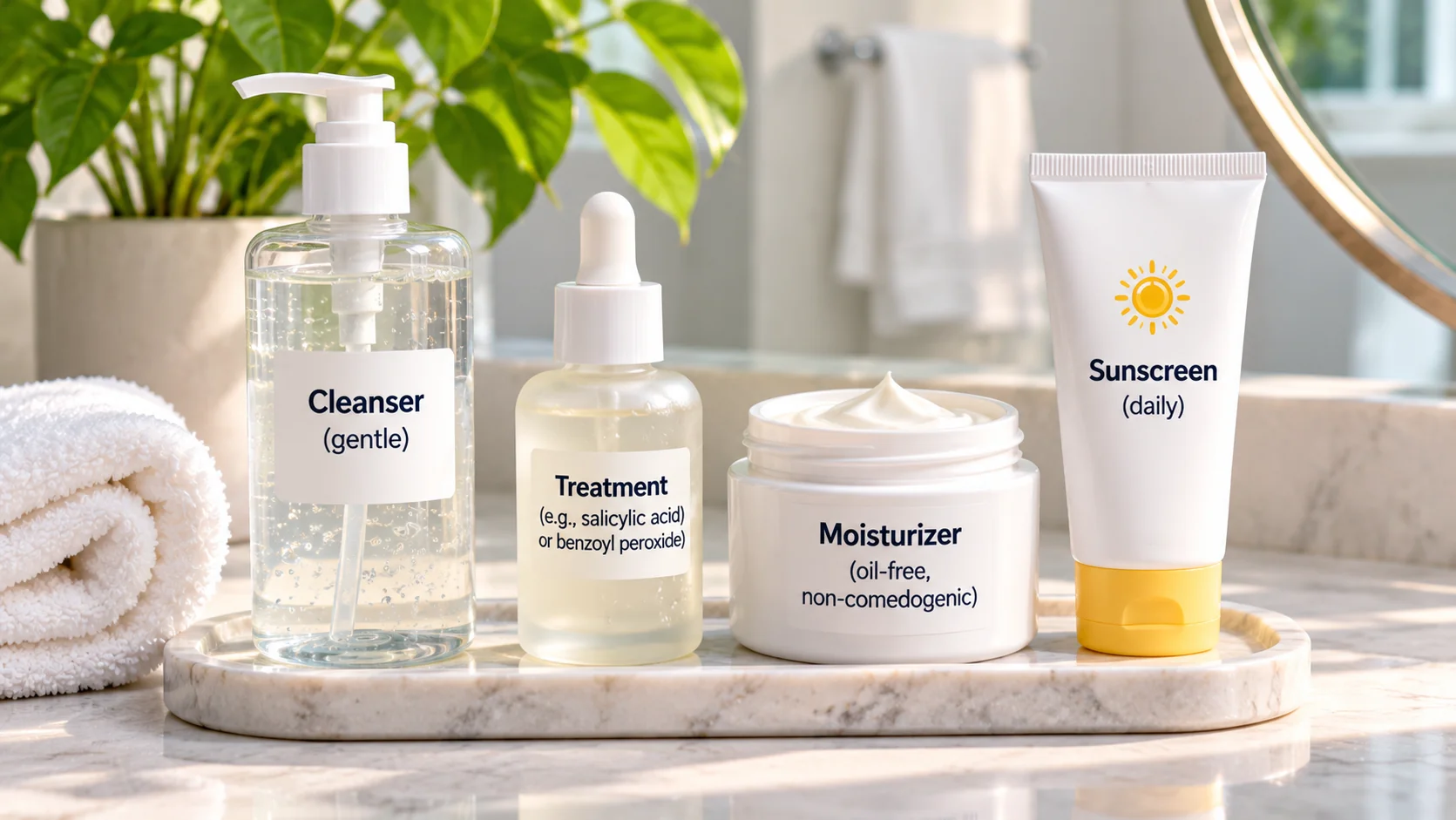
Taken together, the habits above point toward a simpler pattern than “do more”: gentle, fingertip cleansing once or twice daily; acne medication applied evenly rather than spot by spot; patience before switching anything; and non-comedogenic sunscreen, since some acne medications increase sun sensitivity. Apply a gentle, non-comedogenic moisturizer when your skin feels dry, and use it regularly if your acne treatments cause dryness or irritation. For the complete step-by-step version, including how to layer products morning and evening, see our skincare routine for acne-prone skin guide. And if you’re wondering why these habits matter in the first place, our guide to what actually causes acne covers the underlying biology.
Signs Your Skincare Habits May Be Irritating Your Skin
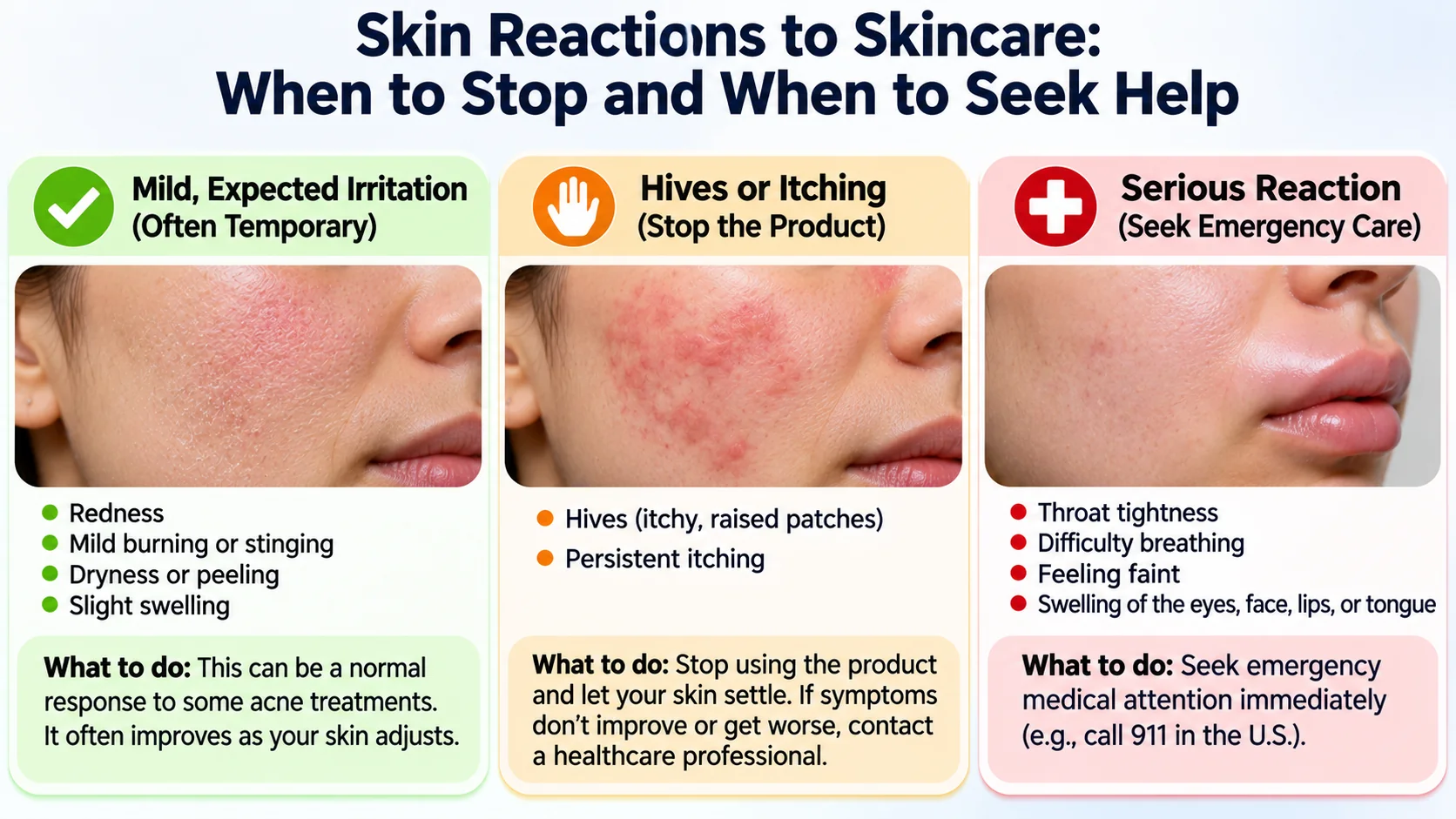
It isn’t always obvious that a routine has tipped from “helpful” into “too much.” Watch for skin that feels tight, raw, or stings after cleansing; new redness or scaling that wasn’t there before you added a product; breakouts that seem to flare shortly after switching to something new; or dryness and peeling that goes beyond the mild, expected adjustment period for a new acne treatment. Mild stinging, dryness, or peeling is a normal, expected side effect of several OTC acne ingredients, particularly in the first few weeks. But the FDA’s own safety communication on benzoyl peroxide and salicylic acid acne products draws a clear line between that expected irritation and a rare, more serious reaction, and it’s worth knowing the difference. If you develop hives or itching of the face or body, the FDA says to stop using the product. If a reaction looks notably worse than ordinary irritation — significant swelling or blistering at the application site, for example — stop the product and get a prompt medical assessment rather than waiting it out. And if you develop throat tightness, difficulty breathing, feeling faint, or swelling of the eyes, face, lips, or tongue, that’s a sign of a serious hypersensitivity reaction: stop using the product and seek emergency medical attention immediately — in the US, that means calling 911 or going to the nearest emergency room, not waiting for a regular appointment.
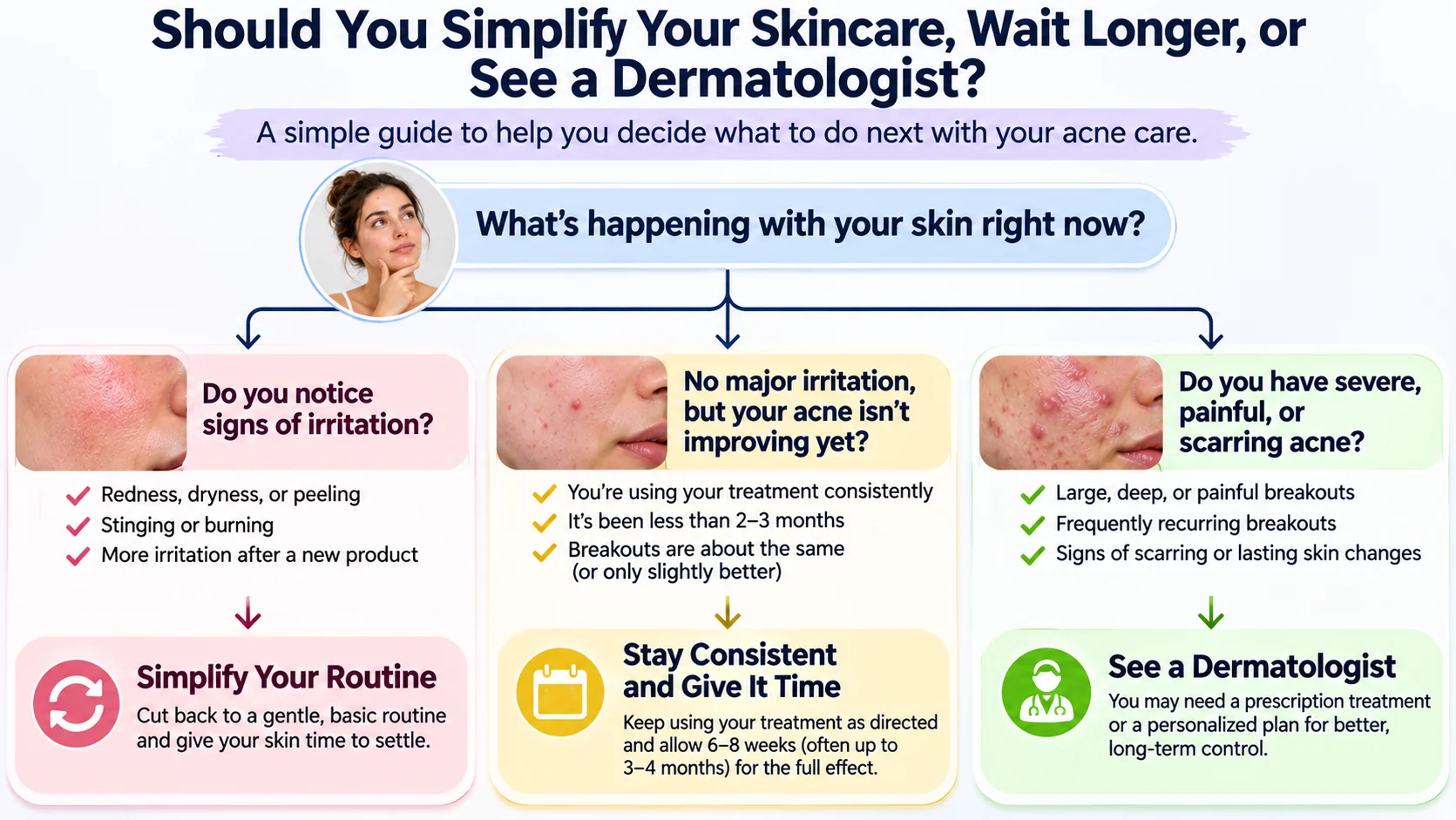
How to Know Whether You Should Simplify Your Skincare or Reconsider Your Acne Treatment
Not every breakout calls for the same response, and figuring out which situation you’re actually in matters more than reaching for one more product.
If you’re seeing the irritation signs above, the fix is almost never a new acne treatment. It’s worth tracing back to what actually changed — a new cleanser, a stronger exfoliant, an extra step added to your routine — since removing the irritant usually does more than adding something new to counteract it.
If your skin feels comfortable but breakouts are still showing up, irritation probably isn’t the main issue, and more products usually aren’t the fix either. This is a better moment to check the basics: are you using your current treatment consistently and as directed, has it actually been long enough to judge it (6 to 8 weeks per the AAD, 2 to 3 months per Mayo Clinic), and does the treatment match the type of acne you’re dealing with — a product aimed at blackheads won’t necessarily help with deep, cystic breakouts.
If your acne is deep, painful, persistent despite a reasonable routine, or leaving marks behind, that’s less a skincare-habit question and more a reason to get a professional opinion. A dermatologist can assess whether your current approach needs adjusting, or whether a prescription-strength option would do more than anything available over the counter.
What to Do When Your Skin Feels Overwhelmed
If your skin is reacting to your current routine, the fix usually isn’t to add something new — it’s to pull back. MedlinePlus’s guidance is specific: use a smaller amount (a pea-sized drop covers the whole face), apply it less often — every other or every third day — until skin adjusts, and wait 10 to 15 minutes after washing before applying. Mayo Clinic’s approach for starting out is similar: begin with a lower-strength product and increase strength or frequency gradually, over several weeks. In both cases, the instinct to add more products or switch to something stronger works against you. This guidance is written for over-the-counter products — check it against that product’s own label — and isn’t a substitute for a prescription treatment’s own instructions, which a dermatologist or pharmacist can adjust directly.
How Long Does It Take to See Improvement?
Patience is part of the routine, not a failure of it. As noted above, the AAD’s 6-to-8-week window and Mayo Clinic’s 2-to-3-month timeline both assume daily, consistent use — and both note that acne can look slightly worse before it improves. Neither source supports judging a product on a weekly or even biweekly basis; doing so is exactly the pattern the AAD flags as a cause of irritation and more breakouts, not fewer.
When Should You See a Dermatologist?
Both MedlinePlus and Mayo Clinic point to the same general threshold: if self-care and OTC treatment haven’t helped after two to three months (MedlinePlus says “several months”), it’s reasonable to bring in a dermatologist for a prescription-strength option. MedlinePlus lists reasons to reach out sooner regardless of timeline: acne that’s painful, with significant redness, cysts, or deep lesions; acne getting worse rather than better; scarring as it clears; or acne causing real emotional stress. If you’re trying to tell the difference between the dark marks acne can leave behind and true scarring, our guide to acne marks vs. acne scars can help — and it’s worth noting that picking or squeezing raises exactly that risk, per the AAD and MedlinePlus, along with a higher chance of infection.
FAQs
Yes. The AAD specifically warns that washing your face several times a day can irritate the skin and lead to more breakouts. Washing once or twice daily, plus after sweating, is the general recommendation from both the AAD and MedlinePlus.
Not necessarily, but how you combine them matters. Mayo Clinic notes it’s fine to use products with different active ingredients, applying one in the morning and a different one at night to help reduce irritation, rather than layering several at once. Dermatologists also sometimes prescribe specific combination treatments, which are formulated and dosed differently than combining over-the-counter products on your own.
No — it tends to do the opposite. The AAD names frequent product-switching as a habit that can irritate skin and trigger more breakouts, and recommends giving a product 6 to 8 weeks before deciding whether to move on.
Not on its own. The AAD recommends daily moisturizer mainly to help skin tolerate drying acne treatments like benzoyl peroxide, salicylic acid, and retinoids. It notes that dry skin can prompt the body to produce more oil, which may lead to more breakouts — but a moisturizer is a supporting step, not an acne treatment by itself. Choosing one labeled oil-free, non-comedogenic, or “won’t clog pores” lowers the chance it causes breakouts of its own, though MedlinePlus notes that even products labeled this way can still cause acne for some people, so it’s worth watching how your own skin responds.
It depends on what’s happening. Tight, stinging, or unusually red skin usually points to irritation, which is better solved by removing a recent addition than by treating it with something new. Comfortable skin that still keeps breaking out points away from irritation and toward checking the basics — consistency, correct use, and whether the treatment matches your acne type. Deep, painful, or scarring acne is a reason to get a dermatologist’s assessment rather than keep adjusting your routine on your own.
At least 6 to 8 weeks, per the AAD, with complete clearing generally taking 3 to 4 months. Mayo Clinic’s figures are close: a few days for initial results, 2 to 3 months for the full effect.
If a consistent routine and over-the-counter treatment haven’t helped after two to three months, or sooner if acne is painful, worsening, scarring, or affecting you emotionally, both MedlinePlus and Mayo Clinic recommend seeing a dermatologist or healthcare provider.
This article is for general educational purposes and isn’t a substitute for personalized medical advice. If your acne is painful, worsening, scarring, or affecting your wellbeing, talk to a dermatologist or healthcare provider.