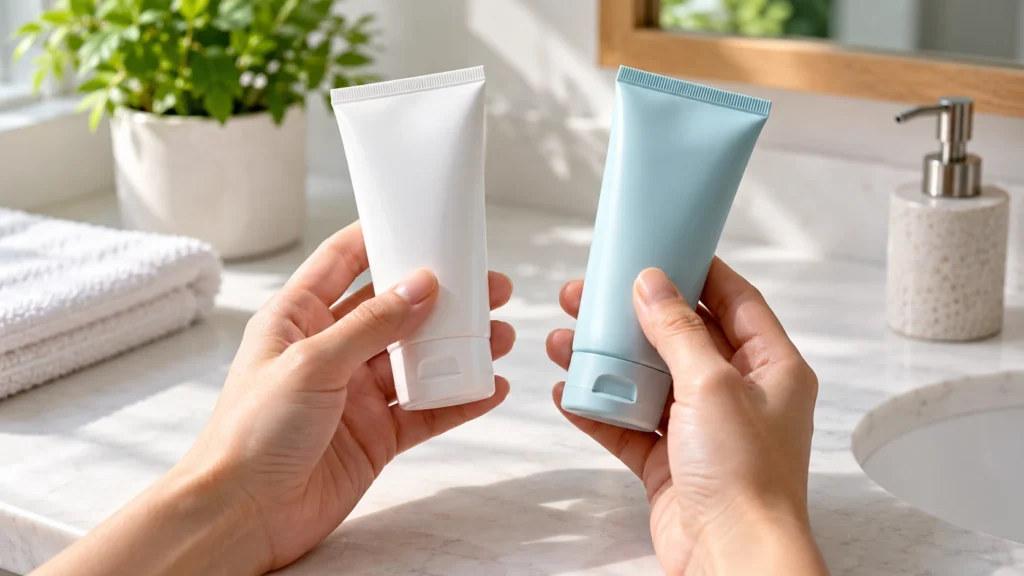
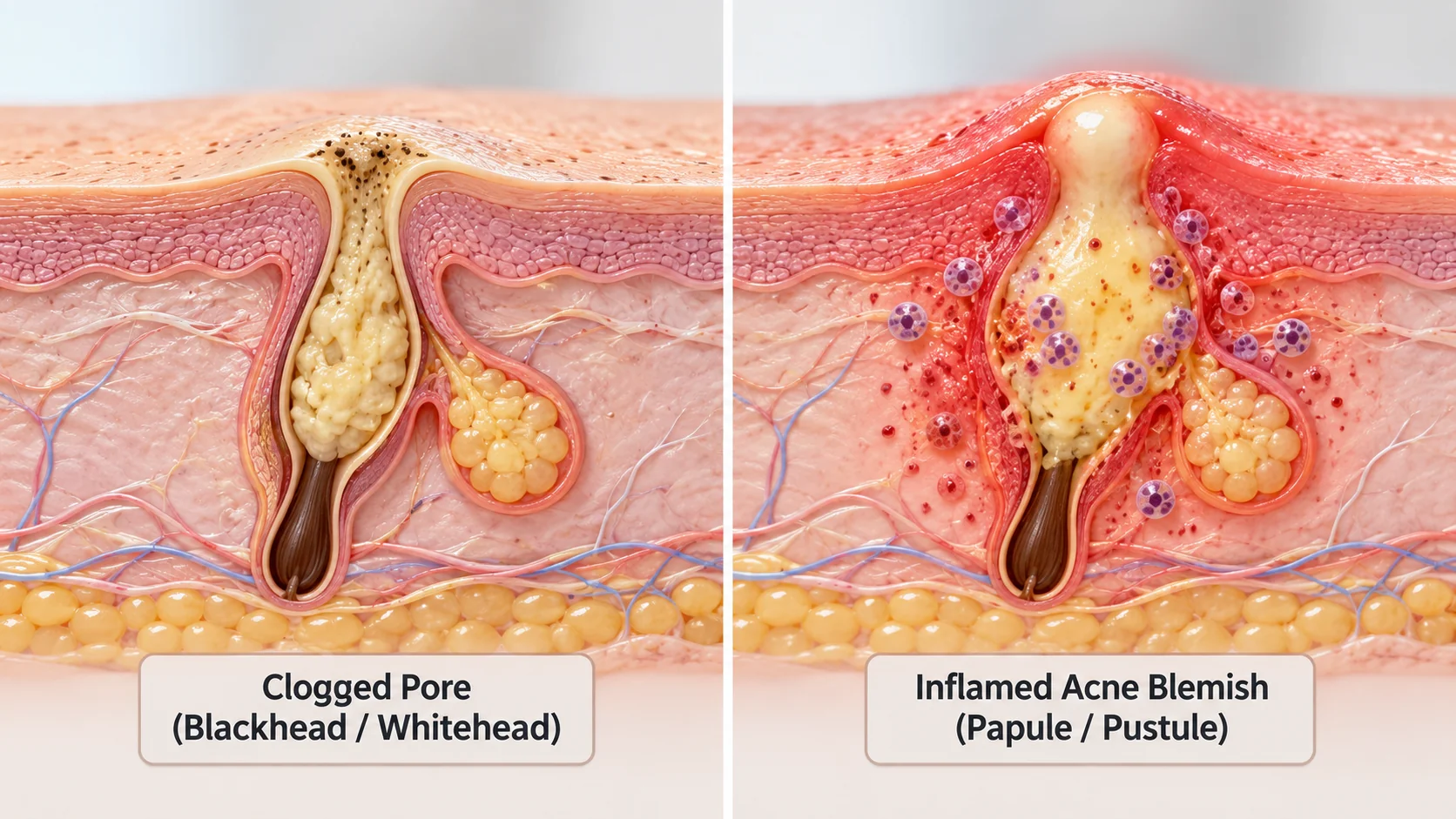
Salicylic acid and benzoyl peroxide treat acne through different mechanisms, and the evidence doesn’t support treating them as interchangeable. Salicylic acid works down inside the pore to loosen the debris that clogs it, which is why it’s particularly relevant to blackheads, whiteheads, and other clogged-pore breakouts. Benzoyl peroxide works mainly by reducing the bacteria associated with acne, part of why dermatology guidelines support it more strongly for red, inflamed pimples. Neither is universally the better choice — the more useful question is which one matches your breakout pattern, how your skin tends to react to new products, and whether you’re using it alone or alongside an existing routine.
In This Guide
- Salicylic Acid vs. Benzoyl Peroxide: Quick Comparison
- How Salicylic Acid Helps Acne
- How Benzoyl Peroxide Helps Acne
- Which Is Better for Your Type of Acne?
- Can You Use Salicylic Acid and Benzoyl Peroxide Together?
- How to Start Without Over-Irritating Your Skin
- How Long Does Acne Treatment Take to Work?
- When to See a Dermatologist
- Frequently Asked Questions
- The Takeaway
Salicylic Acid vs. Benzoyl Peroxide: Quick Comparison
| Comparison point | Salicylic acid | Benzoyl peroxide |
|---|---|---|
| Main action | Keratolytic — loosens and sheds the dead skin cells and debris that clog pores | Antibacterial — reduces acne-associated bacteria on the skin |
| Acne concerns it may help | Blackheads, whiteheads, and other clogged-pore (comedonal) breakouts | Red, inflamed pimples (papules and pustules); mild to moderate inflammatory acne |
| Common OTC product formats | Cleansers, toners, leave-on treatments, and spot gels, often at 0.5%–2% | Washes, leave-on gels and creams, and spot treatments, typically 2.5%–10% |
| Common irritation concerns | Dryness, flaking, mild stinging, especially at higher concentrations or with frequent use | Dryness, redness, peeling, a burning or warm sensation; can bleach hair and colored fabric |
| Important practical precautions | Introduce gradually; avoid combining with other exfoliating acids right away | Start at a lower strength (AAD suggests 2.5%); keep away from hair, towels, and colored clothing; check product expiration dates |
| When a reader might consider it | Breakouts are mostly non-inflamed bumps and clogged pores, not red or painful | Breakouts are visibly red, swollen, or pus-filled, or bacteria-driven inflammation seems to be the main issue |
(This table is a starting reference, not a substitute for reading your specific product’s label or talking with a dermatologist about a persistent breakout.)
How Salicylic Acid Helps Acne
Salicylic acid is a beta-hydroxy acid (BHA), which means it’s oil-soluble and can get down inside a pore rather than just sitting on the surface of the skin. Once there, it works as a keratolytic — it loosens the bond between dead skin cells, helping the pore shed debris instead of trapping it. That’s the mechanism dermatology sources point to when they describe salicylic acid as a pore-unclogging, exfoliating ingredient, and it’s also why it lines up well with blackheads and whiteheads specifically: those are, by definition, clogged follicles rather than inflamed ones.
What salicylic acid doesn’t reliably address on its own is the bacterial and inflammatory side of acne — the red, swollen, or pus-filled lesions that develop once the immune system gets involved. It’s not an antibacterial ingredient, and it isn’t the dermatology-guideline pick for inflammatory breakouts the way benzoyl peroxide is. If most of what you’re seeing is red or tender rather than a flesh-colored bump with a visible clog, salicylic acid alone is less likely to be the main driver of improvement.
Common side effects are dryness, mild stinging, flaking, and occasional irritation, particularly at the higher end of the typical 0.5%–2% over-the-counter range or with too-frequent use. Starting with a lower concentration or less frequent application, then adjusting based on how your skin responds, is a reasonable way to limit that. For a deeper look at how salicylic acid works across skincare more broadly — not just for acne — AvaFitCare’s guide to salicylic acid benefits and how to use it covers concentrations, pairing it with other actives, and sun-exposure considerations in more detail.
How Benzoyl Peroxide Helps Acne
Benzoyl peroxide’s primary action is antibacterial: it reduces Cutibacterium acnes, the skin bacteria tied to inflammatory breakouts (see AvaFitCare’s guide to what actually causes acne for more on how clogged pores, bacteria, and inflammation interact), which is part of why it has a stronger evidence base for pimples that are already red, swollen, or filled with visible pus. The AAD’s updated acne guidelines give benzoyl peroxide a strong recommendation for reducing acne-causing bacteria, and the UK’s NICE guideline lists benzoyl peroxide combinations (with a retinoid, an antibiotic, or both) as first-line options too — though NICE doesn’t address salicylic acid at all.
Over-the-counter formulations commonly range from about 2.5% up to 10%. It’s worth being clear that more concentrated doesn’t automatically mean more effective: consumer guidance from the AAD specifically recommends starting around 2.5% to limit irritation, since higher strengths raise the risk of dryness and irritation without a guaranteed improvement in results. Expect possible dryness, redness, peeling, or a burning or tingling sensation, especially in the first couple of weeks.
Two practical details are easy to overlook. First, benzoyl peroxide can bleach hair and colored or patterned fabric, so product labels routinely warn to keep it away from towels, pillowcases, and clothing that touch treated skin — even brief contact can leave a mark. Second, benzoyl peroxide’s standing as a safe and effective OTC acne ingredient is a separate matter from a more recent contamination question. FDA’s 2010 final rule classified it as generally recognized as safe and effective (GRASE) for nonprescription acne use when labeled per that rule — a regulatory classification, not a guarantee that every individual product is free of contamination. On the contamination question, FDA reported in March 2025 that it tested 95 OTC benzoyl peroxide products for benzene, a possible breakdown byproduct: more than 90% showed undetectable or very low levels, six showed elevated levels, and a limited, retail-level voluntary recall followed for those specific products. FDA described the added cancer risk from normal use as “very low” and didn’t recommend avoiding the ingredient altogether — its advice was to check your product’s expiration date and discard anything that’s expired, since some affected products were approaching that date. Check FDA’s page directly for the most current information.
If you’re new to it, patch-test a small area first, apply to clean, dry skin, and follow the product’s directions on frequency — once daily is a common starting point before increasing, if tolerated.
Which Is Better for Your Type of Acne?
Mostly blackheads and whiteheads. Salicylic acid is most clearly suited here, since these are clogged-pore lesions rather than inflamed ones. Benzoyl peroxide’s evidence base is built around inflammatory acne, not clogged pores on their own, so it isn’t the ingredient dermatology guidance points to for this specific pattern.
Red, inflamed pimples. Benzoyl peroxide has the stronger evidence base here, since its antibacterial action addresses what’s driving the redness and swelling. Salicylic acid isn’t contraindicated, but it’s not the ingredient guidelines point to first for this pattern.
A mixture of clogged pores and inflamed breakouts. This is genuinely common, and it’s part of why combination approaches show up in clinical guidance (more on that below). No single ingredient confidently covers both mechanisms, so one product alone may not be enough here.
Skin that becomes dry or irritated easily. Both ingredients can be irritating, and sensitive skin may do better starting with whichever one is formulated more gently — a wash-off cleanser rather than a leave-on treatment, for instance — and at the lower end of the concentration range, regardless of which one you pick.
Persistent, deep, painful, or scarring acne. Neither ingredient is positioned, in the research reviewed here, as a reliable solution for nodules, cysts, or acne that’s leaving marks or scars. That pattern is a more direct signal to involve a dermatologist rather than to keep adjusting over-the-counter products on your own.
None of this is a diagnosis. If you’re not sure which category best describes what you’re seeing, AvaFitCare’s guide to the different types of acne lesions walks through how to tell blackheads, papules, pustules, nodules, and cysts apart.
Can You Use Salicylic Acid and Benzoyl Peroxide Together?
Combining treatments isn’t unusual in acne care generally — clinical guidelines for benzoyl peroxide, for instance, routinely pair it with a retinoid or an antibiotic rather than using it alone. But none of the clinical sources reviewed for this article directly address pairing salicylic acid with benzoyl peroxide specifically, so there’s no guideline to point to either recommending or discouraging that exact combination. What the AAD’s own consumer guidance does say is more general: pick one product, use it for 6 to 8 weeks, and don’t add another during that window — advice given specifically because adding a second product makes it harder to tell what’s actually causing a reaction if your skin gets dry, red, or uncomfortable.
Whether a given combination makes sense for you depends on the specific products, what else is already in your routine, and how your skin has handled new actives in the past — not on a one-size-fits-all rule. Using more active ingredients at once doesn’t mean faster results; more often it just raises the odds of irritation without a proportional benefit.
A more cautious approach is to introduce one ingredient, give your skin a few weeks to show how it responds, and only then consider adding the second, rather than starting both on day one. Some people eventually land on using one in the morning and the other at night, or alternating days — but that’s a personal pattern built from how your own skin responds over time, not a clinically established schedule you should assume will work for you.
How to Start Without Over-Irritating Your Skin
A few habits make it easier to tell whether a new treatment is working, rather than just making your skin upset:
- Follow the product’s own label instructions first — concentration, frequency, and application method vary by brand, and the label reflects testing specific to that formula.
- Consider applying every other day for the first week or two rather than twice daily right away, then increasing frequency only if your skin tolerates it.
- Avoid introducing more than one new exfoliating or antibacterial product at once, so that if irritation shows up, you have a reasonable idea of what caused it.
- Use a gentle, non-stripping cleanser and a basic moisturizer alongside any acne treatment — a compromised skin barrier tends to make irritation worse, not better.
- Apply a broad-spectrum sunscreen during the day, since dry or irritated skin can be more sun-reactive, and some acne ingredients carry their own sun-sensitivity precautions.
- If you develop significant burning, swelling, blistering, or a rash — not just mild dryness — stop and check with a pharmacist or dermatologist rather than pushing through it.
None of this guarantees a specific result; it’s meant to reduce the odds that irritation derails a treatment you might otherwise have tolerated fine at a slower pace. For how a treatment like this fits into a full morning-and-evening routine, AvaFitCare’s skincare routine for acne-prone skin walks through the complete sequence.
How Long Does Acne Treatment Take to Work?
Patience matters more than most people expect, and the different numbers you’ll see quoted aren’t contradictory — they’re answering slightly different questions. MedlinePlus’s drug information for benzoyl peroxide specifically says improvement may take about 4 to 6 weeks, with a doctor’s input suggested if nothing’s changed by then. The AAD’s general consumer guidance covers choosing any single acne product — not one ingredient in particular — and recommends a 6-to-8-week trial before judging it, without adding anything else during that window. The UK’s NICE guideline is answering a different question again: it covers prescription-strength, multi-ingredient combination regimens, and recommends a full 12-week course before that specific kind of treatment is formally reviewed.
Taken together, a reasonable expectation for an over-the-counter salicylic acid or benzoyl peroxide product is some early signal within about a month, a clearer picture by 6 to 8 weeks, and a confident read on whether it’s working by around 12 weeks if you’re not seeing any change at all. No source guarantees every reader will land on the same timeline — skin, breakout severity, and consistency of use all vary — but switching products every few days makes it genuinely difficult to know what’s working.
When to See a Dermatologist
Over-the-counter salicylic acid and benzoyl peroxide are reasonable starting points for mild to moderate acne, but not for every situation. Consider seeing a dermatologist if:
- Breakouts are deep, firm, or painful under the skin — nodules or cysts rather than surface-level bumps.
- You’re developing scars, or dark or discolored marks that are lingering well after a breakout clears.
- You’ve used an over-the-counter product consistently for 8 to 12 weeks with no meaningful improvement.
- You’re having significant irritation, a rash, or a reaction that seems like more than ordinary dryness.
- Acne is affecting your confidence or daily life — that’s a legitimate reason to ask for help, not just a cosmetic one.
A dermatologist can also offer prescription-strength options, combination therapies, or an accurate diagnosis if what looks like acne turns out to be something else.
Frequently Asked Questions
Neither is universally better — they target different things. Salicylic acid is more relevant to clogged pores, blackheads, and whiteheads, while benzoyl peroxide has stronger evidence behind it for red, inflamed pimples. The better choice depends on which pattern describes your breakouts.
Generally, yes. Salicylic acid’s exfoliating, pore-unclogging action lines up directly with how blackheads and whiteheads form, which is why dermatology sources consistently describe it as well-suited to that specific concern.
Yes — its antibacterial action targets the bacteria associated with inflammatory acne, and it carries a strong evidence-based recommendation for that use. It’s one of the more consistently supported over-the-counter options for red, swollen pimples specifically.
Sometimes, but it’s not something to start on day one. Using both at once makes irritation harder to trace back to a specific cause. A more cautious approach is introducing one first, waiting a few weeks, and adding the second only if your skin has tolerated the first well.
Both can cause dryness, and how much depends more on concentration and formulation than which ingredient you pick. Benzoyl peroxide is often associated with slightly more noticeable dryness and irritation at higher strengths, but either one can be irritating if introduced too quickly.
Most guidance points to somewhere between 6 and 12 weeks, depending on the source and whether you’re using one product or a combination. Give it a genuine, consistent trial before switching, rather than judging after just a few days.
Yes, both are available over-the-counter at concentrations intended for general use, but beginners generally do better starting with a lower strength, applying less frequently at first, and introducing only one new active ingredient at a time.
If breakouts are deep, painful, or scarring; if a consistent 8-to-12-week trial of an over-the-counter product hasn’t helped; if you’re having significant irritation or a possible allergic reaction; or if acne is affecting your well-being, a dermatologist can offer options beyond what’s available over-the-counter.
The Takeaway
Salicylic acid and benzoyl peroxide solve different problems: one targets the clog, the other targets the bacteria and inflammation around it. If your breakouts are mostly blackheads and whiteheads, salicylic acid is the more logical starting point. If you’re dealing with red, inflamed pimples, benzoyl peroxide has the stronger evidence behind it. If you’re seeing both, or you’re not sure, start with one ingredient, give it a genuine multi-week trial, and bring in a dermatologist if persistent or painful breakouts don’t respond to reasonable over-the-counter care.
More In Skincare

Why You Can Trust This Guide
Research-InformedGrounded in established, mainstream guidance — not trends.
Editorial ProcessSee how we write and review guides.
Read our Review Policy for a plain explanation of what our review process does — and doesn't — mean for health-adjacent content.