
Not every bump on your face is the same kind of acne, and that matters more than it might seem — a blackhead, a pus-filled pimple, and a deep, painful lump under the skin can all get lumped together as “acne,” but they form differently, respond to different approaches, and carry different scarring risk. This guide walks through the main types of acne lesions — what they look like, what’s actually happening under the skin, and which signs mean it’s worth having a dermatologist take a look rather than guessing on your own.
In This Guide
- What to Know Before Trying to Identify a Lesion by Appearance
- Blackheads and Whiteheads
- Papules and Pustules: Two Types of Inflammatory Acne
- Nodules and Cyst-Like Lesions
- Comparison Table
- Common Acne Look-Alikes
- Skin-Tone Considerations
- When to See a Dermatologist
- Conclusion
- Optional Products to Explore
- Frequently Asked Questions
- Medical Disclaimer
- References
What to Know Before Trying to Identify a Lesion by Appearance
Before comparing your skin to the descriptions below, it’s worth being upfront about the limits of doing this from a photo or a mirror. Appearance alone can’t reliably rule out a look-alike condition (several skin issues can resemble acne but need a completely different approach), can’t precisely grade how severe a breakout is, and isn’t a substitute for an in-person exam — especially for anything that’s deep, painful, suddenly severe, or not improving with standard care. Think of what follows as a way to understand the vocabulary and narrow down the possibilities, not as a diagnosis.
It also helps to know that acne lesions generally fall into two broad categories: non-inflammatory (comedones — blackheads and whiteheads) and inflammatory (papules, pustules, nodules, and cysts), which involve the body’s immune response and tend to carry more risk of lasting marks or scars.
Blackheads and Whiteheads
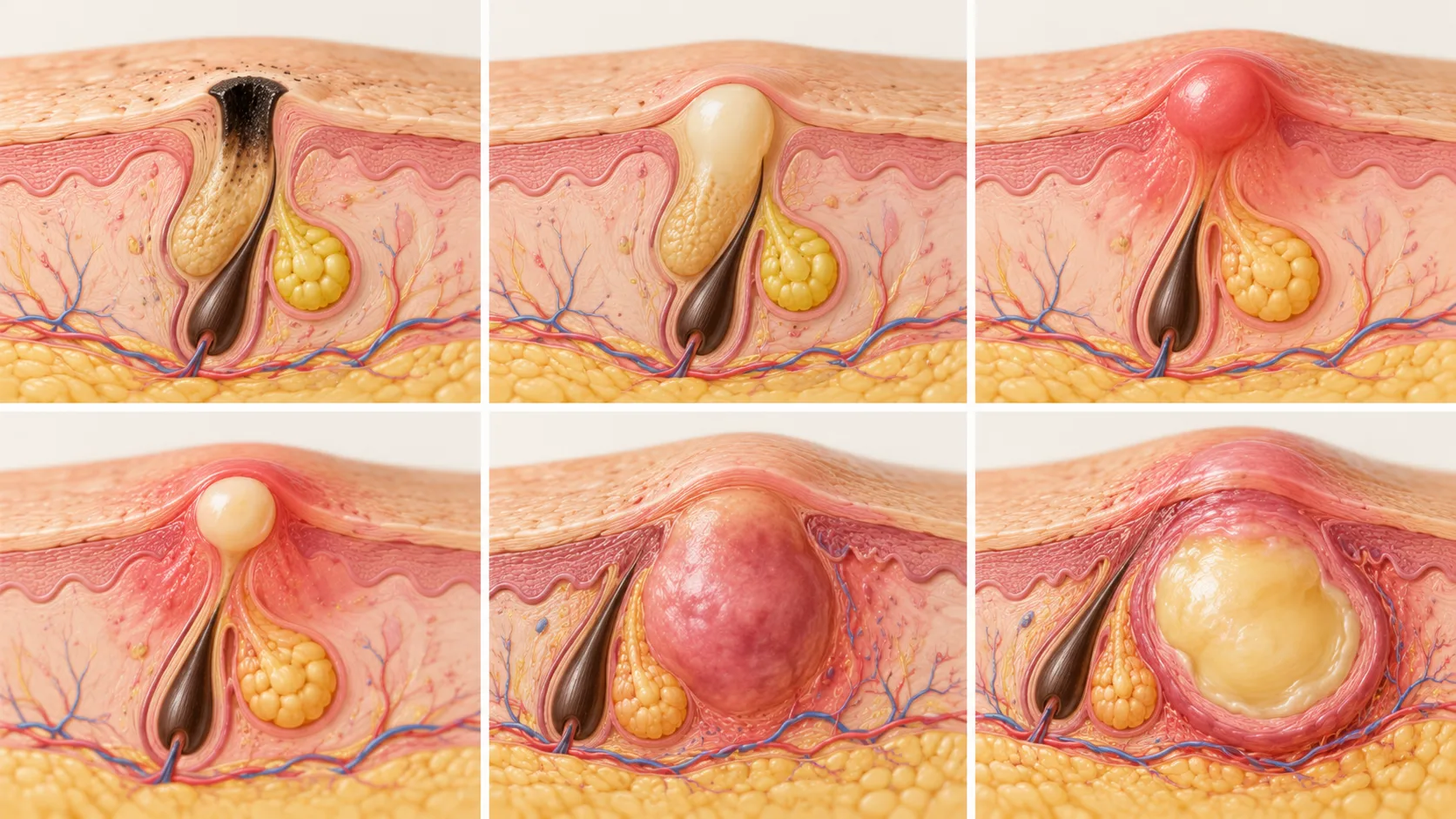
Blackheads and whiteheads are both comedones — clogged hair follicles filled with oil, dead skin cells, and bacteria (Merck Manual). What makes them look different from each other is simply whether the follicle is open or closed at the surface.
A whitehead (a closed comedone) is a small, flesh-colored or whitish bump, typically about 1 to 3 millimeters across, where the follicle has closed over the trapped material. A blackhead (an open comedone) looks similar in size, but the follicle stays open at the surface, and the trapped material darkens — that dark color is oxidized debris, not dirt, which is why scrubbing harder doesn’t actually clean it out and can make acne worse (American Academy of Dermatology).
Neither type is inflamed on its own. They’re the starting point other acne lesions can develop from, but they aren’t the same as the red, swollen bumps covered next.
Papules and Pustules: Two Types of Inflammatory Acne
This is where acne becomes inflammatory — the body’s immune response has kicked in, which is what actually produces the redness and swelling.
A papule is a small, firm, red (or, on deeper skin tones, darker-than-your-skin) bump, generally 2 to 5 millimeters across, without a visible fluid-filled center. A pustule is similar in size and depth, but has a visible yellow or white, pus-filled top (Merck Manual). Both are classified as inflammatory acne — the visible fluid in a pustule reflects where it is in that same inflammatory process, not a separate category of severity.
Both form from the same basic process as a comedone, just further along: oil and dead skin trap bacteria in the follicle, and the resulting inflammation produces a raised, tender bump instead of a flat, non-inflamed one. Picking or squeezing either type raises the risk of a lingering red or dark mark after it heals, which is covered in more detail in the skin-tone section below.
Nodules and Cyst-Like Lesions
This is the category that tends to cause the most confusion — partly because the popular term “cystic acne” is often used, in everyday conversation, to describe any deep, painful breakout, without distinguishing two things that dermatology sources actually treat separately.
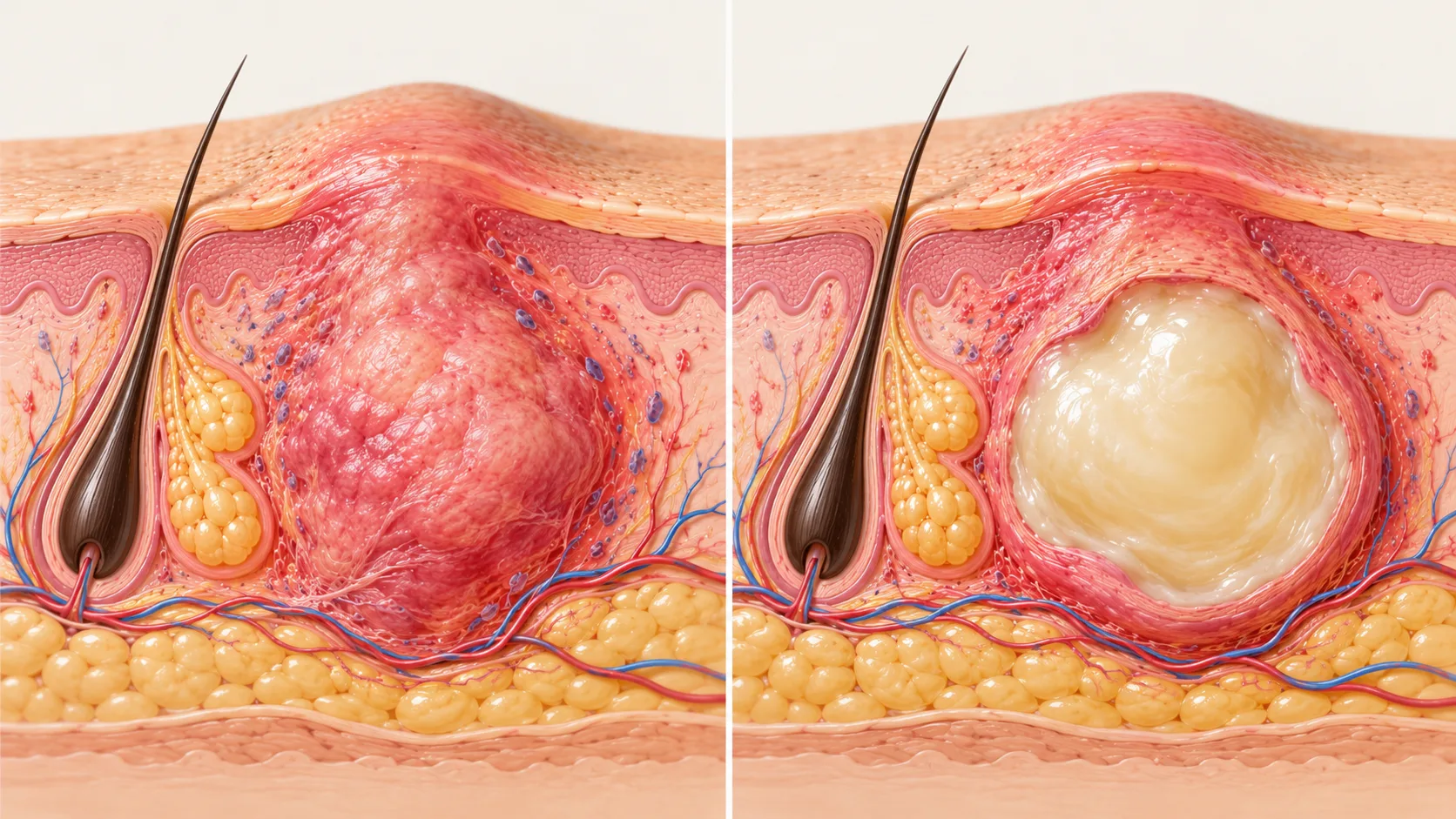
A nodule is a larger, deeper, more solid lump than a papule — it sits further under the skin and doesn’t contain fluid you could drain. A true cyst, in the clinical sense, is a fluid-filled (and often pus-filled) nodule (Merck Manual; Cleveland Clinic). Nodules “can resemble inflamed epidermoid cysts but lack a true cystic structure” (Merck Manual) — meaning a hard, deep lump that looks cyst-like may, more precisely, be a nodule rather than an actual cyst. You generally can’t tell the difference reliably just by looking or feeling from the outside.
In everyday conversation, “cystic acne” is often used as shorthand for both of these — deep, painful, nodule-or-cyst-type breakouts in general — rather than strictly true cysts. That’s worth knowing so you don’t assume a derm visit is only warranted for an exact cyst and not a nodule: both types are deep enough to carry a real risk of permanent scarring, and both are generally a reason to see a dermatologist rather than try to manage it with over-the-counter products alone (Cleveland Clinic).
Comparison Table
| Lesion Type | What It Looks Like | Inflammatory? | Typical Depth/Size | Also Called |
|---|---|---|---|---|
| Whitehead | Small, flesh-colored or whitish bump, closed surface | No | Shallow, ~1–3mm | Closed comedone |
| Blackhead | Similar size, dark/open center | No | Shallow, ~1–3mm | Open comedone |
| Papule | Small, firm, red or darker-than-skin bump, no visible fluid | Yes | ~2–5mm | Early inflammatory pimple |
| Pustule | Similar to a papule, with a visible yellow/white pus-filled top | Yes | ~2–5mm | “Pimple” in the everyday sense |
| Nodule | Larger, deeper, solid lump; no drainable fluid | Yes | Deeper, larger than papules/pustules | Often loosely called “cystic acne” |
| Cyst | Larger, deeper, fluid-filled (often pus-filled) lump | Yes | Deeper, larger than papules/pustules | True “cystic” lesion; also loosely called “cystic acne” |
(Sizing and definitions per Merck Manual, Acne Vulgaris, cross-checked against AAD and Cleveland Clinic.)
Common Acne Look-Alikes
A few other skin conditions can resemble acne closely enough to cause real confusion — and since they don’t respond to typical acne products, telling them apart matters for actually getting better. None of this is meant as a way to self-diagnose; it’s here so you know when “this acne treatment isn’t working” might mean “this isn’t acne.” (Source for this section: US Dermatology Partners.)
- Folliculitis — inflamed or infected hair follicles, often triggered by friction, tight clothing, or shaving, rather than the oil/dead-skin buildup behind true acne.
- Rosacea — persistent facial redness and bumps, mainly on the nose and cheeks, that isn’t caused by clogged pores the way acne is; it’s managed by identifying and limiting individual triggers rather than typical acne treatment.
- Keratosis pilaris — small, rough, dry bumps (often on the upper arms, but sometimes the face), associated with dry skin rather than the oily-skin pattern typical of acne.
- Perioral dermatitis — a rash of red, sometimes scaly bumps concentrated around the mouth, nose, and eyes, that needs its own, different treatment approach rather than standard acne care.
If you’ve been treating something as acne for weeks without improvement, that mismatch — not just the appearance — is itself a good reason to have a dermatologist take a look.
Skin-Tone Considerations
Acne lesions themselves form the same way regardless of skin tone, but one related issue is worth understanding on its own: post-inflammatory hyperpigmentation (PIH) — the flat, discolored mark that can be left behind after an inflammatory lesion (a papule, pustule, nodule, or cyst) heals. Postinflammatory hyperpigmentation “may occur after inflammatory acne lesions resolve” (Merck Manual). PIH is a separate thing from the active lesion itself — it’s a mark left behind, not the lesion continuing.
PIH “is more common and severe in individuals with darker skin tones, specifically those with Fitzpatrick skin types III to VI” (StatPearls / NCBI Bookshelf, “Postinflammatory Hyperpigmentation”). That source doesn’t give a specific rate or percentage for how much more common it is, so this guide isn’t able to state the exact degree of that difference with precise, measured figures — only that the pattern itself is directly, currently supported in a citable clinical reference. What’s also established, from the same source, is the mechanism: individuals with darker skin types are described as more biologically susceptible to this kind of pigment response following inflammation. The practical takeaway stays the same either way: picking or squeezing an inflammatory lesion raises the risk of a lingering mark regardless of skin tone, which is a genuine reason to leave inflamed bumps alone rather than try to speed them along. If dark marks left behind by past breakouts are your main concern — separate from identifying an active lesion — our guide to a skincare routine for dark spots covers that in more depth.
When to See a Dermatologist
A few signs are consistent, specific reasons to get a professional opinion rather than keep managing things on your own:
- A lesion is a nodule or cyst-type bump — deep, firm or fluid-filled, and painful.
- Breakouts haven’t improved after 6 to 8 weeks of consistent over-the-counter treatment (AAD).
- A breakout appears suddenly and severely, especially in an adult, which can sometimes warrant checking for an underlying cause (Cleveland Clinic).
- What you’re treating as acne isn’t responding the way acne normally would — a sign it might be a look-alike condition instead (US Dermatology Partners).
- Acne is leaving scars, or you’re noticing lingering dark or discolored marks that concern you.
- The breakout, or how you feel about it, is affecting your confidence or daily life — that’s a legitimate reason to ask for help, not just a cosmetic one (Cleveland Clinic).
Conclusion
Most acne falls into a handful of recognizable categories — from the shallow, non-inflamed comedones (blackheads and whiteheads) to the inflamed papules and pustules, up to the deeper, more severe nodules and cysts that are often lumped together as “cystic acne.” Knowing roughly which category you’re dealing with can help you understand what’s happening and when it’s worth bringing in a dermatologist — but it isn’t a diagnosis, and it isn’t a treatment plan. For anything deep, painful, scarring, spreading, or simply not responding to basic care, an in-person opinion is the most reliable next step.
Optional Products to Explore
Identifying which type of acne lesion you’re dealing with is the first step — deciding what, if anything, to try next is a separate decision this guide doesn’t make for you. If you’re looking for a starting point, here are three products commonly used for the situations described above. Each plays a different, limited role, and none is a requirement — plenty of people manage their skin well with just one, or with a dermatologist’s guidance instead.
A gentle cleanser doesn’t treat any specific type of acne lesion on its own — it supports the basics of a skincare routine so that anything else you use has a clean base to work with. CeraVe Hydrating Facial Cleanser is labeled by the brand, on its official product page, as “free of added fragrance” and non-comedogenic, which makes it a reasonable, low-risk starting point. See our CeraVe Hydrating Facial Cleanser review for more detail on how it fits sensitive or dry skin specifically.
Salicylic acid is worth knowing about specifically for blackheads and whiteheads, since it works down inside the pore itself rather than just on the surface. Paula’s Choice Skin Perfecting 2% BHA Liquid Exfoliant lists its active ingredient on its official product page as “2% BHA” (beta hydroxy acid) — the official page itself does not use the words “salicylic acid.” A third-party ingredient-database listing for this exact product names salicylic acid directly, as the fourth ingredient in its published 8-ingredient list. The product is also a leave-on formulation: a separate usage page from that same database, quoting what it describes as the brand’s own directions, states “Do not rinse” — so it’s applied and left on rather than washed off, which can make it more irritating than a rinse-off product, and worth introducing gradually either way.
Benzoyl peroxide is worth knowing about specifically for inflammatory pimples — papules and pustules — rather than blackheads or whiteheads. Neutrogena On-The-Spot Acne Treatment lists benzoyl peroxide 2.5% as its active ingredient on its official product page, one of the lower over-the-counter strengths, which can make it a gentler place to start. Per the product’s own label, skin irritation (redness, burning, itching, peeling, or swelling) may occur, and it warns against contact with hair or dyed fabric, which it may bleach.
A couple of things worth keeping in mind before trying any of these: introduce one new active ingredient at a time, since combining several at once makes it hard to tell what’s actually helping or causing irritation. And if a breakout is deep, painful, scarring, or you’re genuinely unsure what you’re looking at, that’s a good reason to have a dermatologist take a look in person rather than guessing.
Frequently Asked Questions
Not necessarily in a medical sense — both are inflammatory acne of similar size and depth. A pustule simply has a visible fluid-filled top; a papule doesn’t. Neither is automatically more serious than the other.
Not reliably. Both are deep, often painful lumps, and the real difference — whether it’s solid or fluid-filled — generally isn’t something you can determine accurately from the outside. This is one of the clearest reasons to let a dermatologist assess a deep, persistent bump rather than guess.
It’s commonly used that way in everyday conversation, but more precisely, dermatology sources distinguish nodules (solid) from true cysts (fluid-filled) — both of which get casually grouped under “cystic acne.” The distinction mainly matters for how a dermatologist discusses or manages it, not for what you should do differently as a reader.
No. The dark color in a blackhead is oxidized trapped material inside the follicle, not dirt on the skin’s surface. Scrubbing harder to “clean it out” can irritate skin and worsen acne rather than help.
Appearance alone often isn’t enough to tell for certain. A useful clue is response to treatment: if something you’re treating as acne isn’t improving the way acne normally would, that mismatch is a reasonable sign it could be a look-alike condition, and a dermatologist can tell the difference reliably.
The lesions themselves form the same way regardless of skin tone, but post-inflammatory hyperpigmentation — the mark left behind after an inflammatory lesion heals — is more common and more severe in people with darker skin tones, specifically Fitzpatrick skin types III to VI.
No. Squeezing a pimple can push its contents deeper into the skin, which increases inflammation, and it also raises the risk of scarring or infection rather than resolving anything. It’s one of the more common mistakes that turns a temporary breakout into a lasting mark.
A few clear signals: the bump is deep, painful, or fluid-filled; nothing has improved after 6–8 weeks of consistent over-the-counter treatment; a breakout appeared suddenly and severely; what you’re treating isn’t responding the way acne normally would; or it’s leaving scars or marks that bother you.
References
- American Academy of Dermatology. “How to Treat Different Types of Acne.”
- Cleveland Clinic. “Acne.”
- Cleveland Clinic. “Cystic Acne.”
- Merck Manual (Professional Edition). “Acne Vulgaris.”
- US Dermatology Partners. “More Than Acne: Understanding Skin Conditions That Mimic Acne.”
- StatPearls / NCBI Bookshelf. “Postinflammatory Hyperpigmentation.”
- American Academy of Dermatology. “Why You Shouldn’t Pop Your Pimples.”
More In Skincare


Why You Can Trust This Guide
Research-InformedGrounded in established, mainstream guidance — not trends.
Editorial ProcessSee how we write and review guides.
Medical Disclaimer IncludedClearly marked below — this guide is educational, not personalized medical advice.
Read our Review Policy for a plain explanation of what our review process does — and doesn't — mean for health-adjacent content.
Medical Disclaimer
This article is for informational purposes only and is not medical advice. It doesn’t diagnose any skin condition or replace personalized care. Talk with a board-certified dermatologist about acne that’s painful, persistent, or affecting your quality of life.