CeraVe Hydrating Facial Cleanser Review: Is It Right for Your Skin?
September 28, 2026
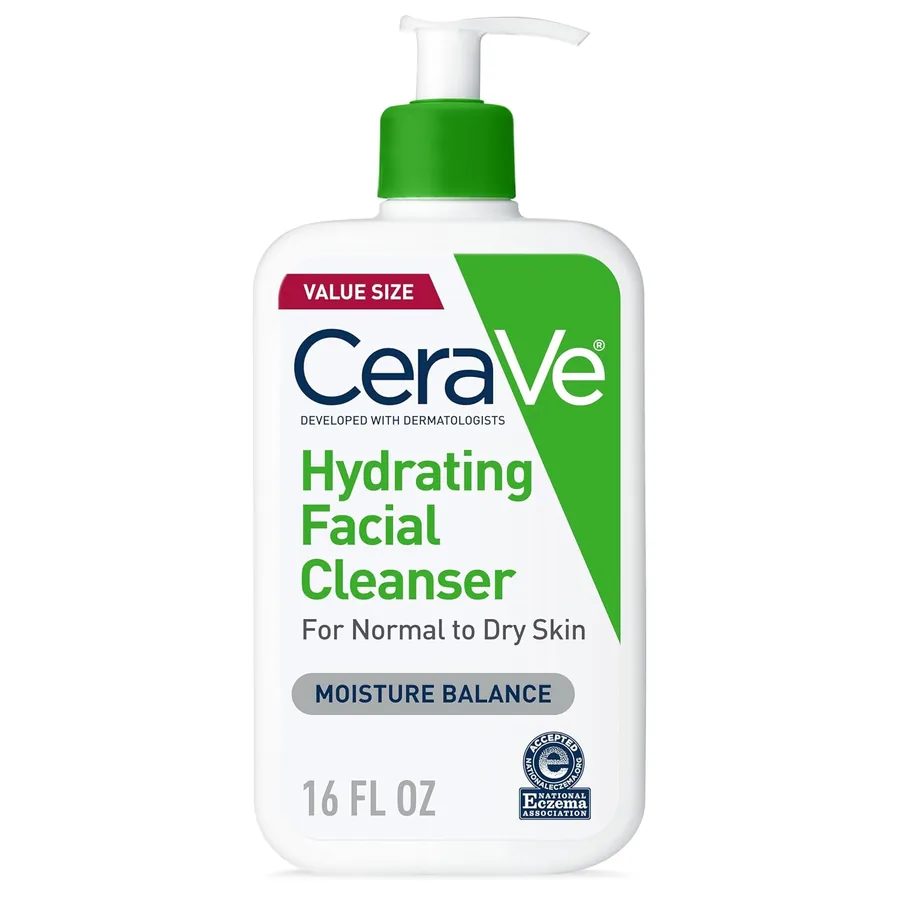
CeraVe Hydrating Facial Cleanser is one of the most recommended drugstore cleansers in the U.S., and it shows up constantly in “gentle cleanser” and “best for dry skin” roundups. This review covers the classic, non-foaming Hydrating Facial Cleanser, specifically the Value Size 16 FL OZ / 473 mL pump bottle for normal to dry skin. It is not a review of the Foaming Facial Cleanser, the Hydrating Cream-to-Foam Cleanser, the Renewing SA Cleanser, or any other CeraVe cleanser.
AvaFitCare has not personally tested this cleanser. What follows draws on CeraVe’s current official U.S. product information, general dermatology guidance on cleansing, and independent editorial reviews, kept clearly separate so you can see where each claim comes from. The goal is to help you decide whether this cleanser’s gentle, non-foaming style fits your skin — not to declare it the “best” cleanser in the abstract.
Product: CeraVe Hydrating Facial Cleanser Version reviewed: Value Size, 16 FL OZ / 473 mL pump bottle Cleanser type: Cream-to-milk, non-foaming daily face wash Skin positioning: Normal to dry skin, per current U.S. labeling Texture: Lightweight, lotion-like cream that rinses without traditional foam or lather Foaming: Does not foam — a design choice, not a defect Notable ingredients: Three ceramides (NP, AP, EOP), hyaluronic acid, glycerin, cholesterol, and phytosphingosine; current U.S. formula is labeled free of added fragrance Major advantage: Cleans without the tight, stripped feeling that stronger cleansers can leave; a common reason dermatology sources point dry or reactive skin toward cream cleansers Potential drawback: No foam and a light rinse-off can feel underwhelming if you’re used to a “squeaky-clean” sensation, and it isn’t built to fully remove heavier makeup or water-resistant sunscreen on its own
This article contains affiliate links. If you buy something through one of them, AvaFitCare may earn a commission at no extra cost to you.
CeraVe Hydrating Facial Cleanser, Value Size 16 FL OZ
The classic non-foaming cream cleanser for normal to dry skin, reviewed above.
CeraVe sells several similarly named cleansers, and mixing them up leads to bad buying decisions. This review covers only the classic Hydrating Facial Cleanser, the original, non-foaming cream cleanser for normal to dry skin. It is not the Foaming Facial Cleanser (foams, built for normal-to-oily skin), the Hydrating Cream-to-Foam Cleanser (a hybrid that whips into light foam), the Renewing SA Cleanser (also salicylic-acid based, formulated for texture/rough skin rather than acne specifically), the Acne Control Cleanser (CeraVe’s salicylic-acid cleanser for acne-prone oily skin, not to be confused with CeraVe’s separate benzoyl-peroxide products, the Acne Foaming Cream Cleanser and Acne Foaming Cream Wash), or the Hydrating Foaming Oil Cleanser (a different CeraVe cleanser formula). Claims and ingredients from those products don’t apply here.
What Is CeraVe Hydrating Facial Cleanser?
Per CeraVe’s current U.S. product page, this cleanser removes dirt, excess oil, and everyday impurities “without stripping skin of its natural oils or leaving it feeling tight and dry.” CeraVe recommends daily use, morning and night, followed by moisturizer. In practice, that makes it a basic, no-frills daily wash rather than a treatment product — it isn’t built to exfoliate, treat breakouts, or replace a dedicated makeup remover.
Ingredients and Formula: What Stands Out?
The current U.S. formula is built around three ceramides (NP, AP, EOP), hyaluronic acid (sodium hyaluronate), glycerin, cholesterol, and phytosphingosine, delivered via CeraVe’s MVE technology, which the brand describes as releasing moisturizing ingredients gradually. Ceramides are lipids naturally present in the skin’s barrier, and hyaluronic acid is a humectant that helps draw in moisture. Both are well-established, generally well-tolerated skincare ingredients.
It’s worth noting that contact time on a rinse-off product is short, a very different exposure than a leave-on moisturizer or serum that stays on skin for hours. That doesn’t make the ceramides or hyaluronic acid meaningless in a cleanser, but it does mean this formula shouldn’t be assumed to provide the same barrier or hydration benefit as a leave-on ceramide product. The formula is labeled free of added fragrance, and CeraVe states it is accepted by the National Eczema Association: a manufacturer-stated, third-party recognition rather than an independent clinical claim verified beyond what’s published.
Texture: Why Doesn’t It Foam?
This trips up a lot of first-time buyers, so it’s worth addressing directly: this is a non-foaming cleanser by design. CeraVe’s own materials describe it as a gentle, non-foaming formula, and independent reviewers consistently describe the texture as a light, lotion-like cream that spreads easily and rinses away with water rather than working into a lather.
That’s a formulation choice, not a sign the product is doing less. How much a cleanser lathers depends on its overall formulation system, not on any single ingredient’s strength or concentration, and foam level doesn’t map cleanly onto how effective, gentle, or irritating a cleanser is. A foaming and a non-foaming cleanser can each be formulated to be gentle, and each can also be formulated to be more stripping; visible lather alone isn’t a reliable way to judge either quality. What foam can’t tell you is whether a cleanser removes dirt and oil effectively, or whether it will feel drying on your particular skin — that depends on the full ingredient system, not on how much it bubbles.
Does It Actually Clean Your Skin Well?
For everyday buildup, sweat, oil, and normal grime, a gentle cream cleanser like this is generally adequate on its own, and independent reviewers describe skin feeling clean and soft afterward without the tightness stronger cleansers can leave. The important distinction is between “clean” and “squeaky clean.” The AAD specifically advises against vigorous scrubbing and cleansers that leave skin feeling overly tight, noting that this kind of irritation isn’t a sign of a more effective cleanse. A cleanser that leaves a small amount of natural residual oil, rather than stripping it completely, is functioning as intended for normal-to-dry skin, not necessarily under-cleaning.
Does It Remove Sunscreen?
There’s no single answer here, because how much sunscreen comes off in one wash depends on several things: the sunscreen’s own formulation, whether it’s labeled water-resistant, how much was applied, and whether it’s layered under makeup or other products. AvaFitCare doesn’t have product-specific testing data to quantify how much sunscreen this cleanser removes, so it’s worth being cautious about any “most” or “all” claim. Independent reviewers report more trouble with water-resistant formulas or sunscreen layered under makeup, and CeraVe’s own guidance for heavier residue points toward a dedicated first cleanse (an oil-based cleanser or micellar water) rather than relying on one wash. If you wear water-resistant sunscreen or a heavier layer daily, adding that first-cleanse step is a reasonable adjustment, not an admission the cleanser failed. That doesn’t mean everyone needs to double cleanse; if a light daily sunscreen and a single wash have been working for you, that’s also reasonable.
Does It Remove Makeup?
CeraVe’s current U.S. product information states that Hydrating Facial Cleanser removes makeup as part of its everyday cleansing function, and that manufacturer claim is worth reporting accurately. In practice, that’s most reasonably read as covering light, everyday makeup — tinted moisturizer, a little concealer or powder — rather than a promise that any single wash fully removes every type of makeup. For heavier, long-wear, or waterproof makeup specifically, independent reviewers are fairly consistent that one wash with this cleanser often isn’t enough, which is part of why CeraVe also sells separate oil-based and micellar products aimed at more thorough makeup removal. If your daily makeup is minimal, this cleanser alone is a reasonable approach; if you wear full-coverage or waterproof makeup regularly, a dedicated remover first, followed by this cleanser, is the more realistic approach.
Is It Good for Dry Skin?
This is the skin type CeraVe positions the product for. A gentle, non-foaming cream cleanser formulated with emollients and humectants like the ones in this product is a reasonable fit for skin that tends toward dryness, since the goal of this type of formula is to clean without adding to that dryness. That doesn’t mean the cleanser fixes dryness on its own; its job is to clean without making dryness worse, while the moisturizer and other steps do the actual hydrating work. For a full routine built around dry skin, AvaFitCare’s skincare routine for dry skin guide covers how a cleanser like this fits alongside moisturizer and other steps.
Is It Good for Sensitive Skin?
A few currently verifiable product characteristics are commonly cited reasons this gets recommended for sensitive skin: it’s labeled free of added fragrance, it carries the National Eczema Association’s Seal of Acceptance, and it’s positioned as a non-foaming cream cleanser rather than a stronger foaming formula. The NEA recognition is real and verifiable, though it reflects that organization’s ingredient and formulation review criteria rather than a guarantee that every person with eczema, rosacea, or reactive skin will tolerate the product. None of these characteristics, individually or together, guarantees individual tolerance. Sensitivity varies enough from person to person that no cleanser can be called universally safe for sensitive skin, and patch-testing before committing to a full routine is a reasonable precaution.
What About Oily or Combination Skin?
CeraVe’s own guidance, echoed by the AAD, generally points oily skin toward a gentle foaming cleanser, which is why this product is labeled for normal to dry skin rather than oily skin. At the same time, the AAD’s broader cleansing guidance is that harsh, overly stripping cleansing can irritate the skin regardless of skin type, and that gentle cleansing is generally preferred. So while oily skin often does better with a gentle foaming cleanser, cleanser preference and tolerance vary by individual, and some people with oily or combination skin do prefer a gentle, non-foaming cleanser like this one, particularly in colder months. If your T-zone still feels oily after using it, that’s a reasonable sign to consider a lighter foaming or gel cleanser instead.
What About Acne-Prone Skin?
This cleanser contains no acne-treating active ingredients — CeraVe’s salicylic-acid Acne Control Cleanser and its separate benzoyl-peroxide products are formulated for that purpose instead — so it shouldn’t be relied on to treat, prevent, or clear acne. A non-comedogenic claim is a formulation statement about ingredients chosen to minimize pore-clogging potential, not a guarantee against breakouts for every individual. Some people with acne-prone skin use a gentle cleanser like this specifically because harsher formulas can irritate active breakouts, relying on separate treatment products for the acne itself — results are highly individual.
Does CeraVe Hydrating Facial Cleanser Leave a Film or Residue?
CeraVe’s own description and independent reviewers both describe the product rinsing away cleanly, without greasy or sticky residue, typically within a splash or two of water. That’s the editorial consensus on how it’s designed to behave. On the consumer-review side, reactions to the after-feel vary: because the formula intentionally isn’t stripping, some people interpret the slightly less “squeaky” after-feel as film even when no visible product remains, while others, especially those coming from foaming cleansers, report the opposite, finding it notably lighter than expected. Neither reaction should be dismissed; what reads as residue to one person may just be the normal, less-stripped feeling this cleanser type is built to leave.
Pros and Cons
Pros:
Non-foaming cream formula positioned by CeraVe for normal-to-dry and sensitive skin
Ceramides, hyaluronic acid, and glycerin are current, verifiable parts of the formula
Free of added fragrance, per current U.S. labeling
Accepted by the National Eczema Association, per CeraVe
Rinses without leaving greasy residue, according to independent reviewers
Simple daily cleanser that layers easily under moisturizer
Cons:
Doesn’t foam, which can feel unsatisfying if you’re used to a lathering cleanser
Not reliable on its own for water-resistant sunscreen or heavy/waterproof makeup
Not formulated for oily skin; some oily-skin users may prefer a foaming alternative
No acne-treating ingredients, so it isn’t a solution for active breakouts
Some users describe a lingering after-feel they interpret as residue
Non-comedogenic claims are a manufacturer statement, not an individual guarantee
Who May Like This Cleanser?
People with normal-to-dry, fragrance-sensitive, or easily irritated skin who want a straightforward daily cleanser are the clearest fit, as is anyone whose skin feels tight after a foaming or gel cleanser and wants a gentler alternative, or anyone who just needs a simple, clean base for moisturizer and other steps.
Who May Want Something Else?
If you want a foaming, lathering wash, this will likely disappoint regardless of how well it cleans on paper — CeraVe’s Foaming Facial Cleanser is the more direct fit. If your routine includes water-resistant sunscreen or long-wear/waterproof makeup and you don’t want an extra first-cleanse step, a stronger single-step cleanser will serve you better. And if you’re shopping specifically for acne treatment, this isn’t that product.
How to Use CeraVe Hydrating Facial Cleanser
Per CeraVe’s current directions: wet skin with lukewarm water, massage the cleanser onto your face in gentle circular motions, then rinse thoroughly and pat dry. CeraVe positions it as usable any time of day, as the first step in a basic cleanse-moisturize-protect routine.
CeraVe Hydrating Facial Cleanser vs. Foaming Facial Cleanser
Hydrating Facial Cleanser
Foaming Facial Cleanser
Skin positioning
Normal to dry
Normal to oily
Texture
Lightweight cream, non-foaming
Gel-based, produces foam
After-feel
Soft, non-foaming cleansing feel
Refreshing foaming cleansing feel; CeraVe describes it as non-drying
Best suited for
Dry, sensitive, or reactive skin
Oily or combination skin
Neither formula is objectively better, and CeraVe doesn’t market either one as cleaning more thoroughly than the other; they’re built for different skin behaviors and different textural preferences. Skin that tends oily by midday fits the Foaming Cleanser’s positioning more conventionally, while skin that tends toward dryness or irritation fits the Hydrating Cleanser. Some combination-skin users rotate between the two by season.
Is CeraVe Hydrating Facial Cleanser Worth Considering?
There’s no universal yes-or-no here — it depends on your skin and habits. For normal-to-dry or easily irritated skin that wants a simple, fragrance-free, non-foaming cleanser that won’t leave the face feeling tight, this is a reasonable, well-documented option. For anyone wanting a foaming cleanse, a single product to strip water-resistant sunscreen or heavy makeup, or an acne treatment, this cleanser isn’t the right match — a fair reason to look elsewhere rather than a flaw in the product.
CeraVe Hydrating Facial Cleanser, Value Size 16 FL OZ
The classic non-foaming cream cleanser for normal to dry skin, reviewed above.
If a non-foaming cream cleanser isn’t right for your skin, a few other categories are worth knowing about. Foaming gel cleansers may suit oily or combination skin that prefers a refreshing foaming cleanse. Micellar water or an oil-based cleanser is worth adding as a first step if your routine regularly includes water-resistant sunscreen or heavier makeup — used before a standard face wash, not as a replacement. If you’re still comparing gentle cleansers, AvaFitCare’s best gentle cleansers for beginners guide covers several options side by side, including this one.
Frequently Asked Questions
Yes — it’s formulated and marketed for normal to dry skin, using a non-foaming cream formula intended to clean without stripping natural oils.
It’s fragrance-free and carries the National Eczema Association’s Seal of Acceptance, both of which support use for sensitive skin, but individual tolerance varies and neither is a guarantee.
It can, but it isn’t formulated for oily skin specifically. Dermatology guidance generally favors a gentle foaming cleanser for oily skin, though individual preference and tolerance vary, and some oily-skin users still prefer this gentler, non-foaming formula.
It contains no acne-treating ingredients and shouldn’t be relied on to treat or prevent breakouts. Some acne-prone users choose it as a gentle daily cleanser alongside separate treatment products.
It’s a non-foaming cream cleanser by design. Lather depends on a cleanser’s overall formulation, not on any one ingredient’s strength, and foam level alone doesn’t indicate how effectively or gently a cleanser cleans.
CeraVe states it removes makeup as part of everyday cleansing, which likely holds best for light, everyday makeup. Heavier, long-wear, or waterproof makeup typically needs a dedicated remover first.
It depends on the sunscreen: formulation, water resistance, and how much was applied all matter. Independent reviewers report more difficulty with water-resistant or heavier sunscreen without an added first cleanse.
CeraVe and independent reviewers describe it as rinsing clean without greasy residue. Some users describe a mild after-feel they interpret as film, which is more about individual sensation than actual residue.
Hydrating Facial Cleanser is a non-foaming cream for normal-to-dry skin; Foaming Facial Cleanser is a gel-based, lathering formula for normal-to-oily skin.
Yes — CeraVe positions it for daily use, up to twice a day, as part of a standard cleanse-moisturize-protect routine.
Research Sources Used
CeraVe U.S. official product page — Hydrating Facial Cleanser (cerave.com): Current product positioning, ingredient list, fragrance status, non-comedogenic claim, National Eczema Association recognition, and directions for use.
CeraVe U.K. official product page — Hydrating Cleanser (cerave.co.uk): Confirmed the “non-foaming” texture description and key ingredient roles.
CeraVe U.S. official product page — Foaming Facial Cleanser (cerave.com): Comparison product’s positioning, texture, and ingredients for the head-to-head comparison section.
CeraVe “How to Choose a Face Wash Cleanser for Skin Type” guidance page (cerave.com): Manufacturer guidance on foaming vs. cream/lotion cleansers by skin type, and double-cleansing/makeup-removal positioning.
CeraVe U.S. official acne skincare page (cerave.com/skincare/acne): Verified that Acne Control Cleanser is CeraVe’s salicylic-acid cleanser for acne-prone oily skin, distinct from CeraVe’s separate benzoyl-peroxide products (Acne Foaming Cream Cleanser, Acne Foaming Cream Wash) and from the Renewing SA Cleanser.
American Academy of Dermatology — “Face washing 101” (aad.org): General dermatologist-backed technique for face washing, including guidance against over-scrubbing and the “squeaky clean” misconception.
American Academy of Dermatology — oily skin guidance (aad.org): General recommendation of a gentle foaming cleanser for oily skin and caution that harsh cleansing can irritate skin.
Notes by Alice — independent CeraVe Hydrating Cleanser review (notesbyalice.co.uk): Independent editorial description of texture, residue behavior, and makeup-removal limitations.
The Beauty Inside Out — independent CeraVe Hydrating Facial Cleanser review (thebeautyinsideout.com): Independent editorial description of texture, rinse-off behavior, sunscreen-removal limitations, and best/worst-fit skin types.