
If you’ve seen CeraVe PM recommended as a nighttime moisturizer and want to know whether it’s actually right for you, the short answer depends on your skin type. It’s a lightweight, oil-free lotion built around ceramides, niacinamide, and hyaluronic acid, and it tends to be the better fit for oily, combination, or normal skin looking for a nighttime moisturizer without a heavy, occlusive feel. For genuinely dry or eczema-prone skin, independent commentary suggests this particular formula may not be rich enough used on its own. The breakdown below separates what CeraVe states directly, what independent sources report, and what’s still unconfirmed — this is not a first-hand product trial.
In This Guide
- CeraVe PM at a Glance
- What Is CeraVe PM Facial Moisturizing Lotion?
- Key Ingredients and What They Do
- Is CeraVe PM Good for Oily or Combination Skin?
- Is It Suitable for Acne-Prone Skin?
- Is It Enough for Dry Skin?
- Can You Use CeraVe PM During the Day?
- Texture, Finish, and Layering
- How to Use CeraVe PM
- Pros and Cons
- CeraVe PM vs. CeraVe Moisturizing Cream
- CeraVe PM vs. Daily Moisturizing Lotion
- CeraVe PM vs. Vanicream Daily Facial Moisturizer
- CeraVe PM vs. La Roche-Posay Toleriane Double Repair Face Moisturizer
- Who Should Choose It — and Who Might Prefer Something Else?
- Final Verdict: Is CeraVe PM Facial Moisturizing Lotion Worth It?
- Frequently Asked Questions
CeraVe PM at a Glance
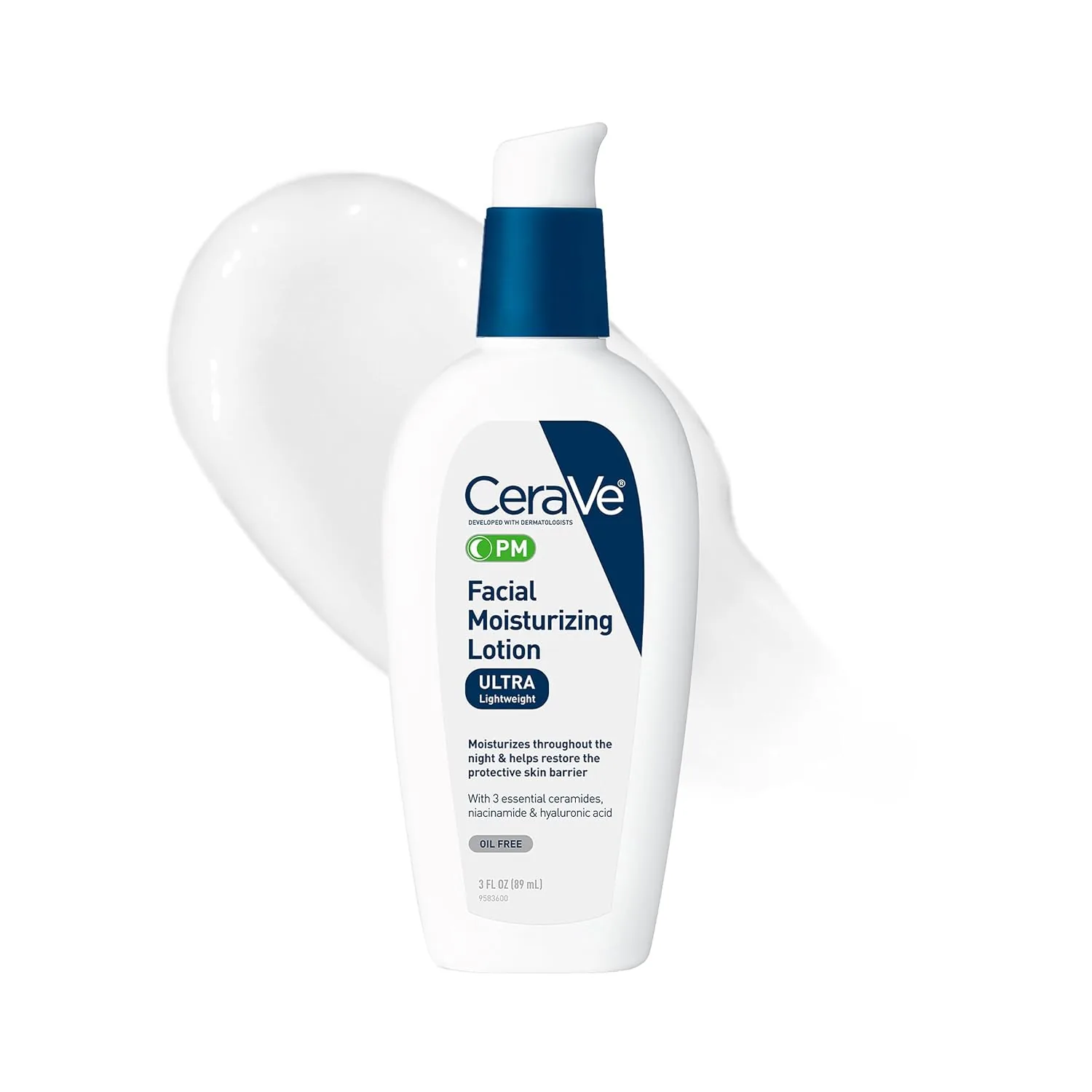
- Product: CeraVe PM Facial Moisturizing Lotion
- Size: 3 fl oz (89 mL), pump bottle
- Key ingredients: Niacinamide, three ceramides (NP, AP, EOP), hyaluronic acid (as sodium hyaluronate)
- Texture: Lightweight lotion, described by the brand as oil-free
- Brand-stated skin type fit: All skin types
- Time-of-day labeling: “PM Only” per CeraVe’s own site
- SPF: None
- Fragrance: Free of added fragrance
- Comedogenicity claim: Non-comedogenic (brand claim)
This article contains an affiliate link. See our affiliate disclosure for details.
CeraVe PM Facial Moisturizing Lotion
View on Amazon (paid link)
What Is CeraVe PM Facial Moisturizing Lotion?
CeraVe PM Facial Moisturizing Lotion is a facial moisturizer built around CeraVe’s three-ceramide formula, with niacinamide and hyaluronic acid added in. CeraVe’s own US product page lists it as “Made For: All Skin Types” and labels it “PM Only,” meaning the brand markets and positions it specifically as a nighttime product — it sells a separate AM Facial Moisturizing Lotion with SPF 50 for daytime use.
The brand describes this as a “developed with dermatologists” formula that uses its MVE (Multivesicular Emulsion) delivery technology, which CeraVe says releases moisturizing ingredients gradually rather than all at once. That’s a brand-stated mechanism, not something independently measured for this review — it’s useful context for understanding the product’s design philosophy, not proof of a specific result.
Directions on the official packaging, per CeraVe’s site, are straightforward: apply liberally to the face and neck at night, or as directed by a physician.
Key Ingredients and What They Do
- Niacinamide — a form of vitamin B3 that’s one of the more broadly well-tolerated active ingredients in skincare. CeraVe doesn’t publicly disclose the exact concentration used in this formula, so any specific percentage you see quoted online (including on some independent ingredient sites) is that source’s own estimate, not a confirmed brand figure. Niacinamide is commonly associated with a calmer, more even-looking complexion over time, though results vary by person and this specific finished formula hasn’t been independently clinically tested as a standalone product in the research for this review. If you want a closer look at this ingredient on its own, our guide to niacinamide covers how it works and how to use it beyond this one product.
- Ceramide NP, Ceramide AP, and Ceramide EOP — three types of ceramides, which are lipids that occur naturally in skin and are a well-established category in dermatology for supporting the skin’s outer barrier (the layer that helps keep moisture in and irritants out). Ceramide-containing moisturizers as a category have real supporting research; that doesn’t automatically translate into a guaranteed result for this exact product, since CeraVe doesn’t publish ceramide concentrations either.
- Hyaluronic acid (listed as sodium hyaluronate) — a humectant that helps draw and hold water in the skin’s outer layers.
- MVE Technology — CeraVe’s proprietary delivery system, described by the brand as a controlled-release mechanism. This is manufacturer-stated, not independently verified for this review.
A fair, honest caveat: CeraVe doesn’t publish exact concentrations for niacinamide, the ceramides, or the hyaluronic acid in this specific product, so claims about “how much” of anything is in the bottle aren’t verifiable from public information. That’s true of most mass-market skincare, not a criticism unique to this product.
Is CeraVe PM Good for Oily or Combination Skin?
This is arguably where CeraVe PM gets recommended most often, and the brand’s own labeling supports that use case: it’s described as oil-free and lightweight, and independent commentary consistently describes the texture as thinner and less rich than CeraVe’s own Moisturizing Cream.
For oily or combination skin specifically, a lightweight, oil-free lotion is generally a more comfortable fit than a dense cream, and that’s consistent with why this product shows up so often in “moisturizer for oily skin” recommendations, including in our own guide to choosing a moisturizer for your skin type. That said, “oily skin” isn’t one uniform category — some oily-skin users want even less on their face at night, and others find a lightweight lotion is exactly the right amount of hydration. There’s no universal answer, just a reasonably good formulation fit on paper.
Is It Suitable for Acne-Prone Skin?
CeraVe labels PM “non-comedogenic,” meaning it’s formulated to be less likely to clog pores. That’s a real, meaningful formulation claim — but it’s not a guarantee. Non-comedogenic testing methods vary across the industry and aren’t independently standardized the way some other skincare claims are, so “non-comedogenic” is best read as “formulated with pore-clogging risk in mind,” not “will never cause a breakout for anyone.”
This product is also not an acne treatment. It doesn’t contain salicylic acid, benzoyl peroxide, or any other ingredient marketed for treating existing acne — it’s a moisturizer, and its role in an acne-prone routine is to support hydration and the skin barrier alongside whatever actual acne-focused products you’re using, not to replace them.
Individual tolerance still varies, and niacinamide-containing products are no exception — see the FAQ below for more on that specific ingredient.
Is It Enough for Dry Skin?
This is the question where CeraVe PM’s “All Skin Types” brand positioning runs into some real-world pushback. Independent commentary on this formula (including at least one independent ingredient-review source examined for this piece) suggests its lightweight texture — commonly described by independent sources as fast-absorbing — may not be rich enough as a standalone nighttime moisturizer for genuinely dry or eczema-prone skin. Some users report layering it under a heavier cream or occlusive when their skin needs more.
CeraVe’s own Moisturizing Cream, by contrast, is explicitly positioned by the brand for normal-to-dry skin and carries the National Eczema Association’s Seal of Acceptance. If dry skin is your main concern, the Moisturizing Cream (or a similar richer formula) is probably the better starting point; PM reads more as an oily-to-combination-skin pick that happens to carry a broad “all skin types” label than as a dry-skin specialist product. For more on that comparison, see our CeraVe Moisturizing Cream review.
Can You Use CeraVe PM During the Day?
CeraVe markets and labels this specific product “PM Only,” and the brand sells a separate AM Facial Moisturizing Lotion with SPF 50 for daytime use. That’s a real labeling and marketing distinction worth taking seriously if you’re trying to follow the brand’s intended system.
That said, nothing in CeraVe’s own product information states that using this formula during the day is unsafe or harmful — the “PM Only” label reflects how the brand positions and sells the product, not a safety restriction. The practical issue with daytime use is that this lotion contains no SPF, so if you did use it in the morning, you’d still need a separate, dedicated sunscreen over or instead of it. For most people, following the brand’s own AM/PM system (a dedicated SPF product by day, this lotion by night) is the simpler and more consistent approach.
Texture, Finish, and Layering

Independent sources commonly describe CeraVe PM as lightweight and non-greasy, with a thinner, less occlusive feel than CeraVe’s Moisturizing Cream. No specific absorption time is stated here, since exact numbers vary by source and by skin — the consistent theme across independent commentary is a texture that’s reported as sinking in relatively quickly rather than sitting heavily on the skin.
On makeup compatibility: in a question-and-answer posted on Target’s US retail listing for this product, the guidance given was that makeup can be applied over this lotion once it has absorbed. Letting it fully absorb before your next step may help with how makeup sits on top of it, though this hasn’t been independently verified to work equally well under every foundation or makeup formula — how it behaves under your specific makeup routine may still vary.
Some users also report this lotion “pilling” — balling up into small flakes — when used with certain other products. Pilling is generally a multi-factor issue: it can depend on which other products are layered underneath or on top, how much of each product is applied, the order products are applied in, and how different formulas interact with each other, not on any single ingredient in isolation. CeraVe PM does contain dimethicone, a silicone ingredient sometimes discussed in connection with pilling in combination with certain other formulas, but dimethicone alone doesn’t reliably predict whether pilling will happen with a given routine. If you notice pilling, the usual troubleshooting steps are waiting longer between layers, applying less product per step, or adjusting application order.
How to Use CeraVe PM

Per CeraVe’s own directions, apply liberally to the face and neck at night, after cleansing. Since this is a nighttime lotion with no SPF, there’s no additional sunscreen step needed afterward.
If you’re also using a retinoid, an exfoliating acid, or another potentially drying active, there isn’t one single, universally correct order for layering it with CeraVe PM. The right sequence can depend on the specific treatment product’s own instructions, your personal tolerance, and guidance from a dermatologist — some routines apply a moisturizer before a retinoid, others apply it after, and even brand customer-service answers on this exact question aren’t fully consistent with each other. Rather than treating any one order as a fixed rule, following the directions that came with your specific treatment product, or checking with a dermatologist if you’re unsure, is more reliable than a generic rule. For general routine-building context, see our skincare routine for combination skin guide.
Pros and Cons
Pros:
- Lightweight, oil-free texture, distinct from CeraVe’s richer Moisturizing Cream
- Contains niacinamide alongside ceramides and hyaluronic acid — a combination that’s generally well-tolerated for most skin types
- Fragrance-free formulation
- Non-comedogenic (brand claim)
- Widely available at mass retailers and drugstores
Cons:
- No SPF, and not marketed for daytime use
- May be too light as a standalone moisturizer for genuinely dry or eczema-prone skin
- CeraVe doesn’t disclose exact ingredient concentrations
- Some users report pilling when layering with certain other products
- Scattered, individual reports of pump issues
CeraVe PM vs. CeraVe Moisturizing Cream
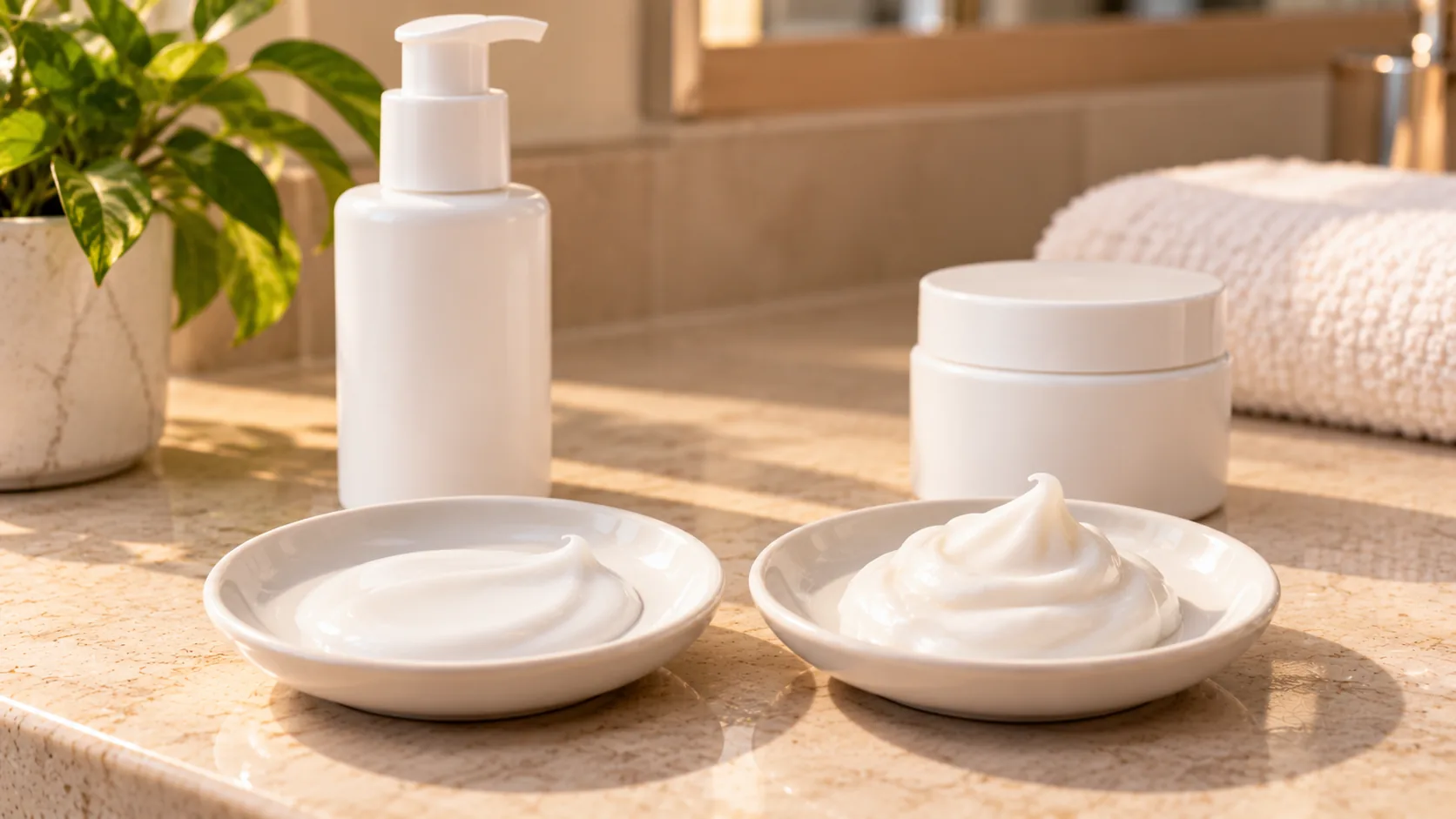
These two are easy to confuse because they’re from the same brand and share some of the same ingredient language, but they’re built for different jobs. CeraVe PM is a lightweight, oil-free lotion with niacinamide added in, labeled for nighttime facial use. CeraVe Moisturizing Cream is a richer, more occlusive formula — it contains petrolatum and dimethicone rather than being labeled oil-free — positioned by the brand for normal-to-dry skin on both the face and body, and it carries the National Eczema Association Seal of Acceptance.
Neither is objectively “better.” If your skin runs oily to combination and you want something light for your face specifically, PM is the more natural fit. If you have normal-to-dry skin, want one moisturizer for face and body, or deal with eczema-prone skin, the Moisturizing Cream is the brand’s own pick for that use case. We cover the Moisturizing Cream in full in our separate review.
CeraVe PM vs. Daily Moisturizing Lotion
CeraVe Daily Moisturizing Lotion is the brand’s other lightweight, oil-free option — and on paper, it’s structurally similar to PM. Both are labeled oil-free and non-comedogenic, and both contain the same three ceramides (NP, AP, EOP) plus sodium hyaluronate. The clearest differences: CeraVe lists Daily Moisturizing Lotion as usable “Anytime,” with no time-of-day restriction, and its ingredient list doesn’t include niacinamide the way PM’s does.
In practice, this makes Daily Moisturizing Lotion the more flexible, all-purpose pick if you want one lightweight lotion for both morning and night (keeping in mind it also has no SPF, so daytime use still needs a separate sunscreen). PM is the narrower, nighttime-specific option with niacinamide folded in.
CeraVe PM vs. Vanicream Daily Facial Moisturizer
Vanicream Daily Facial Moisturizer takes a different formulation approach. The brand positions it for sensitive skin, and it’s fragrance-free, dye-free, and free of botanical extracts or essential oils. Its ceramide lineup lists five types (EOP, NG, NP, AS, AP), compared with PM’s three — though a longer ceramide list doesn’t by itself make a moisturizer more effective; overall formulation matters more than ingredient count. Vanicream also lists hyaluronic acid as a key ingredient but, notably, doesn’t include niacinamide.
Which of the two suits you better depends on your own skin’s response and whether you specifically want niacinamide in the formula — neither product has a documented, inherent advantage over the other for sensitive skin specifically; that’s an individual-fit question, not a settled comparison.
CeraVe PM vs. La Roche-Posay Toleriane Double Repair Face Moisturizer
It’s worth being precise here: La Roche-Posay sells more than one version of this product, including a plain Toleriane Double Repair Face Moisturizer with no SPF and a separate SPF 30 version (also sold in a “Matte” variant for oily skin). This comparison refers specifically to the non-SPF version, confirmed directly from La Roche-Posay’s own US product page.
Per that official page, the non-SPF Toleriane Double Repair’s ingredient list includes niacinamide, Ceramide NP, glycerin, squalane, and dimethicone, among others, built on the brand’s Prebiotic Thermal Water base. It’s labeled fragrance-free, oil-free, and non-comedogenic, and the brand describes it as suitable for all skin types, including sensitive skin, recommended for normal-to-combination and dry skin. Directions call for morning and/or evening use — unlike PM, it isn’t restricted to nighttime use. One formulation difference worth flagging: La Roche-Posay’s own ingredient list doesn’t include hyaluronic acid or sodium hyaluronate, which is a named ingredient in CeraVe PM.
Being oil-free doesn’t automatically mean either product is the right pick for acne-prone skin specifically — that still comes down to your own skin’s response, not the oil-free label alone. Overall, these two products are close enough in concept that the choice often comes down to brand preference, price, and whether PM’s nighttime-only labeling matters to your routine.
Who Should Choose It — and Who Might Prefer Something Else?
Likely a good fit if you:
- Have oily, combination, or normal skin and want a lightweight nighttime lotion
- Want niacinamide included alongside ceramides and hyaluronic acid
- Prefer a fragrance-free formula
- Are comfortable following a nighttime-specific product rather than a one-size-fits-all lotion
Probably worth trying something else if you:
- Have genuinely dry or eczema-prone skin and want one moisturizer that’s rich enough on its own (consider CeraVe Moisturizing Cream instead)
- Want a single lightweight lotion you can use both morning and night without a time-of-day restriction (CeraVe Daily Moisturizing Lotion may fit better)
- Specifically want niacinamide left out of your routine, or want to compare a more minimal ingredient philosophy (Vanicream is worth comparing)
- Specifically want SPF built into your moisturizing step (none of the products compared here without SPF will cover that — you’d need a dedicated sunscreen or an SPF-formulated moisturizer)
Final Verdict: Is CeraVe PM Facial Moisturizing Lotion Worth It?
For its apparent sweet spot — oily, combination, or normal skin that wants a lightweight, oil-free nighttime lotion with niacinamide, ceramides, and hyaluronic acid — CeraVe PM is a reasonably well-formulated option built from ingredients with real standing in dermatology, even though CeraVe doesn’t disclose exact concentrations. It’s fragrance-free and non-comedogenic by brand claim, and it’s easy to find at most drugstores and mass retailers.
Where it’s worth being careful is exactly where the brand’s broad “All Skin Types” label gets tested by independent, real-world commentary: if your skin runs genuinely dry or eczema-prone, this lightweight formula may not be rich enough on its own, and CeraVe’s own Moisturizing Cream — positioned and credentialed specifically for that use case — is probably the better starting point. It’s also not an acne treatment and carries no SPF, so it needs to sit alongside, not replace, the rest of a complete routine. Whether it’s “worth it” ultimately comes down to whether its lightweight, nighttime-only profile matches what your skin is actually asking for.
CeraVe PM Facial Moisturizing Lotion
View on Amazon (paid link)
Frequently Asked Questions
It can be — it’s labeled oil-free and lightweight, and that texture is generally a more comfortable fit for oily skin than a richer cream. It’s one of the more commonly recommended options for this skin type, though individual preference still varies.
It’s labeled non-comedogenic by the brand, which means it’s formulated to be less likely to clog pores — but that’s a formulation claim, not a guarantee for every individual. It’s also not an acne treatment product, so it shouldn’t be expected to improve existing breakouts on its own. As with any moisturizer, individual tolerance varies, and anyone prone to breakouts should watch how their own skin responds.
CeraVe markets and labels this specific product “PM Only,” and nothing in the brand’s own information suggests it’s unsafe to use in the daytime — it’s simply not how the brand positions or sells it. The practical issue is that it has no SPF, so daytime use would still require a separate sunscreen.
No. This lotion contains no sun protection. CeraVe sells a separate AM Facial Moisturizing Lotion with SPF 50 for daytime use.
CeraVe doesn’t publicly disclose the exact percentage. Any specific concentration figure you see cited online — including estimates from independent skincare sites — is that source’s own estimate, not a number confirmed by the brand.
It’s fragrance-free, which is a meaningful plus for sensitive skin generally, and niacinamide at typical cosmetic concentrations is broadly considered one of the better-tolerated common active ingredients. That said, individual sensitivity varies, and anyone with a history of reacting to multiple skincare products should patch-test any new product, including this one.
It can be for some people, but independent commentary suggests its lightweight texture may not be rich enough as a standalone nighttime moisturizer for genuinely dry or eczema-prone skin. CeraVe’s own Moisturizing Cream, which is positioned for normal-to-dry skin and carries the National Eczema Association Seal of Acceptance, is generally the better-suited option for that skin type.
Pilling can happen for several reasons — which other products you’re layering, how much you’re applying, the order of application, and how different formulas interact with each other — rather than being caused by one ingredient alone. CeraVe PM contains dimethicone, which is sometimes discussed in connection with pilling, but dimethicone by itself doesn’t reliably predict whether pilling will occur in a given routine. Waiting longer between layers or using less product per step can help.
PM is a lightweight, oil-free lotion labeled for nighttime facial use, with niacinamide added to its ceramide-and-hyaluronic-acid base. Moisturizing Cream is a richer, more occlusive formula (it contains petrolatum and isn’t labeled oil-free), positioned for normal-to-dry skin on the face and body, and it carries the NEA Seal of Acceptance.
Both are labeled oil-free, lightweight, and non-comedogenic, with the same three ceramides and hyaluronic acid. The main differences are that Daily Moisturizing Lotion is labeled for “Anytime” use rather than nighttime only, and it doesn’t include niacinamide the way PM does.
More In Product Reviews

Why You Can Trust This Guide
Research-InformedGrounded in established, mainstream guidance — not trends.
Editorial ProcessSee how we write and review guides.
Read our Review Policy for a plain explanation of what our review process does — and doesn't — mean for health-adjacent content.