If you’ve spent any time researching facial sunscreens, you’ve probably run into EltaMD UV Clear Broad-Spectrum SPF 46. It’s sold through dermatology-clinic retailers and shows up constantly in U.S. searches for acne-prone and sensitive-skin sunscreens — which also means it comes with a lot of marketing noise to sort through.
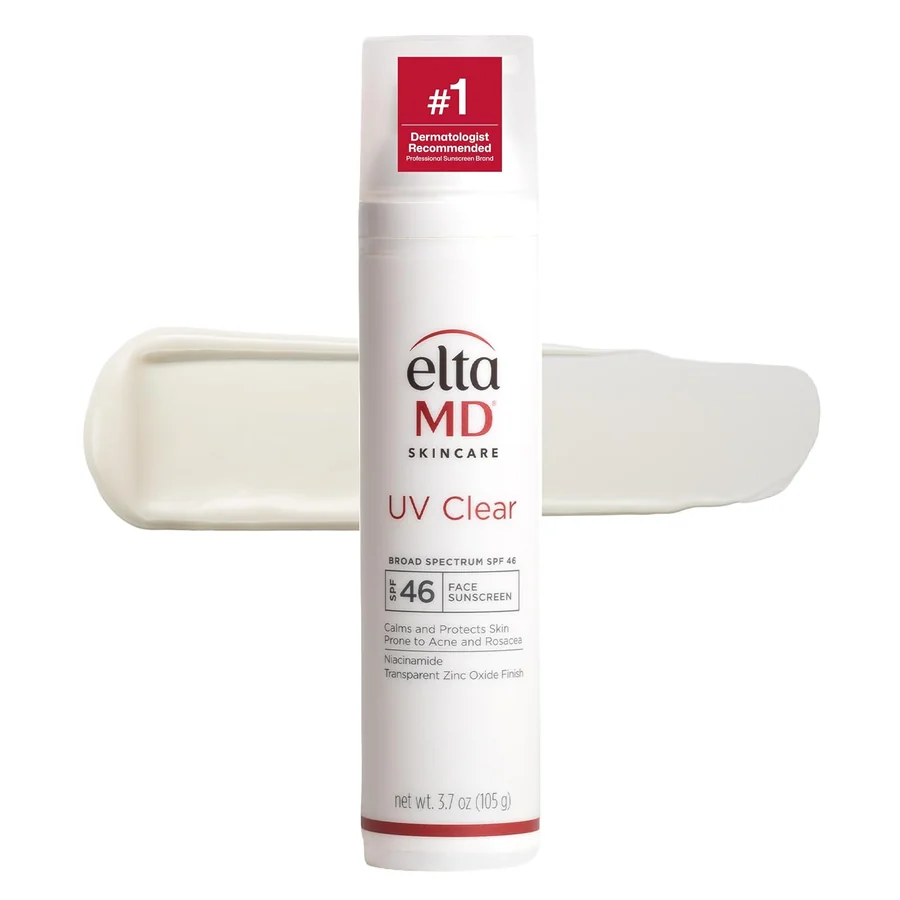
This review covers the untinted version of EltaMD UV Clear Broad-Spectrum SPF 46. It’s a broad-spectrum SPF 46 sunscreen with a hybrid formula — not mineral-only — built around zinc oxide and octinoxate, and EltaMD positions it for sensitive skin that’s prone to breakouts, rosacea, and discoloration. That positioning is a big part of why it shows up so often in acne-prone and sensitive-skin searches.
Here’s the short version: it has a reasonable case for being a solid daily facial sunscreen for a lot of people, especially those drawn to its oil-free, fragrance-free, noncomedogenic claims. But it isn’t labeled water-resistant, it’s a hybrid rather than mineral-only formula, and real user reviews include a meaningful number of breakout and irritation reports that complicate the manufacturer’s breakout-prone-skin positioning. We’ll walk through all of it, including where the evidence is solid and where it genuinely isn’t.
One thing upfront: AvaFitCare has not personally tested this product. This review is built from the product’s official Drug Facts label, manufacturer information, and clearly attributed independent reviews and user reports — not from our own firsthand use.
Sensitive skin prone to breakouts, rosacea, and discoloration
Fragrance
Fragrance-free (manufacturer claim)
Oil content
Oil-free (manufacturer claim)
Noncomedogenic claim
Yes (manufacturer claim)
Water resistance
Not labeled water-resistant
Best-fit use case
Daily facial SPF for breakout-prone or sensitive skin, non-water-heavy routines
Major limitation
No labeled water-resistance duration; hybrid, not mineral-only
This article contains affiliate links. If you buy through them, AvaFitCare may earn a commission at no extra cost to you. See our Affiliate Disclosure for details. Our editorial judgment isn’t influenced by affiliate relationships.
EltaMD UV Clear Broad-Spectrum SPF 46 is a facial sunscreen made by CP Skin Health Group’s EltaMD line, sold in both tinted and untinted versions. This review is specifically about the untinted version — the tinted formula is a separate product with its own name, and we’re not treating the two as interchangeable.
Per its FDA Drug Facts label, the product combines two active sunscreen ingredients — zinc oxide and octinoxate — at SPF 46 with broad-spectrum (UVA and UVB) coverage. EltaMD markets it as oil-free, fragrance-free, and noncomedogenic, and positions it specifically for people with sensitive skin that’s prone to breakouts, rosacea, and discoloration. That’s a manufacturer positioning statement, not an independent clinical finding, and it’s worth keeping that distinction in mind as we go through the rest of this review.
Beyond its UV filters, the formula includes niacinamide, sodium hyaluronate (a form of hyaluronic acid), tocopheryl acetate (a vitamin E ester), and lactic acid. None of these ingredients have a disclosed concentration in any source we checked, so we won’t be putting a number on any of them here.
Is EltaMD UV Clear Good for Acne-Prone or Oily Skin?
This is probably the single most common reason people search for this product, so it’s worth covering carefully — and honestly, from both directions.
What the manufacturer says: EltaMD markets UV Clear as oil-free and noncomedogenic, and positions it specifically for skin that’s prone to breakouts. That positioning is a big part of its reputation as a go-to sunscreen for acne-prone and oily skin, and it’s one of the products commonly sold through dermatology-clinic retailers.
What that positioning doesn’t mean: “Positioned for breakout-prone skin” is not the same as “treats acne” or “prevents acne.” No evidence available to us shows that this sunscreen treats, clears, or reduces acne — and we’re not going to claim that it does.
What user reports add to the picture: Independent user reviews on long-running skincare review platforms include a real, recurring pattern of breakout reports — some users describe painful, inflamed bumps, pimples, or whiteheads after starting to use it. This isn’t a single off-hand complaint; it shows up across multiple reviewers, which makes it worth mentioning honestly rather than glossing over it. At the same time, there’s also a recurring pattern of users reporting the opposite — that it works well as a daily moisturizer-replacement step without causing problems for their skin.
The practical takeaway: Individual skin responses to any sunscreen — mineral, chemical, or hybrid — can vary a lot, and that appears to be true here. The noncomedogenic and oil-free claims are real manufacturer claims, not marketing fluff, but they also don’t guarantee a universal result. If you’ve reacted to hybrid sunscreens or specific filters before, that history is probably more predictive of your experience than the product’s general positioning.
What About Sensitive or Rosacea-Prone Skin?
EltaMD also positions UV Clear for rosacea-prone and generally sensitive skin — again, this is a manufacturer suitability statement, not a treatment claim. Nothing here is intended to suggest, and we won’t suggest, that this sunscreen treats, prevents, or reduces rosacea.
As with the acne-prone positioning, user reports complicate a simple “yes, it’s gentle” conclusion. Alongside positive reports of a calm, non-irritating experience, there are also multiple user reports describing stinging, burning, or redness after application. We don’t have evidence pointing to a specific cause, but it’s a real, self-reported pattern worth knowing about before you buy.
If you have sensitive or rosacea-prone skin, the manufacturer’s positioning still isn’t a guarantee of individual tolerance. Pay attention to how your skin responds, follow the product’s directions, and seek appropriate professional advice if irritation persists.
Does EltaMD UV Clear Leave a White Cast?
Short answer: it depends on who you ask, and that’s worth taking seriously rather than smoothing over.
Independent reviewer accounts describe meaningfully different outcomes depending on skin tone. One firsthand account on lighter/olive skin described the sunscreen blending in with essentially no visible cast. A separate independent reviewer source, however, reported a more noticeable, slightly ashy cast on medium-deep skin tones that faded within roughly ten minutes of application, while reporting little to no cast on fairer skin in the same testing.
We haven’t tested this across skin tones ourselves, and we’re not aware of any controlled, multi-skin-tone study on this specific product’s white-cast performance — what exists is a handful of individual reviewer accounts. So rather than giving you a flat “no white cast” verdict (which a lot of shorter reviews do), the more accurate takeaway is: white-cast visibility on this product appears to vary by skin tone. If white cast on deeper skin tones is a dealbreaker for you, that’s a legitimate reason to look closely at reviews from people with a similar skin tone before buying, or to consider a sunscreen with documented performance across a wider range of tones.
Texture, Finish, and How It Layers Under Makeup
One independent reviewer described the texture as thin and lotion-like, absorbing in about a minute and leaving a matte-to-natural finish. That same source reported it layered under makeup without pilling during their testing.
That’s not the whole picture, though. A separate editorial review reported the opposite experience with makeup — that foundation applied over it looked drier than usual, and that a glowy primer helped offset that. Isolated pilling complaints also show up in user reviews, though not nearly as consistently as the breakout reports discussed above.
Put together, this reads as a product where texture and makeup compatibility are genuinely mixed — not “it never pills” and not “it always pills.” Your own moisturizer, primer, and foundation formula will likely affect how it behaves more than any single review can predict.
Mineral or Chemical? Understanding the UV Filters
This is one of the more commonly misunderstood things about EltaMD UV Clear, so it’s worth being precise.
The product’s two active sunscreen ingredients are zinc oxide (9.0%) and octinoxate (7.5%). Zinc oxide is a mineral (physical) UV filter; octinoxate is a chemical (organic) UV filter. Having both in the same formula makes this a hybrid sunscreen — not a mineral-only one. If you’re specifically looking for a mineral-only sunscreen with no chemical filters at all, this isn’t that product.
On octinoxate specifically: a 2019–2020 study linked to FDA research found that several chemical sunscreen filters, octinoxate included, were absorbed into the bloodstream at levels above the threshold that triggers a request for more safety data under FDA’s testing framework. That’s worth knowing, but it’s also easy to overstate. The finding prompted calls for additional research — it did not establish that octinoxate is unsafe, and the FDA has continued to recommend sunscreen use broadly while that additional data is gathered. If you’d rather avoid chemical filters like octinoxate altogether, that’s a reasonable personal preference, and it’s one more reason to consider a mineral-only alternative (we cover a couple below).
Key Ingredients Beyond the UV Filters
Beyond the sunscreen actives, UV Clear’s formula lists niacinamide, sodium hyaluronate, tocopheryl acetate (a vitamin E ester), and lactic acid.
At the ingredient level, niacinamide is generally studied in skincare for roles like supporting the skin barrier and helping with the appearance of oiliness; sodium hyaluronate is a hyaluronic acid derivative generally associated with hydration; tocopheryl acetate is an antioxidant form of vitamin E; and lactic acid is a mild alpha-hydroxy acid.
Here’s the important caveat: none of these ingredients have a disclosed concentration in this specific product, in any source we checked — including the product’s own Drug Facts label. That means we can’t tell you how much niacinamide, hyaluronic acid, vitamin E, or lactic acid is actually in the bottle, and a specific percentage you might see repeated elsewhere online (we’ve seen a claim of “5% niacinamide” circulating) isn’t backed by EltaMD or any regulatory source we could find. We’re not going to repeat that figure here.
It’s also worth separating ingredient-level science from finished-product claims: the fact that niacinamide is generally studied for certain benefits doesn’t mean this specific sunscreen, at whatever concentration it actually uses, delivers those benefits in a clinically proven way. Nothing here should be read as a promise of barrier repair, oil control, exfoliation, or hydration improvement from using this product.
EltaMD UV Clear Tinted vs. Untinted
EltaMD sells UV Clear in two separate versions: the untinted formula this review covers, and a separately named UV Clear Tinted version. We haven’t independently researched the tinted formula’s specific ingredient list or claims in enough depth to make direct comparisons here, so we’re not going to guess at how the two formulas differ beyond the obvious (one has tint, one doesn’t).
If you specifically want a sheer tint for light coverage, EltaMD’s tinted version is the one to look at — just treat it as its own product with its own formula details to check, not an assumption carried over from this review of the untinted version.
Is EltaMD UV Clear Water-Resistant?
No — and this is one of the more practically important things to know before buying.
The product’s FDA Drug Facts directions include the standard, generic reminder to use a water-resistant sunscreen if you’re swimming or sweating heavily. That’s boilerplate language that appears on sunscreen labels generally; it is not a claim that this specific product is water-resistant. No specific water-resistance duration (like the 40-minute or 80-minute claims you’ll see on some other sunscreens) is listed for this product.
To be clear, that doesn’t mean the product performs badly in water — the absence of a water-resistance claim isn’t evidence of poor performance, it’s simply the absence of a claim. But practically speaking, if you swim regularly, work out heavily, or sweat a lot outdoors, you may want a sunscreen that carries a labeled water-resistance duration so you know exactly when reapplication is expected, rather than guessing with one that doesn’t make that claim at all.
UV Clear vs. UV Daily vs. UV Elements
Since EltaMD sells several sunscreens with similar-sounding names, it’s worth a brief note on how they relate — though we’re keeping this short on purpose, because some of the naming around EltaMD’s product lineup has genuine inconsistencies we haven’t been able to fully resolve.
EltaMD UV Daily uses the same verified UV-filter combination as UV Clear — zinc oxide 9.0% and octinoxate 7.5% — but it’s positioned differently by the manufacturer (more toward aging, combination, and normal skin, rather than breakout- and rosacea-prone skin specifically) and carries a different SPF (40 vs. UV Clear’s 46). Its exact current retail/availability status is also inconsistent across the sources we checked, so treat UV Daily’s current status as unconfirmed rather than assuming it’s a standard, always-in-stock product. EltaMD’s current UV AOX Elements line is a separate, mineral-only sunscreen built around antioxidant and environmental-protection claims rather than acne-specific positioning. Older “UV Elements SPF 44” listings also exist, but it wasn’t established whether that’s simply the same formula under an earlier name or a distinct, discontinued predecessor product — so we’re not treating the two as confirmed to be identical, and you should check EltaMD’s current listing directly before comparing labels. None of these three is the universally “better” choice — they’re different formulas built for somewhat different priorities.
Pros and Limitations
Evidence-supported pros:
Broad-spectrum SPF 46, which exceeds the SPF 30+ minimum the American Academy of Dermatology generally recommends
Manufacturer-stated oil-free, fragrance-free, and noncomedogenic formulation
Specifically positioned by the manufacturer for breakout-prone, rosacea-prone, and sensitive skin
Uses a hybrid zinc oxide + octinoxate formula for readers comfortable with both mineral and chemical filters
Includes niacinamide, sodium hyaluronate, tocopheryl acetate, and lactic acid alongside its UV filters
Available in both tinted and untinted versions within the UV Clear line
Limitations:
Not labeled water-resistant — a real consideration for swimming, heavy sweating, or workouts
A hybrid formula, not mineral-only, for anyone who specifically wants to avoid chemical filters
White-cast visibility appears to vary by skin tone, based on limited individual reviewer accounts rather than broad testing
A recurring minority of user reviews report breakouts or skin irritation, despite the noncomedogenic positioning
Makeup layering and pilling experiences are mixed across reviewers
Concentrations of niacinamide, sodium hyaluronate, vitamin E, and lactic acid are not disclosed
Who May Like EltaMD UV Clear SPF 46?
Someone looking for a daily facial sunscreen with broad-spectrum SPF 46 coverage
Someone who’s comfortable with a hybrid (mineral + chemical) formula rather than requiring mineral-only
Someone drawn to the manufacturer’s positioning for breakout-prone, rosacea-prone, or sensitive skin, who wants to try it for themselves
Someone who specifically wants a fragrance-free, oil-free, noncomedogenic daily SPF
Someone whose main sun exposure is day-to-day (commuting, indoor/outdoor office time, errands) rather than swimming or heavy sweating
Who May Want a Different Sunscreen?
Someone who wants a verified mineral-only sunscreen with no chemical filters at all
Someone who needs a sunscreen with a labeled water-resistance duration for swimming or intense workouts
Someone who prefers to avoid octinoxate after reading the 2019–2020 systemic-absorption research discussed above
Someone concerned about white cast on deeper skin tones, given the limited and mixed reviewer evidence above
Someone whose skin has previously reacted to hybrid sunscreens or to this product specifically, based on the breakout/irritation reports in user reviews
Alternatives to EltaMD UV Clear SPF 46
These aren’t ranked as “better” — each fits a different specific need that UV Clear doesn’t meet in the same way.
CeraVe Hydrating Mineral Sunscreen Face Lotion SPF 50 — a good option if you specifically want a verified mineral-only formula instead of UV Clear’s hybrid mineral-plus-chemical approach.
Cetaphil Sheer Mineral Sunscreen Face Lotion SPF 50 — another mineral-only option, useful if you want to compare two mineral-only formulas by texture or brand preference.
Neutrogena Ultra Sheer Invisible Gel Facial Sunscreen SPF 40 — worth a look if a labeled water-resistance duration matters to you; this one carries a manufacturer-confirmed water-resistance claim of 80 minutes, which UV Clear doesn’t have.
CeraVe AM Facial Moisturizing Lotion SPF 30 — a good fit if you’d rather combine your moisturizer and sunscreen into a single step instead of layering a standalone sunscreen over other products.
How to Apply and Reapply It
Per the product’s FDA Drug Facts directions, apply liberally to the face and neck about 15 minutes before sun exposure, and reapply at least every two hours — and immediately after swimming, sweating, or towel-drying. If you’re going to be swimming or sweating heavily, the label’s general guidance is to choose a water-resistant sunscreen for that specific activity, which (as covered above) this product doesn’t claim to be.
This lines up with the American Academy of Dermatology’s general sunscreen guidance: use a broad-spectrum, SPF 30-or-higher sunscreen, apply it generously, and reapply roughly every two hours or after swimming or sweating.
If you’re newer to building a sunscreen habit in general — not specific to this product — our guide to Best Sunscreens for Beginners covers the basics in more depth.
Final Verdict — Is EltaMD UV Clear SPF 46 Worth It?
There’s a reasonable case for EltaMD UV Clear Broad-Spectrum SPF 46 as an everyday facial sunscreen, particularly if you’re drawn to its oil-free, fragrance-free, noncomedogenic positioning and you’re comfortable with a hybrid SPF formula rather than requiring mineral-only protection. Its SPF 46 broad-spectrum coverage is solid, and its ingredient list beyond the UV filters — niacinamide, hyaluronic acid, vitamin E, lactic acid — is a reasonable supporting cast, even though we can’t tell you exactly how much of each is in the bottle.
It’s a less compelling pick if you specifically need a mineral-only formula, a sunscreen with a labeled water-resistance duration for swimming or heavy workouts, or if your skin has a history of reacting to hybrid sunscreens — the recurring breakout and irritation reports in user reviews are real enough that they shouldn’t be ignored just because the manufacturer’s positioning sounds reassuring.
We’re not going to give this a blanket “yes, buy it” or manufacture a value verdict based on price, since we don’t have verified, current pricing to compare it against. The honest answer is that it fits a specific profile well — daily, non-water-heavy use, hybrid-formula tolerance, interest in its breakout/sensitive-skin positioning — and it’s worth deciding based on whether that profile matches your own skin and routine.
EltaMD markets and positions UV Clear as oil-free and noncomedogenic for skin prone to breakouts, but that’s a suitability claim, not a treatment claim — it doesn’t treat or prevent acne. User reviews are mixed: many report no issues, but a recurring number of reviewers report breakouts after use, so individual results can vary.
It depends on who’s wearing it. Some reviewers on lighter or olive skin report little to no visible cast, while at least one independent reviewer reported a more noticeable, fading cast on medium-deep skin tones. There’s no broad, multi-skin-tone study available, so treat white-cast results as individual rather than universal.
It’s a hybrid. Its active ingredients are zinc oxide (9.0%), a mineral filter, and octinoxate (7.5%), a chemical filter. It is not a mineral-only sunscreen.
This review covers the untinted version. EltaMD also sells a separately named UV Clear Tinted product with its own shade range. We haven’t independently verified the tinted version’s full ingredient list, so we’re not drawing direct formula comparisons between the two here.
Yes — EltaMD states the product is fragrance-free and oil-free, along with being noncomedogenic. These are manufacturer claims.
EltaMD positions it for sensitive, rosacea-prone skin, but that’s manufacturer positioning, not a treatment claim — it doesn’t treat or prevent rosacea. Some user reviews also report stinging, burning, or redness, so it doesn’t guarantee a non-irritating experience for everyone.
Reports are mixed. One independent reviewer found it layered under makeup without pilling, while another reported foundation applying drier than usual over it. Isolated pilling complaints also appear in user reviews. Results seem to depend on your specific skincare and makeup routine.
Niacinamide is listed in the formula, but no authoritative source we checked — including EltaMD’s own materials and its FDA Drug Facts label — discloses an exact concentration. A “5%” figure circulates in some unofficial sources, but it isn’t verified, so we don’t repeat it.
No. It isn’t labeled with a specific water-resistance duration. Its directions include only the generic reminder to use a water-resistant sunscreen when swimming or sweating — that’s standard label language, not a claim about this specific product.
Per its Drug Facts directions, apply about 15 minutes before sun exposure and reapply at least every two hours, and immediately after swimming, sweating, or towel-drying.