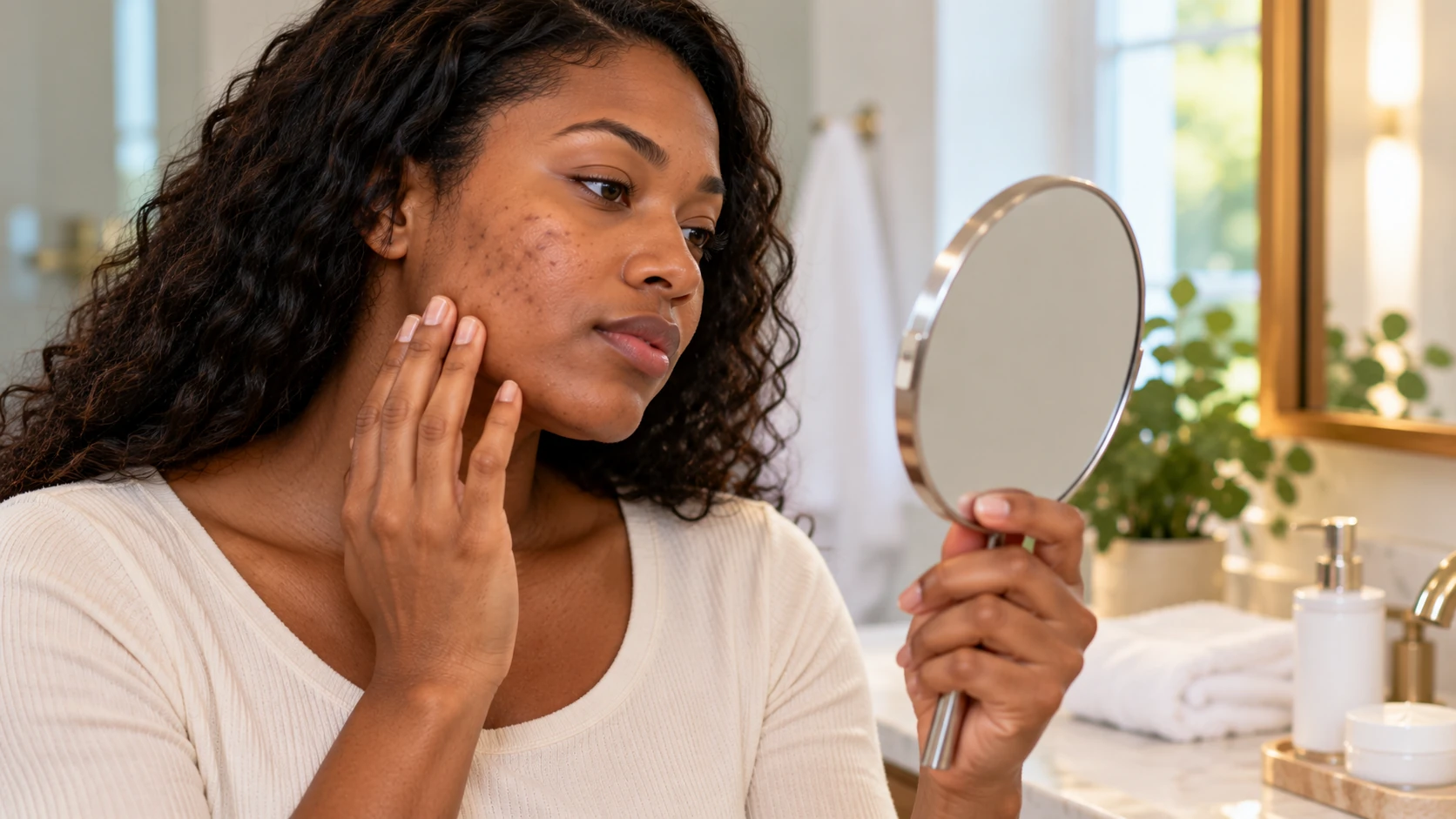
Azelaic acid has quietly become one of the most recommended ingredients in skincare — mentioned for acne, for rosacea, for dark spots, sometimes for all three at once. What gets lost in that broad popularity is that “azelaic acid” isn’t one single product. A 10% serum from the skincare aisle and the 15% or 20% prescription formulas dermatologists prescribe are genuinely different products, with different levels of evidence behind them, even though they share the same active ingredient name on a label.
This guide separates what’s actually been studied — at which strength, for which condition, in which kind of trial — from what’s simply repeated often enough to sound settled. It’s written for U.S. readers who are new to this ingredient and deciding whether and how it fits into their routine.
Azelaic acid is a naturally occurring dicarboxylic acid used in skincare for acne, rosacea, and certain kinds of discoloration. The strongest evidence sits with the FDA-approved prescription formulas: a 15% gel or foam for the inflammatory bumps of mild-to-moderate rosacea, and a 20% cream for mild-to-moderate inflammatory acne. Good trial evidence also supports a 20% concentration for melasma and for acne-related dark marks (post-inflammatory hyperpigmentation, or PIH). Over-the-counter products, often formulated around 10%, are typically marketed and classified as cosmetics rather than drugs — the FDA does regulate cosmetics, but a cosmetic-classified product generally hasn’t gone through the premarket drug-approval and efficacy-testing process that Finacea and Azelex did — and the research in this guide does not show they deliver the same results as the prescription strengths. They’re a different product, not simply “the same thing, lower dose.” Tolerability isn’t uniform: azelaic acid is reasonably well tolerated in absolute terms, but in the one direct head-to-head rosacea trial located for this guide, it actually caused more facial skin reactions than metronidazole (32% vs. 9%) despite a modest efficacy edge — so “generally milder” isn’t a safe claim to make across the board, and irritation (burning, stinging, dryness) is common enough with azelaic acid itself to expect, not rare enough to ignore. There are also real (if unquantified and uncommon) reports of skin lightening and worsened asthma. It has not been proven safe in pregnancy by controlled human studies, and current FDA labeling for the prescription products is explicit that each should be used in pregnancy only when a doctor decides it’s clearly needed — though the exact wording differs somewhat from product to product (see Pregnancy and Breastfeeding, below).
What Is Azelaic Acid?
Azelaic acid is a dicarboxylic acid that occurs naturally — it’s produced by a yeast (Malassezia furfur) that lives on normal skin, and it’s also present in whole grains like wheat, rye, and barley. In skincare and medicine, it’s used as a topical treatment, available both as an FDA-approved prescription drug (Finacea gel or foam, Azelex cream) and as an ingredient in over-the-counter products typically formulated at lower concentrations and marketed as cosmetics rather than drugs — a distinction explained in more detail below.
Three properties explain most of what azelaic acid is used for:
It has antibacterial activity. It reduces the growth of follicular bacteria associated with acne, including Cutibacterium acnes.
It mildly affects keratinization. It helps normalize how skin cells in the follicle shed and renew, which plays a role in both comedonal acne and general texture.
It inhibits tyrosinase. Tyrosinase is the enzyme that drives melanin (pigment) production. Azelaic acid’s inhibition of this enzyme is dose-dependent and reversible — a genuinely different mechanism from hydroquinone, which works differently and whose own safety profile is a separate discussion.
How Does Azelaic Acid Work?
The pigment-related mechanism is worth a closer look, because it explains an important and often-missed nuance: azelaic acid is described in the dermatology literature as sparing normal melanocytes, meaning it’s selective for overactive pigment-producing cells rather than lightening all skin uniformly. That’s the mechanistic reason it’s used for discoloration rather than as a general skin-lightening agent.
For acne and rosacea, the antibacterial and anti-keratinizing effects work together: fewer acne-causing bacteria, less of the follicular buildup that contributes to clogged pores and inflammatory lesions, which is also consistent with azelaic acid’s reduction of inflammatory lesion counts in the rosacea and acne trials described below.
Benefits of Azelaic Acid
Acne
The FDA approved 20% azelaic acid cream (Azelex) specifically for mild-to-moderate inflammatory acne vulgaris, with improvement in the majority of patients within about four weeks.¹ The American Academy of Dermatology’s current acne guidelines list azelaic acid as a conditional recommendation — a real, supported option, but not the guideline’s strongest-tier recommendation — describing its role as helping “unclog pores, kill bacteria, and fade dark spots that may continue when an acne spot clears.”² That second half of the AAD’s own description is worth sitting with: the professional guideline itself connects azelaic acid to post-acne discoloration, not just to active breakouts.
A 2020 Cochrane systematic review puts real numbers on how azelaic acid compares to other acne treatments, specifically by participant self-assessment:³
Vs. benzoyl peroxide: azelaic acid probably gives a worse response (moderate-certainty evidence).
Vs. tretinoin: probably little or no difference (moderate-certainty evidence).
Vs. clindamycin: may make little or no difference (low-certainty evidence).
Vs. adapalene: uncertain (very-low-certainty evidence — too little data to say).
So: a real option, comparable to low-strength tretinoin, generally less potent than benzoyl peroxide, but with its own tolerability profile that may make it worth trying, especially for people who don’t do well with stronger actives. If you’re building a full routine around acne-prone skin rather than just this one ingredient, our skincare routine for acne-prone skin guide covers where an ingredient like this fits alongside cleansing, moisturizing, and sun protection.
Rosacea
This is where azelaic acid has some of its strongest, most specific FDA-approved evidence — and also where the strength and formulation matter most. The FDA-approved indication is specifically for the inflammatory papules and pustules of mild-to-moderate rosacea — not rosacea’s background redness (erythema) in general. Both FDA-approved 15% products (gel and foam) carry this same, narrower indication.¹ ⁴
In the gel’s own clinical trials (two 12-week studies, 664 patients), mean inflammatory lesion counts dropped 50–58% with the 15% gel versus 38–40% with vehicle, and 61% of gel-treated patients reached a “clear, minimal, or mild” rating versus 40–48% on vehicle.¹ The foam’s separate 12-week trials showed a smaller but still real benefit over vehicle (32.1% vs. 23.4% success in one trial, 43.4% vs. 32.5% in another) — a different trial, different numbers, and not something that should be read as “the foam works the same as the gel.”⁴
A separate, industry-sponsored head-to-head trial (251 patients, 15 weeks) compared 15% azelaic acid gel directly against 0.75% metronidazole gel, a standard rosacea treatment.⁵ Azelaic acid came out modestly ahead on lesion counts, erythema improvement, and global ratings — but it also caused more facial skin reactions (32% vs. 9%) and had a lower tolerability rating (89% vs. 96% rated it tolerable). The trial’s own authors concluded both are reasonable options, and the right choice comes down to individual tolerance. A separate Cochrane review of rosacea treatments overall rates the evidence for topical azelaic acid’s effectiveness (versus vehicle) as high-quality.⁶
Hyperpigmentation — melasma and post-inflammatory hyperpigmentation are not the same thing
This is one of the places where popular skincare content tends to blur two genuinely different conditions together, and it’s worth being precise:
Melasma is a distinct condition, typically triggered by a combination of sun exposure and hormonal factors (including pregnancy, hence the old nickname “mask of pregnancy,” and oral contraceptive or hormone-therapy use). It’s more common in women and disproportionately affects people with darker skin tones.⁷ This is the condition with the strongest azelaic acid pigmentation evidence: a 2023 systematic review and meta-analysis of six randomized trials (673 patients, mostly 20% azelaic acid vs. 4% hydroquinone) found azelaic acid reduced melasma severity (MASI score) significantly more than hydroquinone, with no significant difference in adverse events — though the authors’ own conclusion was that azelaic acid “may be better,” a measured finding, not a declaration of a clear winner, and they called for larger, longer studies.⁸ A separate pooled review of 43 trials found 20% azelaic acid outperformed vehicle and 2% hydroquinone for melasma, while 3% topical tranexamic acid outperformed azelaic acid in that same pooled data.⁹
Post-inflammatory hyperpigmentation (PIH) is different: it’s discoloration left behind after skin inflammation or injury — in this context, after an acne lesion heals. Evidence specific to PIH is more limited but genuinely encouraging, and it’s worth being precise about what the numbers actually measured: a 2024 randomized, placebo-controlled trial (60 patients) found 15% azelaic acid gel significantly improved post-inflammatory redness (PIE) specifically by weeks 8 and 12, while post-inflammatory hyperpigmentation (PIH) improved in both the azelaic acid and placebo groups from baseline, with azelaic acid showing greater gains by week 12.¹⁰ The widely quoted “100% vs. 56.66%” figure from this trial is a patient-rated satisfaction measure covering PIE and PIH together — not a measure of complete pigment clearance in every patient. A separate, stricter clinical threshold (more than 60% improvement) was met by 73.33% of azelaic-acid patients versus 13.33% on placebo — a smaller, more conservative number worth citing alongside the headline figure rather than instead of it. An earlier, smaller 2011 study — described in its own title as a baseline-controlled pilot, not a placebo-controlled or clearly randomized trial — reported similar directional support for 15% gel in PIH.¹¹ Both studies used populations skewed toward lighter-to-medium skin tones (mostly Fitzpatrick type III), which is a real limitation worth naming rather than glossing over.
Darker skin tones specifically: the original evidence here is older than it might sound. A 1998 multicenter, randomized, double-masked trial (Lowe NJ, Rizk D, Grimes P, Billips M, Pincus S, Clinical Therapeutics) enrolled patients with facial hyperpigmentation specifically within Fitzpatrick phototypes IV–VI and compared 20% azelaic acid cream against its vehicle over 24 weeks, finding greater reduction in pigmentary intensity and greater global improvement with azelaic acid (both statistically significant), alongside slightly more burning and stinging early in treatment. This 1998 trial is highlighted again in a 2025 comprehensive review as one of the few studies to use darker skin tones as its actual study population rather than a secondary note¹² — worth knowing it’s a real, if decades-old, trial being freshly re-surfaced, not a brand-new 2025 study.
If dark spots or uneven tone (whatever the underlying cause) are your main concern day to day, our skincare routine for dark spots and skincare routine for uneven skin tone guides cover the fuller routine picture — including how an ingredient like this one fits alongside sunscreen, which matters for any pigmentation concern regardless of cause.
What Strength of Azelaic Acid Should You Use? (10% vs. 15% vs. 20%)
This is the single most important distinction this guide can offer, because almost none of the ranking consumer content makes it clearly: the strong evidence above is strength-specific, not evidence for “azelaic acid” as a generic category.
Strength
Status in the U.S.
What it’s actually studied for
Example products
~10% (varies by brand)
Over-the-counter cosmetic product — U.S. cosmetics are regulated by the FDA, but typically without the premarket drug-approval and efficacy-testing process required for Finacea or Azelex; classification as “cosmetic” vs. “drug” depends on a product’s intended use and marketing claims, not on concentration alone
Not the concentration used in the FDA trials or systematic reviews cited throughout this guide
Various OTC serums and creams, sold without a Drug Facts panel
15%
FDA-approved prescription drug (Finacea Gel, Finacea Foam)
Inflammatory papules/pustules of mild-to-moderate rosacea; also studied for acne-related PIH/PIE
Finacea Gel 15%, Finacea Foam 15%
20%
FDA-approved prescription drug (Azelex Cream); also the concentration used in most melasma and darker-skin-tone pigmentation trials
A product “containing azelaic acid” at an unlisted or low percentage is not automatically a weaker dose of the same proven treatment — it’s often classified in a different regulatory category altogether. U.S. cosmetics are still subject to FDA oversight, but a product marketed as a cosmetic generally hasn’t gone through the premarket drug-approval and efficacy-testing process that Finacea and Azelex did — and that classification depends on the product’s intended use and the claims made for it, not on the percentage listed on the label. AvaFitCare’s salicylic acid guide explains this same cosmetic-vs-drug distinction in more depth for that ingredient. The research gathered for this guide did not find a direct trial comparing a 10% OTC product against the 15%/20% prescription strengths for any of these conditions — so treat “10% should work similarly, just more gently” as a reasonable-sounding assumption, not a tested finding.
It’s also worth noting that Finacea Gel and Finacea Foam, despite sharing the same 15% concentration and the same FDA-approved rosacea indication, are not interchangeable: the foam is a pressurized, flammable aerosol product with its own application instructions (shake before use, avoid occlusive dressings), and its FDA label currently uses more cautious pregnancy and lactation language than the gel’s label does. Two products, same active ingredient and strength, genuinely different labeling in places — which is a useful reminder that “azelaic acid” alone never tells the whole story about a specific product.
Azelaic Acid Products to Consider
The three products below are cosmetic-positioned 10% azelaic acid products — not the FDA-approved 15%/20% prescription formulas discussed throughout this guide, and not interchangeable with them. They’re included as concrete, verified examples of what’s actually available to U.S. consumers at the OTC strength, not as a claim that any of them matches the prescription-strength trial results above.
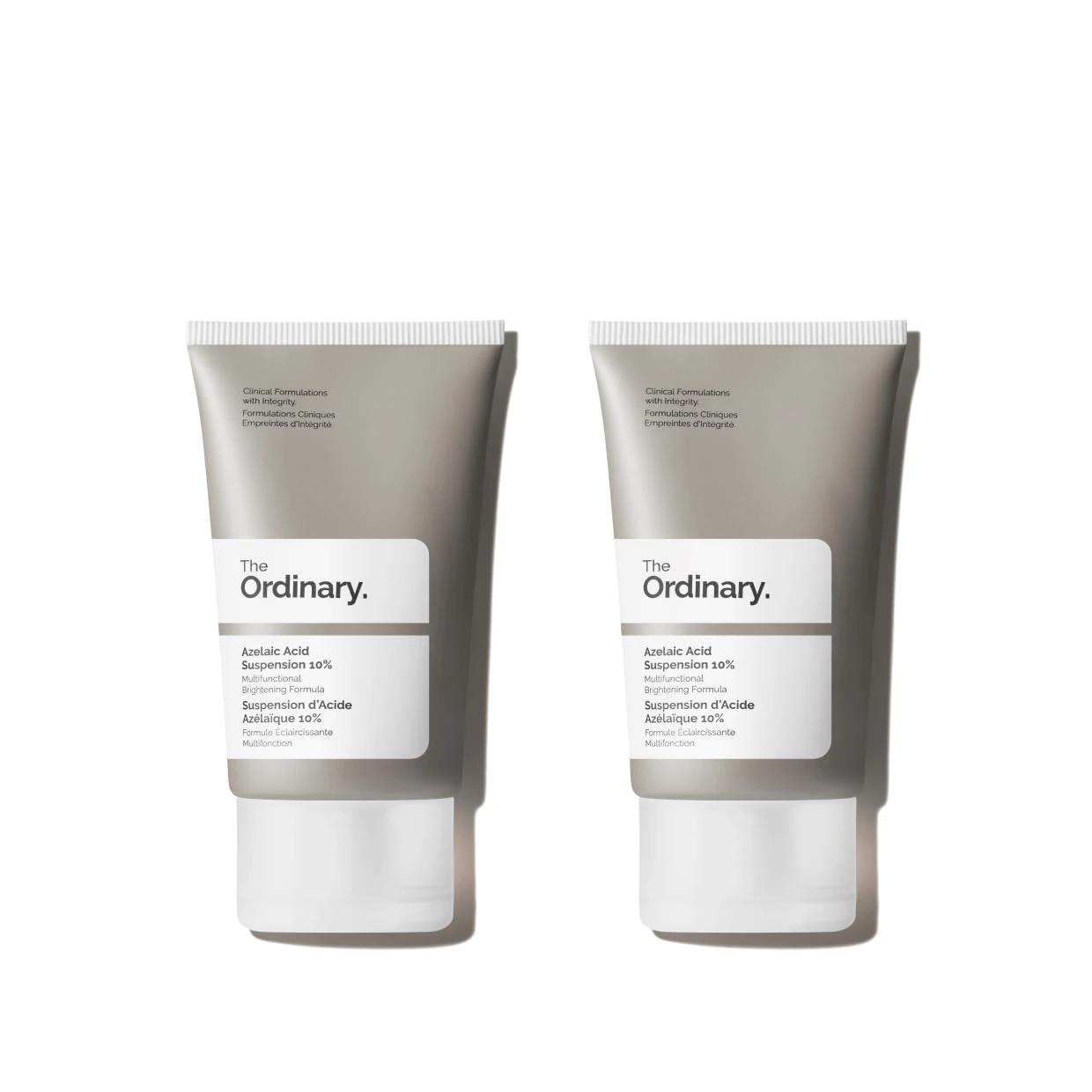
The Ordinary — Azelaic Acid Suspension 10%
The Ordinary’s Azelaic Acid Suspension 10% is a silicone-forward, cream-like formula built around a single primary active — 10% azelaic acid, confirmed directly in the product’s current official ingredient list, with tocopherol (vitamin E) as the only other notable active. It’s a minimalist option for someone who wants to add azelaic acid without a second treatment-level ingredient riding along. The texture is silicone-based, so it can feel heavy or pill under certain other products, and the brand’s own site lists real combination restrictions — it specifically advises against layering this with copper peptides, direct acids, direct vitamin C, retinoids, and several other named Ordinary products in the same routine. That’s worth knowing before building it into an already-active-heavy routine; it isn’t universally compatible with everything else on a shelf.
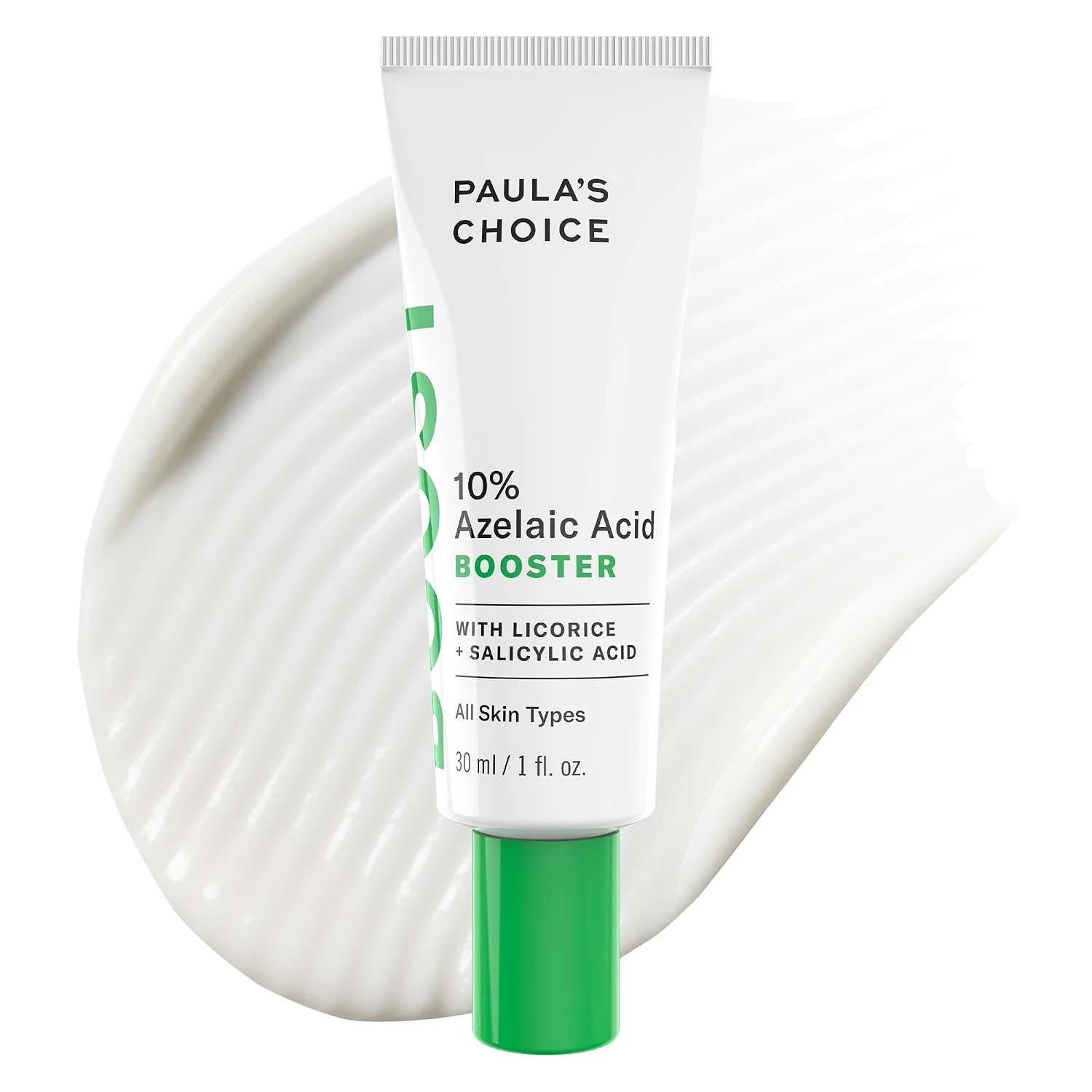
Paula’s Choice markets this as a “Booster” — a concentrated cream meant to be used alone or mixed into another moisturizer or serum. It’s a multi-active formula, not a single-ingredient azelaic acid product: alongside 10% azelaic acid, its current official ingredient list also includes salicylic acid (a BHA, concentration not disclosed), plus adenosine, licorice root extract, allantoin, and bisabolol. For someone who wants azelaic acid and a mild exfoliating acid in one step, that combination can simplify a routine — but it also means this isn’t the product to reach for if the goal is isolating azelaic acid’s effects specifically, and anyone already using a separate salicylic acid or other exfoliating-acid product should factor in the overlap rather than stacking both at full strength right away. People with a known salicylate sensitivity should also note that this isn’t a “plain” azelaic acid formula.
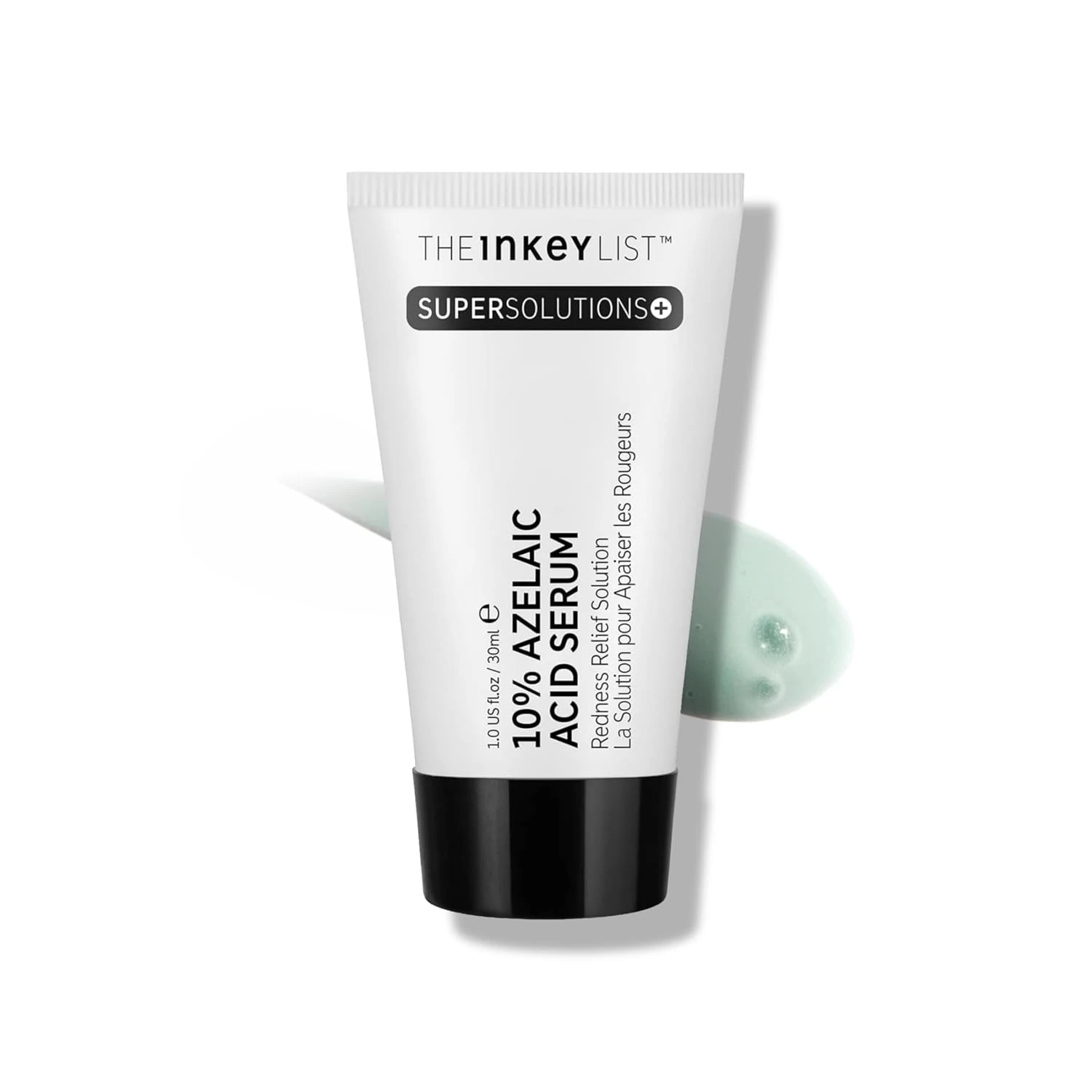
The INKEY List — 10% Azelaic Acid Serum for Redness Relief
The INKEY List’s entry is a lightweight serum built around a shorter ingredient list than the other two: 10% azelaic acid plus 0.3% allantoin for soothing, with gardenia extracts providing a cosmetic green tint (a visual effect, not a treatment mechanism). Its redness-focused marketing and simpler formula make it a reasonable fit for someone whose main interest is visible redness, or who wants fewer added ingredients overall. One important caveat: the brand’s own marketing includes claims like “clinically proven to minimize redness in 4 days” and “91% agree skin was instantly soothed,” based on small, brand-commissioned studies (22 participants) rather than independently replicated clinical research — worth knowing as a brand-reported claim, not an independently confirmed one. And to be clear, a cosmetic-positioned 10% serum like this one is not equivalent to, and shouldn’t be substituted for, the FDA-approved prescription 15% Finacea Gel or Foam discussed earlier in this guide for actual rosacea bumps and pustules.
A fragrance-free, redness-focused 10% azelaic acid serum with a short ingredient list; brand clinical claims are based on small, brand-commissioned studies.
None of these three is presented as “best” — they differ in format (suspension, booster, serum) and in what they’re combined with (nothing extra, a BHA, a soothing-only complex), and which one fits depends on what’s already in your routine and what you’re trying to address.
Azelaic Acid vs. Other Options
Ingredient
Typical strength studied
How it compares to azelaic acid
Who it may suit better
Benzoyl peroxide (for acne)
3% (in combination with clindamycin 1%, in the cited trial)
Outperformed azelaic acid 20% for acne lesion reduction in pooled trial data³ ⁹
Someone prioritizing maximum acne-lesion reduction who tolerates benzoyl peroxide’s dryness
Tretinoin (for acne)
0.05%
Probably little or no difference vs. azelaic acid 20% (moderate-certainty evidence)³
Either is a reasonable starting point; tolerance and other goals (e.g., anti-aging interest) may decide
Metronidazole (for rosacea)
0.75% gel
Azelaic acid 15% gel showed a modest efficacy edge in one 251-patient head-to-head trial, but caused more skin reactions (32% vs. 9%) and was rated less tolerable⁵
Someone prioritizing tolerability over the modest extra efficacy edge may prefer metronidazole
Hydroquinone (for melasma)
2–4%
Azelaic acid 20% reduced melasma severity more in a 2023 meta-analysis, though the finding is described as “may be better,” not definitive⁸ ⁹
Hydroquinone remains a standard comparator and may still suit people who don’t respond to or tolerate azelaic acid
Tranexamic acid (topical, for melasma)
3%
Outperformed azelaic acid 20% in pooled trial data for melasma⁹
Worth discussing with a dermatologist as an alternative if melasma is the primary concern
Not a head-to-head efficacy comparison — see “What Can You Use With Azelaic Acid?” below
Often layered together rather than chosen instead of one another
How to Use Azelaic Acid
Follow your specific product’s own label first. A prescription gel, a prescription foam, and an OTC cosmetic serum are regulated, formulated, and labeled differently, and their own instructions take priority over any general description here.
Frequency: clinical guidance for the prescription products generally starts once daily, building to twice daily as tolerated. Improvement in acne trials was typically noted within about four weeks; rosacea trials assessed results over 12 weeks, and the PIH trial discussed above assessed results over 12 weeks as well, with continued improvement from week 8 to week 12.¹ ¹⁰ Don’t expect results in days — give it several weeks to months of consistent use before judging whether it’s working for you.
Morning or night: no source reviewed for this guide requires one over the other. If you use it in the morning, pair it with daily sunscreen as a matter of routine (not because azelaic acid itself carries a specific sun-sensitivity warning distinct from general sun-protection practice); if you prefer night use, that’s equally reasonable. For help deciding where it fits in a full routine, see our morning skincare routine and night skincare routine guides for beginners.
Introducing it: because irritation (burning, stinging, dryness) is common enough to expect rather than unusual — the PIH trial above saw it in two-thirds of treated patients, though it was mild and resolved quickly for most — introducing it gradually and pairing it with a basic moisturizer is a reasonable, low-risk approach, especially if you have sensitive skin.
No dedicated combination RCT was located in this research. AvaFitCare’s own retinol guide already describes azelaic acid as “one of the gentlest actives” to pair with retinol — a tolerability-based, consensus-level statement, not a clinical-trial finding
Many people use them without issue; if you’re new to either, introducing one at a time is still the lower-risk approach
No documented incompatibility found; AvaFitCare’s niacinamide guide already lists azelaic acid as “generally compatible”
Fine to combine in the same routine
Vitamin C
Likely yes
No dedicated combination RCT located for this specific pairing
If irritation-prone, separating them (one AM, one PM) is a reasonable comfort choice rather than a proven requirement
Benzoyl peroxide
Likely yes, with attention to cumulative dryness
No dedicated combination-safety RCT located; both are independently well-studied as acne treatments, including head-to-head against each other (see comparison table above)
Alternating rather than maximum-strength layering immediately is a sensible starting approach
Same cautious, gradual-introduction approach applies
The honest summary: azelaic acid is reasonably well tolerated in general use, which is a reasonable basis for it being a layering-friendly ingredient in practice, and that’s consistent with how AvaFitCare’s existing retinol and niacinamide guides already describe it. But “reasonably well tolerated” isn’t the same as “milder than everything else” — in the one direct head-to-head trial in this guide’s evidence (azelaic acid vs. metronidazole for rosacea), azelaic acid actually caused more facial skin reactions, not fewer. None of these layering-specific claims come from a dedicated trial testing that exact combination, either — they’re reasonable, consensus-level guidance, not settled research findings, and this guide isn’t going to present them as more certain than they are.
Potential Side Effects
Across the FDA labels and trials reviewed for this guide, the most consistently reported side effects are burning, stinging, tingling, itching, dryness, scaling, and redness — reported in the Finacea gel trials at rates up to 29% for burning/stinging alone, and in roughly two-thirds of patients (with mild severity) in the 2024 PIH trial.¹ ¹⁰ These typically show up early and often ease with continued use or a brief pause.
Less common, but reported independently across multiple FDA labels (Finacea gel, Finacea foam, and Azelex) and a Cochrane review background section: temporary skin lightening (hypopigmentation), with labeling specifically advising extra monitoring for people with darker complexions, and worsening of asthma symptoms in rare cases.¹ ³ ⁴ None of the sources reviewed for this guide give a specific numeric rate for either of these two effects, so treat them as real, reported, and worth knowing about — not as common outcomes.
Rare but serious postmarketing reports for the prescription gel include angioedema, facial or eye swelling, hives, difficulty breathing, and eye irritation from accidental contact.¹ Stop use and seek medical attention for any of these.
Who Should Be More Cautious?
Known hypersensitivity to azelaic acid or to a specific formulation’s other ingredients is a contraindication stated directly on the FDA labels.
Very sensitive skin or eczema may be more prone to irritant contact dermatitis — not an absolute reason to avoid it, but a reason to introduce it more gradually and keep expectations realistic about some initial irritation.
A history of asthma is worth mentioning to your doctor before starting, given the repeated, independent (if unquantified) signal across multiple product labels.
Darker skin tones are in a genuinely two-sided position worth stating plainly: azelaic acid is specifically used for pigmentation concerns that disproportionately affect darker skin (melasma, PIH), and a 1998 randomized trial specifically in Fitzpatrick IV–VI patients showed real benefit for facial hyperpigmentation — but hypopigmentation is also a labeled risk that’s “more noticeable” in darker skin tones. Both facts are true at once, and neither cancels the other out; this is a reasonable topic to discuss with a dermatologist who can assess your specific skin.
Pregnancy and Breastfeeding
This deserves precision rather than reassurance, and the available sources aren’t identical to each other — worth laying out rather than flattening into one tidy answer.
Pregnancy: Finacea Gel’s current FDA label states azelaic acid is minimally absorbed systemically and that “maternal use is not expected to result in fetal exposure to the drug,” based on absorption data and animal studies showing embryotoxicity only at maternally toxic doses, with no malformations observed. Finacea Foam’s label, for the same 15% active ingredient and the same approved indication, is written in more cautious terms — it uses the older Pregnancy Category B language and states plainly that “there are no adequate and well-controlled studies in pregnant women,” recommending use only if the potential benefit justifies the potential risk. Azelex’s (20% cream) label is similarly cautious: “this drug should be used during pregnancy only if clearly needed,” with the same note that no adequate controlled human studies exist. None of this amounts to a “proven safe in pregnancy” claim, and a separate 2025 review’s statement that topical azelaic acid “is considered safe during pregnancy” rests on a single, less rigorously documented citation rather than a dedicated controlled study — this guide isn’t adopting that more reassuring framing over what the actual FDA labels say. If you’re pregnant or trying to conceive, this is a conversation for your OB-GYN or dermatologist, not a decision to make from a product label alone.
Breastfeeding: azelaic acid occurs naturally in the body, in food, and in breastmilk, and only about 4% of a topically applied dose is absorbed at all, which is the basis for it being considered a low risk to a nursing infant. That said, it hasn’t been specifically studied during breastfeeding, and needing to use it isn’t considered a reason to stop breastfeeding. The practical guidance: don’t apply it to the breast or nipple area, keep your infant’s skin from contacting treated areas, and prefer water-miscible creams or gels (rather than ointments) for anything used near the chest. Azelex’s own label is somewhat more cautious in tone here too, noting that passage into breast milk “may occur” and advising caution in nursing mothers — another example of labels for different azelaic acid products not being perfectly identical in how carefully worded they are.
As with any pregnancy or breastfeeding question, treat this section as a starting point for a conversation with your own doctor, not a final answer.
Common Azelaic Acid Myths
“Azelaic acid is azelaic acid, no matter the percentage.” Not supported by the evidence in this guide. The strongest trial data is strength-specific — 15% for rosacea, 20% for acne and melasma — and a 10% OTC product hasn’t been shown to deliver the same results.
“OTC azelaic acid works the same as the prescription version.” Not something this research found support for. OTC products are typically marketed as cosmetics rather than drugs — which changes what premarket testing they’ve gone through, even though the FDA still regulates cosmetics generally — and no direct comparison trial between OTC-strength and prescription-strength azelaic acid was located.
“Azelaic acid is proven better than hydroquinone for pigmentation.” Overstated. The best available meta-analysis found azelaic acid “may be better” for melasma severity specifically — a real, worth-noting finding, but not the same as a settled, one-sided verdict.
“Melasma and post-acne dark spots are the same thing, treated the same way.” Not accurate. They’re different conditions with different triggers, and the evidence quality differs — melasma has stronger azelaic acid trial data than PIH does.
“You can’t combine azelaic acid with retinol or niacinamide.” Overstated. No evidence located here supports a hard incompatibility; both of AvaFitCare’s own retinol and niacinamide guides already describe azelaic acid as generally compatible, though that’s based on tolerability reasoning rather than a dedicated trial.
“Azelaic acid is too gentle to cause irritation.” Not accurate. It’s comparatively well tolerated in some head-to-head trials, but irritation (burning, stinging, dryness) is common enough in the actual trial data that it should be expected, not dismissed as impossible.
Frequently Asked Questions
It has antibacterial, mild keratinization-normalizing, and pigment-regulating (tyrosinase-inhibiting) effects, which is why it shows up in acne, rosacea, and discoloration treatments.
Not necessarily. Most OTC products are formulated around 10% and sold as cosmetics; the FDA-approved prescription products are 15% (Finacea gel or foam, for rosacea) or 20% (Azelex cream, for acne) and have gone through drug-approval trials those OTC products haven’t.
15% and 20% are the FDA-approved prescription strengths with the clinical trial evidence described throughout this guide; 10% is a common OTC cosmetic strength without that same regulatory testing behind it. Higher isn’t automatically “better” for your specific skin, but it does mean a different evidence base.
Its FDA-approved indication is specifically for the inflamed bumps (papules and pustules) of mild-to-moderate rosacea — not a general erythema/redness treatment, per the FDA label’s own wording.
In pooled trial data, azelaic acid 20% was generally less effective than benzoyl peroxide (including benzoyl peroxide/clindamycin combinations) for acne, though it’s still a legitimate option, especially for people who don’t tolerate benzoyl peroxide well.
It depends which kind. There’s solid trial evidence for melasma at 20% and encouraging, if more limited, trial evidence for acne-related post-inflammatory hyperpigmentation at 15%. It’s not a universal “dark spot eraser” regardless of cause.
Melasma is a distinct condition linked to sun exposure and hormonal factors, more common in women and in darker skin tones. PIH is discoloration left behind after skin inflammation or injury, such as a healed acne lesion. They can look similar but aren’t the same thing, and the research behind azelaic acid differs for each.
Generally yes, based on tolerability reasoning and existing guidance rather than a dedicated combination trial. Many people use both without major issues.
Likely yes for both; no documented incompatibility was found in this research, though dedicated combination trials for these specific pairings weren’t located either.
Burning, stinging, tingling, itching, dryness, and redness — generally mild and often easing with continued use, but common enough that you should expect some adjustment period.
Temporary hypopigmentation has been reported, independently, across multiple FDA labels, and labeling specifically recommends closer monitoring for people with darker complexions. An exact rate isn’t given in the sources reviewed for this guide.
Not something current FDA labeling describes as proven safe. Labels differ somewhat in tone, but all note the absence of well-controlled human studies in pregnant people, and recommend use only when a doctor determines it’s clearly needed.
Considered low risk based on minimal (about 4%) absorption and azelaic acid’s natural presence in the body, though it hasn’t been specifically studied during breastfeeding. Avoid applying it to the breast or nipple area.
Acne improvement has been reported within about four weeks for many patients; rosacea and pigmentation trials generally assessed results over 12 weeks or longer. Give it a realistic, multi-week trial before judging results.
It’s often described as comparatively gentle, but it isn’t irritation-free — introducing it gradually, alongside a basic moisturizer, is a reasonable approach if you have sensitive skin.
Bottom Line
Azelaic acid is a genuinely well-evidenced ingredient — just not as one single thing. The FDA-approved prescription strengths (15% for rosacea, 20% for acne) carry real clinical trial data behind specific, narrower indications than “clears up your skin” marketing language suggests, and the strongest pigmentation evidence is specific to melasma, with encouraging but more limited evidence for acne-related dark marks. A 10% OTC serum shares the name but not the evidence base. It’s reasonably well tolerated compared to some alternatives, but irritation is common enough to expect, not rare enough to ignore, and its pregnancy and breastfeeding picture calls for a conversation with your doctor rather than a confident yes or no from a label alone. Used with realistic expectations about which strength does what, it’s a solid, well-studied option — not a cure-all, and not interchangeable across every product that lists it on an ingredient panel.
This guide was researched using current FDA prescribing information for Finacea Gel 15%, Finacea Foam 15%, and Azelex Cream 20%; the American Academy of Dermatology’s 2024 acne management guidelines; two Cochrane systematic reviews (on topical acne treatments and on rosacea interventions); a 2023 systematic review and meta-analysis specifically comparing azelaic acid to hydroquinone for melasma; a 2023 pooled systematic review of 43 randomized trials across acne, rosacea, and melasma; one randomized, placebo-controlled trial (2024) and an earlier, smaller 2011 baseline-controlled pilot study, both on azelaic acid for acne-related post-inflammatory hyperpigmentation; a 2025 comprehensive pharmacological review that re-surfaces a 1998 randomized, double-masked trial conducted specifically in Fitzpatrick IV–VI (darker) skin tones; and NIH LactMed’s breastfeeding guidance (accessed via a content mirror after the primary NCBI Bookshelf page was not fully retrievable in this research pass — flagged rather than silently smoothed over). Where sources disagreed in tone — most notably, the different pregnancy-language wording across Finacea Gel’s, Finacea Foam’s, and Azelex’s own FDA labels — this guide reports that disagreement rather than picking whichever version sounds more reassuring. This guide does not claim clinical or dermatologist review and is not a substitute for personalized medical advice, particularly for pregnancy, breastfeeding, persistent irritation, or any skin condition that hasn’t responded to consistent use.
Medical Disclaimer IncludedClearly marked below — this guide is educational, not personalized medical advice.
Read our Review Policy for a plain explanation of what our review process does — and doesn't — mean for health-adjacent content.
Sources & Further Reading
U.S. Food & Drug Administration — Finacea (azelaic acid) Gel, 15% prescribing information. accessdata.fda.gov
American Academy of Dermatology — “American Academy of Dermatology issues updated guidelines for the management of acne” (2024). aad.org; full guideline: Reynolds RV, et al., “Guidelines of care for the management of acne vulgaris,” Journal of the American Academy of Dermatology, 2024. jaad.org
Liu H, Yu H, Xia J, Liu L, Liu GJ, Sang H, Peinemann F — “Topical azelaic acid, salicylic acid, nicotinamide, sulphur, zinc and fruit acid (alpha-hydroxy acid) for acne,” Cochrane Database of Systematic Reviews, 2020;5:CD011368. doi.org/10.1002/14651858.CD011368.pub2
U.S. Food & Drug Administration — Finacea Foam (azelaic acid), 15% prescribing information. accessdata.fda.gov
American Academy of Family Physicians — summary of a randomized trial comparing 15% azelaic acid gel and 0.75% metronidazole gel for papulopustular rosacea, American Family Physician, 2004. aafp.org
van Zuuren EJ, et al. — “Interventions for rosacea,” Cochrane Database of Systematic Reviews, 2015;CD003262.pub5, as summarized by Cochrane’s featured-review page. cochrane.org
Duly Health and Care — “Post Inflammatory Hyperpigmentation v. Melasma: What’s the Difference?” (patient-education summary used for the PIH-vs-melasma distinction). dulyhealthandcare.com
Albzea W, AlRashidi R, Alkandari D, et al. — “Azelaic Acid Versus Hydroquinone for Managing Patients With Melasma: Systematic Review and Meta-Analysis of Randomized Controlled Trials,” Cureus, 2023;15(7):e41796. doi.org/10.7759/cureus.41796
King S, et al. — “A systematic review to evaluate the efficacy of azelaic acid in the management of acne, rosacea, melasma and skin aging,” Journal of Cosmetic Dermatology, 2023. doi.org/10.1111/jocd.15923
Shucheng H, Zhou X, Du D, Li J, Yu C, Jiang X — “Effects of 15% Azelaic Acid Gel in the Management of Post-Inflammatory Erythema and Post-Inflammatory Hyperpigmentation in Acne Vulgaris,” Dermatology and Therapy, 2024;14:1293–1314. doi.org/10.1007/s13555-024-01176-2
“Efficacy and safety of azelaic acid (AzA) gel 15% in the treatment of post-inflammatory hyperpigmentation and acne: a 16-week, baseline-controlled study,” Journal of Drugs in Dermatology, 2011;10(6):586–590. pubmed.ncbi.nlm.nih.gov/21637899
Petrovici A-G, Spennato M, Bîtcan I, Péter F, Cotarcă L, Todea A, Ordodi VL — “A Comprehensive Review of Azelaic Acid Pharmacological Properties, Clinical Applications, and Innovative Topical Formulations,” Pharmaceuticals, 2025;18(9):1273. doi.org/10.3390/ph18091273 — this 2025 review discusses the original darker-skin-tone trial: Lowe NJ, Rizk D, Grimes P, Billips M, Pincus S, “Azelaic acid 20% cream in the treatment of facial hyperpigmentation in darker-skinned patients,” Clinical Therapeutics, 1998;20(5):945–959, doi:10.1016/S0149-2918(98)80076-3.
U.S. Food & Drug Administration — Azelex (azelaic acid) Cream, 20% prescribing information. accessdata.fda.gov
Affiliate Disclosure: This article contains affiliate links. If you buy through these links, AvaFitCare may earn a commission on qualifying purchases at no additional cost to you. Product selection and descriptions on this page are based on verified manufacturer information, not on affiliate relationships — affiliate participation does not influence which products are included or how they are described, and the article’s medical and scientific conclusions are not affected by, and do not depend on, any affiliate relationship.
This article is for general informational and educational purposes only and is not a substitute for professional medical advice, diagnosis, or treatment. It does not create a doctor-patient relationship. Always seek the advice of a dermatologist, physician, or other qualified healthcare provider with any questions you may have regarding a medical condition, pregnancy or breastfeeding, a known drug allergy, or persistent skin irritation.
Get New Guides in Your Inbox
No spam, no filler — just new articles as we publish them.