A lot of nighttime skincare advice makes it sound like bedtime requires a ten-product ritual. For most beginners, it doesn’t. This guide walks through what a basic nighttime routine actually needs, what order to do it in, how to handle makeup and sunscreen removal, and which extra steps are genuinely optional versus which ones matter more than people expect.
In This Guide
- Quick Answer
- Key Takeaways
- What Is a Good Night Skincare Routine for Beginners?
- Night Skincare Routine Order
- Do You Need to Wash Your Face Before Bed?
- How Should You Remove Makeup and Sunscreen at Night?
- Do You Need to Double Cleanse Every Night?
- Is Cleanser and Moisturizer Enough at Night?
- Do You Need Toner at Night?
- Do You Need a Serum at Night?
- Do You Need a Separate Night Cream?
- Do You Need Eye Cream at Night?
- How Long Should You Wait Between Nighttime Skincare Steps?
- The Simplest Night Skincare Routine When You’re Tired
- Night Skincare Routine by Skin Type
- Common Nighttime Skincare Mistakes
- Night Skincare Routine Checklist
- Frequently Asked Questions
- Bottom Line
- Why You Can Trust This Guide
- Sources
- Medical Disclaimer
Quick Answer
A basic nighttime skincare routine for beginners can be built around two core steps — cleanse and moisturize — plus two optional ones: removing makeup or heavy sunscreen first if you’re wearing either, and an optional treatment or serum. For a lot of people, "cleanse, then moisturize" is a complete, legitimate nighttime routine. Whether you need a separate first cleansing step depends mainly on what’s on your skin at the end of the day, not on a fixed rule that applies to everyone.
Key Takeaways
- The core nighttime routine is cleanse, then moisturize. Everything else is optional.
- Double cleansing (a makeup/sunscreen-dissolving step before your regular cleanser) can be genuinely useful for heavy makeup or thick, water-resistant sunscreen, but it isn’t a universal requirement for every person, every night.
- Toner, serum, eye cream, facial oil, and a dedicated "night cream" are all optional add-ons, not requirements.
- There’s no scientifically fixed number of seconds to wait between skincare steps — follow the product’s own directions.
- A suitable regular moisturizer works fine at night for most people; a separately labeled night cream isn’t required to get a functional routine.
What Is a Good Night Skincare Routine for Beginners?
A good nighttime routine is one you’ll actually do consistently, not the longest one you can build. This article goes deeper into the nighttime-specific decisions that a broader routine guide only briefly covers — what to do about makeup and sunscreen, whether double cleansing is necessary, and which of the many "recommended" nighttime products are actually optional. If you haven’t already, our broader beginner skincare guide covers the full picture, morning and night together, along with the basics of identifying your skin type and building a routine from scratch.
The short version for nighttime specifically: figure out whether anything needs to come off your skin before you cleanse (makeup, sunscreen, a full day of product and environmental buildup), cleanse, and moisturize. Anything beyond that should be added because you have a specific reason to add it — not because a routine with only two steps feels incomplete.
Night Skincare Routine Order
Label: Prep → Cleanse → Optional Treatment → Moisturize
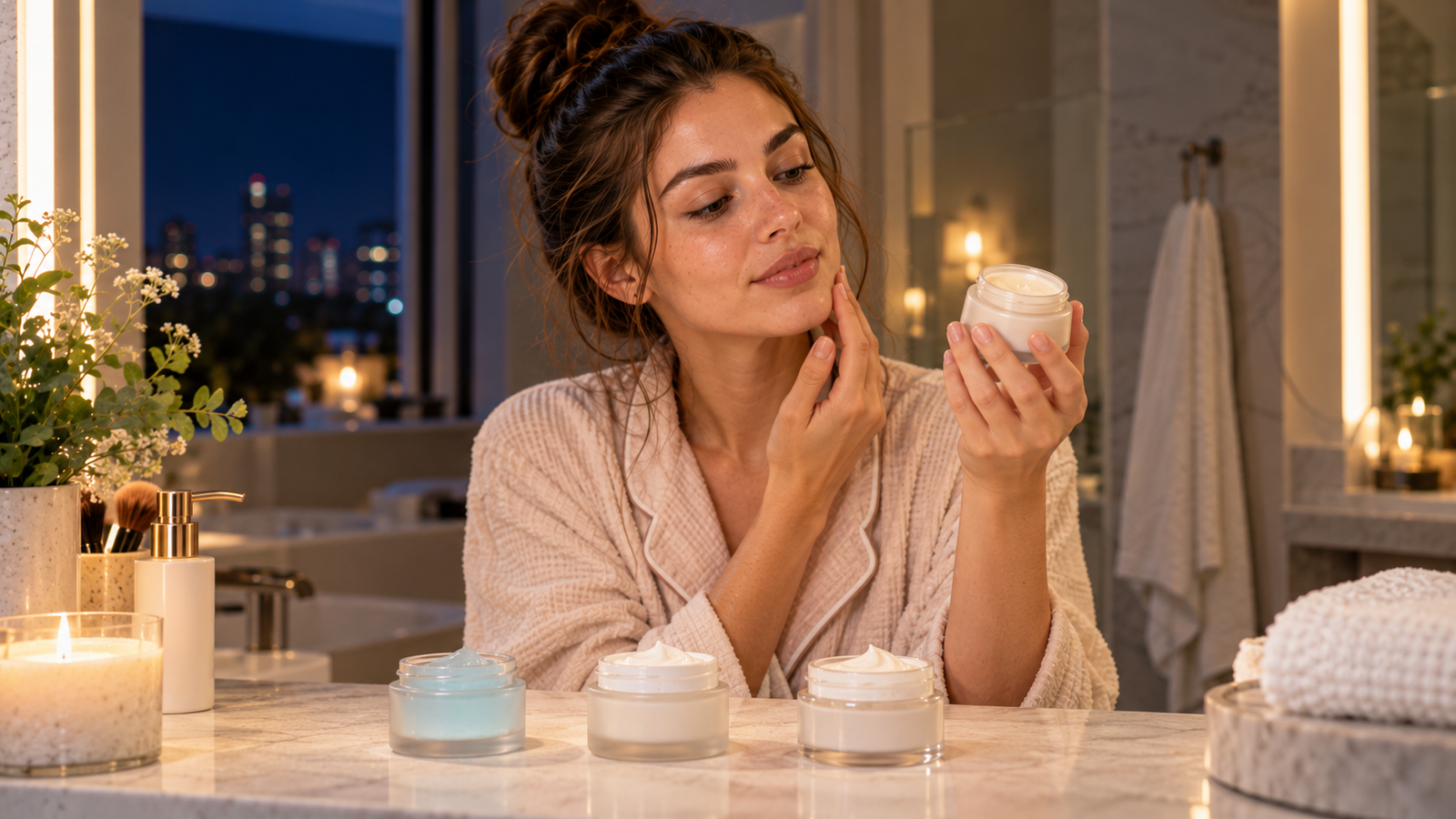
A basic nighttime routine follows a simple order — only cleansing and moisturizing are required.
01
Remove Makeup or Sunscreen If Needed
If you wore makeup or a heavier, water-resistant sunscreen during the day, this is where you deal with it — either as a distinct first step or as something your regular cleanser handles on its own. More on how to judge this in the sections below.
02
Cleanse
A gentle, non-abrasive cleanser applied with your fingertips, rinsed with lukewarm water. Cleansing at night helps remove the day’s buildup, along with sunscreen and makeup when you’ve worn them.
03
Optional Treatment or Serum
Skip this step unless you have a specific product and a specific reason to use it — persistent breakouts, visible dullness, fine lines you’re actively addressing. A beginner routine doesn’t need a treatment step to be complete.
04
Moisturize
A moisturizer suited to your skin type, applied after cleansing (and after a treatment, if you’re using one). This is the second core step, alongside cleansing.
Notice that isn’t a mandatory four-product list — it’s a decision tree. For many beginners, especially on a day without makeup or heavy sunscreen, the real routine is just cleanse and moisturize.
Do You Need to Wash Your Face Before Bed?
For most people, yes, on a normal basis. The American Academy of Dermatology’s general guidance is to limit face-washing to twice a day — once in the morning, once at night — plus after heavy sweating. Skipping the nighttime wash occasionally isn’t a catastrophe, but going to bed without cleansing regularly leaves the day’s sunscreen, oil, and any makeup sitting on your skin overnight, which is the main reason the nighttime cleanse tends to matter more than the morning one for a lot of people.
When you do cleanse, the technique matters more than the product lineup: a gentle, non-abrasive, alcohol-free cleanser, applied with your fingertips rather than a washcloth or sponge, using lukewarm (not hot) water, followed by patting — not rubbing — your skin dry. Scrubbing or over-washing doesn’t get your skin "more clean"; it mostly just irritates it.
How Should You Remove Makeup and Sunscreen at Night?
This is where a nighttime routine genuinely differs from a morning one, and it’s worth slowing down on.
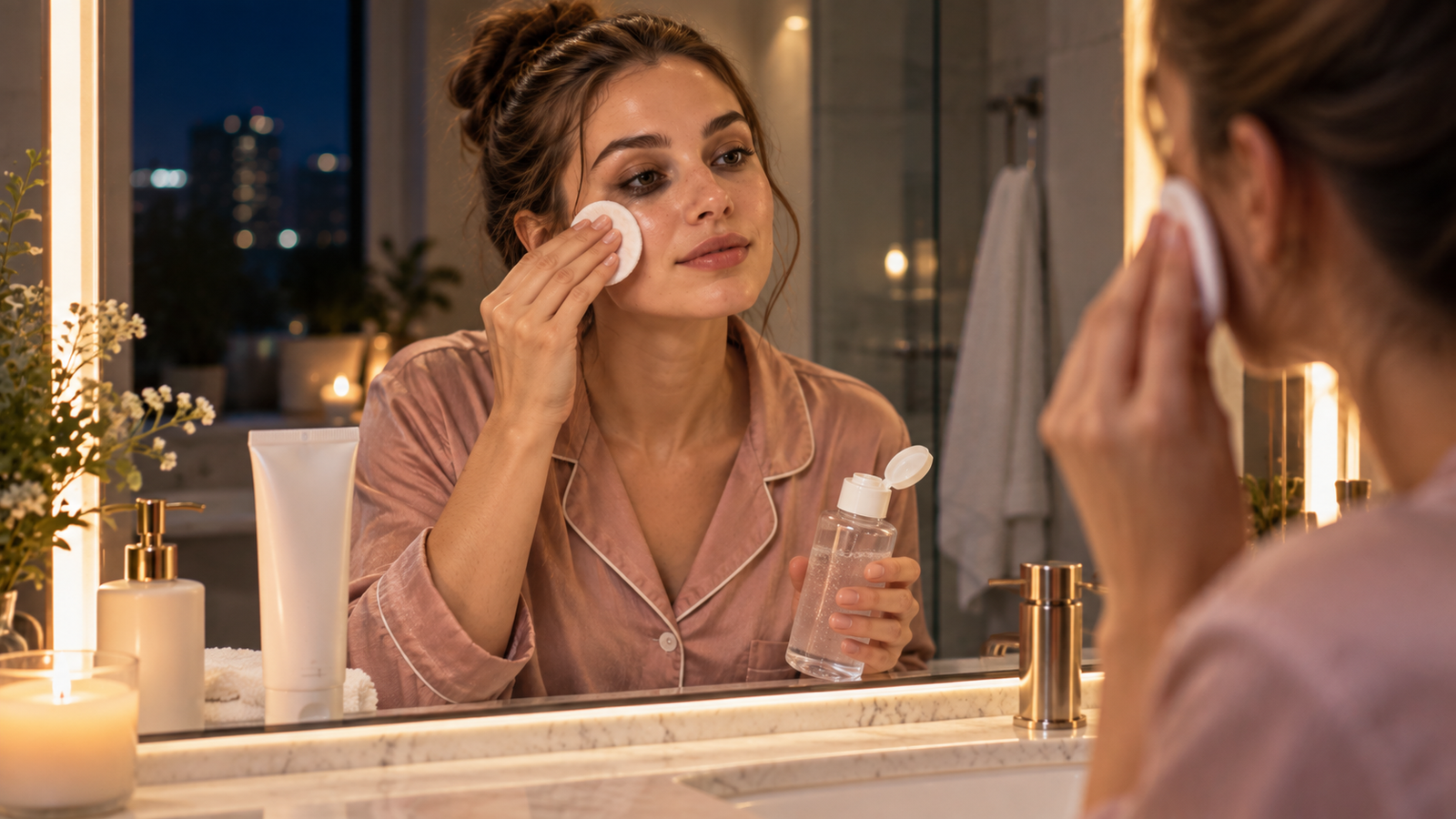
Removing makeup thoroughly is the first step for anyone who wore it during the day.
If you didn’t wear makeup or sunscreen that day, a single gentle cleanse is typically enough — there isn’t a separate layer of product sitting on your skin that needs to be broken down first.
If you wore light, everyday sunscreen and no makeup, many people find a single thorough cleanse removes it adequately. Some prefer an extra step anyway, particularly with thicker, more water-resistant, or mineral sunscreen formulas, which can be harder to fully rinse away with a single pass of a gentle cleanser.
If you wore makeup — especially long-wear, waterproof, or heavily pigmented products — a dedicated first step (a micellar water, cleansing balm, or oil-based cleanser) before your regular cleanser is genuinely useful. Foundation, waterproof mascara, and long-wear lip color are the categories most likely to leave residue behind after a single cleanse. If you’re not sure your regular cleanser is the right fit for this job, our guide to choosing a cleanser for your skin type covers what to look for.
The practical test isn’t a rule — it’s your skin. If your cleanser routinely leaves a filmy residue, if your pillowcase shows makeup or product transfer, or if a cotton pad still picks up color or tint after cleansing, that’s a sign an additional removal step would help. If your skin looks and feels clean after your regular cleanser and none of those signs show up, you likely don’t need to add one.
Do You Need to Double Cleanse Every Night?
Not automatically, but it can be a genuinely useful method in the right situation.
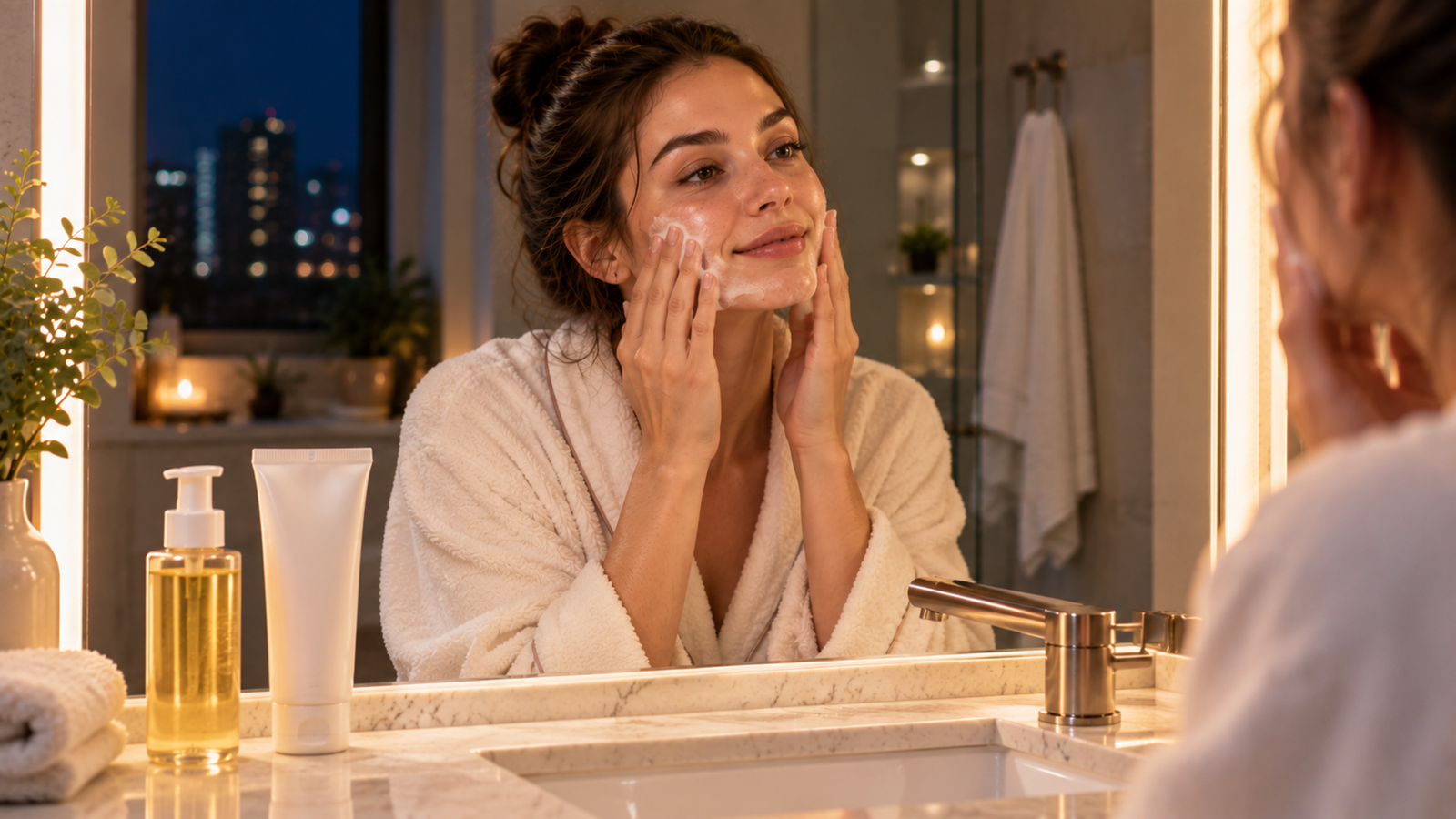
Double cleansing pairs an oil-based first cleanser with a gentle second cleanse.
Double cleansing means using a first product — usually an oil-based cleanser, cleansing balm, or micellar water — to dissolve makeup, sunscreen, and the day’s surface buildup, followed by your regular, water-based cleanser to clean the skin itself. A first-step cleanser such as a cleansing oil, balm, or micellar water can help remove makeup or more persistent sunscreen before a gentle second cleanse. How well a single cleanser works depends on the cleanser and the products being removed.
Double cleansing tends to be most useful when:
- You wore makeup, especially long-wear or waterproof formulas.
- You wore a thicker or more water-resistant sunscreen.
- Your regular cleanser routinely leaves residue behind (see the signs above).
Double cleansing is often unnecessary when:
- You didn’t wear makeup and used a light, everyday sunscreen.
- Your single cleanse already leaves your skin feeling clean with no visible residue.
- You have dry or sensitive skin that tends to react to extra cleansing steps.
If you don’t wear makeup at all, you don’t automatically need to double cleanse — the reasoning behind the method is about removing a specific layer of product, and if that layer isn’t there, there’s less for a second cleanse to do. Sunscreen alone doesn’t automatically require it either: lighter, easily rinsed formulas may come off adequately with one thorough cleanse for a lot of people, while thicker or more water-resistant formulas are more likely to benefit from an extra step. Some dermatologists recommend double cleansing routinely for anyone wearing sunscreen or makeup, as a reliable default; others treat it as one option among several, useful in specific situations rather than a nightly requirement for everyone. Because there isn’t one universal medical guideline settling this either way, it’s more accurate to treat double cleansing as a technique to reach for when you have a reason to (makeup, heavy sunscreen, visible residue) than as a mandatory nightly step.
It’s also worth being cautious about the opposite mistake: treating double cleansing as inherently better and doing it every night regardless of need. Over-cleansing — whether that’s one harsh cleanse or two unnecessary ones — can strip natural oils and irritate the skin barrier, particularly for dry or sensitive skin. More cleansing isn’t automatically better cleansing.
Is Cleanser and Moisturizer Enough at Night?
For a lot of beginners, yes. A gentle cleanser followed by a moisturizer suited to your skin type is a complete, legitimate nighttime routine — not a "starter" version of a real routine that you need to eventually upgrade. Toner, serum, treatments, eye cream, and facial oil can all add value in specific situations, but none of them are required to have a functional, skin-supporting nighttime routine. If cleanse-and-moisturize is genuinely all you do most nights, that’s a fine place to stay unless you have a specific concern a basic routine isn’t addressing.
Do You Need Toner at Night?
No, not as a required step. Older-style toners existed partly to rebalance skin pH after harsher, less pH-balanced cleansers; most modern gentle cleansers don’t leave skin needing that correction. Some toners can still be useful for a specific purpose — a hydrating toner for an extra layer of moisture, or an exfoliating toner for people specifically working on texture or congestion — but "useful for a specific goal" is different from "necessary for a basic routine." If you don’t have a specific reason to add one, skipping toner is a reasonable, complete choice.
Do You Need a Serum at Night?
No. A serum can be a good way to deliver a concentrated ingredient for a specific concern once your basic routine is established and comfortable, but it isn’t a required layer. Beginners often feel pressure to add a serum because it seems like a "real" routine should have one; a routine without one isn’t missing anything if you don’t have a specific concern you’re addressing with it.
Do You Need a Separate Night Cream?
Not necessarily. Using the same moisturizer morning and night is reasonable for most people, and there’s no requirement to buy a separate product just because it’s labeled for nighttime use. Where a difference sometimes makes practical sense is texture and formulation: a daytime moisturizer is often designed to sit comfortably under sunscreen and makeup, while a nighttime option — sometimes labeled a "night cream" — may be a bit richer or include ingredients (like retinoids or certain acids) that aren’t meant to be worn during sun exposure. Neither of those is a reason a beginner specifically needs two separate jars. If your regular moisturizer works well for your skin and isn’t formulated specifically for daytime wear (with added SPF, for example), it’s reasonable to use it both morning and night. For a fuller breakdown of how to choose one, see our guide to choosing a moisturizer for your skin type.
Do You Need Eye Cream at Night?
No, not as a required step. The skin around your eyes is thinner and more sensitive than the rest of your face, and some people prefer a lighter, specifically formulated product there. But a well-chosen regular moisturizer, applied gently around (not directly into) the eye area, is often perfectly workable for a beginner routine. Eye cream is a reasonable add-on for a specific concern — noticeable dryness or sensitivity in that area — not a default requirement.
How Long Should You Wait Between Nighttime Skincare Steps?
Less than a lot of skincare content implies, and there’s no universally fixed waiting period that applies to every product or every person. For a basic routine — a gentle cleanser followed by a moisturizer — there’s generally no need to pause between steps at all. If you’re layering an optional treatment or serum first, the most reliable guidance is to follow the directions on that specific product, since formulations vary.
If immediate layering causes pilling, tackiness, or visible product balling up on your skin, let the previous layer settle a little longer, or simplify how many products you’re using — that typically resolves it. Outside of that, there’s no need to set a timer between steps.
The Simplest Night Skincare Routine When You’re Tired
Some nights, a multi-step routine just isn’t happening, and that’s fine. Here’s the version that still counts as taking care of your skin:

On a tired night, removing makeup and a quick cleanse still count as a real routine.
1
Remove makeup if you’re wearing any
If you’re wearing makeup, remove it with a suitable makeup-removal or cleansing product before cleansing.
2
Cleanse
— a quick, gentle cleanse, even a shorter one than usual, still matters more than skipping it entirely.
3
Moisturize
— a basic layer is enough.
Skip toner, serum, eye cream, facial oil, and any treatment on nights like this. A short version of your routine, done consistently, is more useful to your skin over time than an elaborate routine you only do when you have energy for it.
Night Skincare Routine by Skin Type

Product texture, not the routine steps themselves, is what usually changes by skin type.
The core steps above stay the same for every skin type. What typically changes is product texture, whether an extra removal step is worth it, and how the skin tends to behave overnight. If you’re not sure which category fits you, our guide to determining your skin type at home walks through how to figure that out first.
Oily Skin
A lightweight, oil-free gel or gel-cream moisturizer tends to feel more comfortable than a heavier cream. Nighttime cleansing is worth being consistent about here, since oil, sunscreen, and daily buildup are more noticeable by evening. Full routine: skincare routine for oily skin.
Dry Skin
A richer, more emollient moisturizer usually feels better than a light gel. Be cautious with anything that promises extra "detox" or deep-cleansing action — dry skin is more prone to irritation from over-cleansing or unnecessary double cleansing. Full routine: skincare routine for dry skin.
Combination Skin
A medium-weight moisturizer across the whole face is a reasonable starting point, with some people preferring a lighter layer on the T-zone specifically. Whether an extra removal step is worth it at night often depends on how much oil and product has built up by evening. Full routine: skincare routine for combination skin.
Sensitive Skin
Keeping the nighttime routine simple tends to help. A fragrance-free, minimal-ingredient cleanser and moisturizer are worth considering, and it’s reasonable to skip an extra cleansing step unless there’s a clear reason for it, since more steps mean more opportunity for irritation. If a product causes stinging, burning, or a rash, stop using it and consider checking in with a dermatologist. Full routine: skincare routine for sensitive skin.
Acne-Prone Skin
A lightweight, non-comedogenic moisturizer is worth prioritizing, and thorough — not harsh — nighttime cleansing matters, since leftover sunscreen, oil, and makeup can contribute to clogged pores overnight. That doesn’t mean aggressive scrubbing; gentle, consistent cleansing does more good than an abrasive one. Full routine: skincare routine for acne-prone skin.
Normal Skin
Most people with normal, balanced skin can keep the core two-step routine (cleanse, moisturize) as their nightly baseline without much adjustment, adding a treatment step only if a specific concern comes up. Full routine: skincare routine for normal skin.
Common Nighttime Skincare Mistakes
- Going to bed without removing makeup. This is one of the more avoidable nighttime habits to break, especially with long-wear or waterproof products.
- Skipping cleansing after a day of sunscreen or heavy product use. Even without makeup, sunscreen and daily buildup benefit from being cleansed off before sleep.
- Assuming double cleansing is mandatory for everyone, every night. It’s a useful method in specific situations, not a universal rule — see the section above.
- Cleansing too aggressively. Scrubbing, hot water, and abrasive tools irritate skin rather than making it "more clean."
- Adding several new products at once. Introduce new products one at a time so it’s easier to identify how your skin responds and which product may be responsible if irritation occurs.
- Copying a long, complicated routine from social media. A ten-step routine isn’t inherently better than a two-step one; it’s just more steps.
- Assuming toner is a required step. It’s optional, as covered above.
- Assuming a separately labeled night cream is required. A suitable regular moisturizer is often enough.
- Layering too many potentially irritating products at once — for example, several exfoliating or active ingredients on the same night without easing in.
- Ignoring persistent irritation instead of simplifying the routine or checking in with a dermatologist.
- Constantly switching products before giving any one of them enough time to show whether it’s working.
- Expecting overnight transformation. Most nighttime skincare benefits — supporting your skin barrier, keeping it clean and moisturized — show up gradually, not the next morning.
Night Skincare Routine Checklist
- Makeup or heavy sunscreen removed, if applicable
- Skin cleansed gently, with lukewarm water and fingertips
- Optional treatment applied only if you have a specific reason to use one
- Moisturizer applied
- No unnecessary scrubbing or over-cleansing
- New products introduced one at a time, not all at once
- Routine simplified (not skipped entirely) on tired nights
Frequently Asked Questions
A cleanser and a moisturizer suited to your skin type, with makeup or heavy sunscreen removed first if you wore either. Everything beyond that — toner, serum, eye cream, facial oil, a dedicated treatment — is optional and worth adding only for a specific reason.
Remove makeup or sunscreen if needed, cleanse, apply an optional treatment or serum if you’re using one, then moisturize. The full framework is covered above.
Not automatically. It’s a genuinely useful method for heavy makeup or thick, water-resistant sunscreen, but a single thorough cleanse is often enough if you didn’t wear makeup or wore a lighter sunscreen formula.
Yes, for a lot of people. It’s a complete, legitimate nighttime routine, not an incomplete version of a "real" one.
Not necessarily. A suitable regular moisturizer often works fine both morning and night. Some night-labeled formulas are richer or contain ingredients meant only for nighttime use, but that doesn’t mean a beginner needs two separate products.
In most cases, yes, as long as it isn’t formulated specifically for daytime wear (for example, with built-in SPF).
No. Both are optional add-ons worth considering only if you have a specific goal they address, not required steps for a basic routine.
There’s no universally fixed wait time. For a basic cleanse-and-moisturize routine, no pause is typically needed; for a layered treatment, follow that product’s own directions.
Remove makeup if you’re wearing any, cleanse, moisturize. Skip everything else that night — a short routine done consistently matters more than an elaborate one done occasionally.
Check for residue after your regular cleanse — a filmy feeling, tint transferring to a cotton pad, or makeup showing up on your pillowcase. If none of those show up, your regular cleanse is likely doing the job on its own.
Bottom Line
A nighttime skincare routine for beginners doesn’t need to be complicated to be effective. Cleansing and moisturizing consistently — with an extra removal step added only when makeup or heavy sunscreen genuinely calls for it — covers most of what matters. Toner, serum, eye cream, facial oil, and a dedicated night cream can all be useful later, once you have a specific reason to add them, but none of them are required to have a real routine. If you’re ready to put together the products for a simple starter routine, our best skincare products for beginners guide is a reasonable next stop.
Why You Can Trust This Guide
This guide focuses on the nighttime portion of a skincare routine and is written to work alongside, not repeat, our broader beginner skincare guide and our morning skincare routine guide. General cleansing guidance draws on publicly available recommendations from the American Academy of Dermatology, and guidance on patch testing and introducing new products draws on publicly available information from the U.S. Food and Drug Administration. Where authoritative sources don’t establish one universal answer — such as whether double cleansing is necessary for everyone — this guide says so directly instead of presenting one approach as correct for every reader. This article does not diagnose skin conditions and isn’t a substitute for individual advice from a dermatologist.
More In Skincare



Why You Can Trust This Guide
Sources ProvidedReal citations you can check yourself, listed below.
Research-InformedGrounded in established, mainstream guidance — not trends.
Editorial ProcessSee how we write and review guides.
Medical Disclaimer IncludedClearly marked below — this guide is educational, not personalized medical advice.
Read our Review Policy for a plain explanation of what our review process does — and doesn't — mean for health-adjacent content.
Sources & Further Reading
American Academy of Dermatology — Face Washing 101American Academy of Dermatology — 10 Skin Care Secrets for Healthier-Looking SkinU.S. Food and Drug Administration — Allergens in Cosmetics
This guide was researched and fact-checked following our Editorial Guidelines and Review Policy.
Medical Disclaimer
This article is for general educational purposes only and isn’t a substitute for professional medical advice, diagnosis, or treatment. If you have persistent, severe, painful, or worsening skin symptoms, consider speaking with a dermatologist or other qualified healthcare professional.