Quick answer: Consider seeing a dermatologist if your acne is painful, deep (nodules or cysts), leaving marks or scars, affecting your mood or confidence, or hasn’t improved after several weeks to a couple of months of consistent over-the-counter treatment. You don’t need to wait for “severe” acne to make an appointment — a dermatologist can help at almost any stage, and earlier treatment generally means less risk of lasting acne scars.
Acne is common enough that it’s easy to assume it’s just something to manage on your own. Most mild acne does respond to consistent over-the-counter (OTC) care — but there’s no rule that says you have to white-knuckle it alone, and there are specific situations where waiting isn’t the safest or most comfortable choice. The American Academy of Dermatology (AAD) puts it plainly: “many people with acne can benefit from seeing a dermatologist. You don’t have to have severe acne.” (AAD)
This article walks through the specific signs that point toward booking sooner rather than later, how long a fair OTC trial actually looks like, what a dermatologist can (and can’t) promise about scarring, a few words on adult acne specifically, what actually happens at a first visit, how to prepare for it, and what to do if you can’t get an appointment right away.
You don’t need every item on this list to justify a visit — any one of these is a reasonable enough reason on its own.
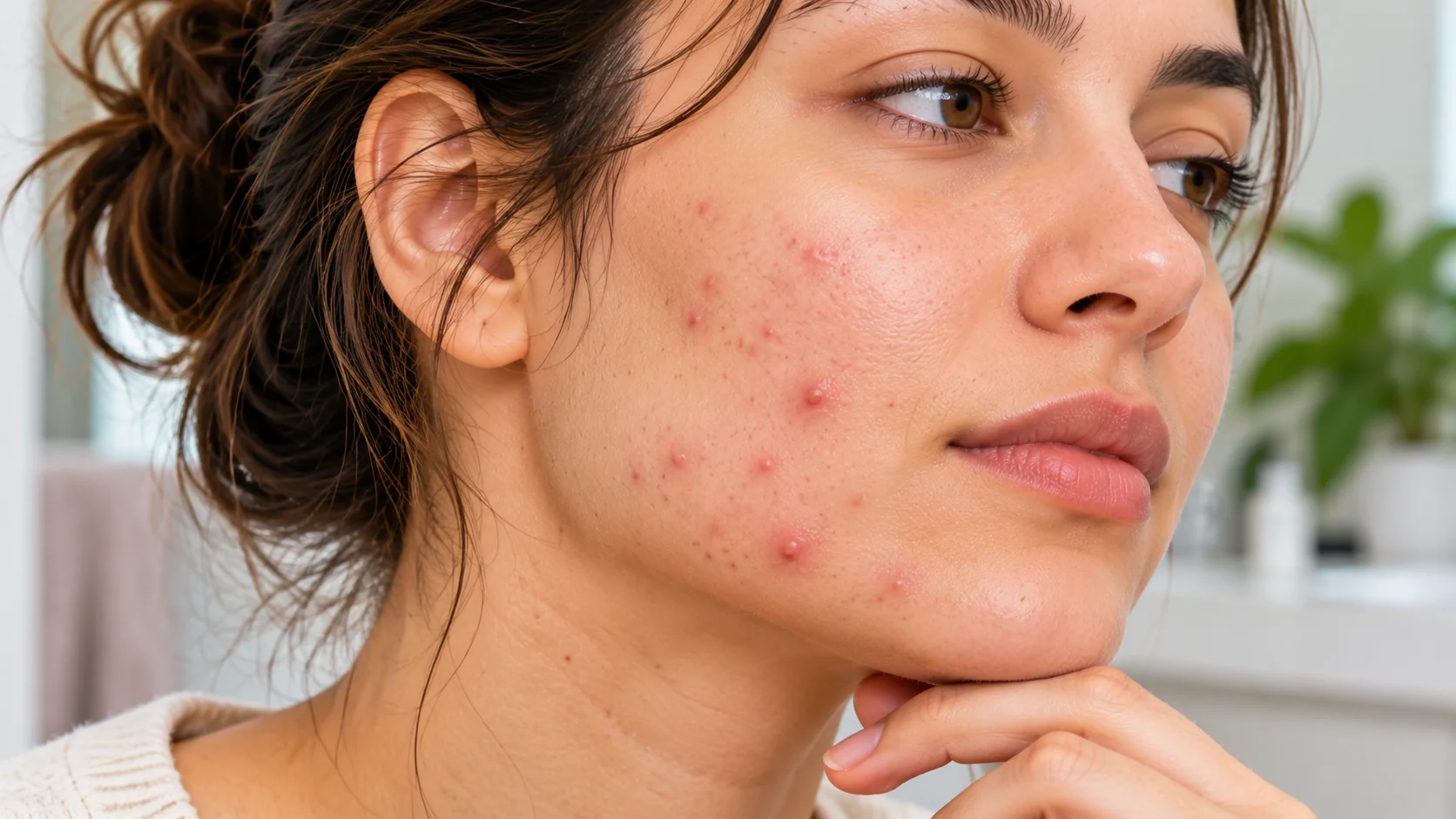
Deep, painful bumps (nodules or cysts). The AAD describes severe acne as breakouts that “often extend deep into the skin,” calling them cysts and nodules that “tend to be painful” (AAD). These typically don’t respond to anything you can buy without a prescription.
Acne that’s getting worse or won’t let up, even with a consistent routine. If you’ve been doing everything right and it’s trending in the wrong direction, that’s worth a conversation rather than another product swap.
Marks or scars are starting to show up. If breakouts are healing but leaving behind noticeable discoloration or textured marks, earlier evaluation gives you more treatment options than waiting does.
Acne is affecting your mood, confidence, or social life. This matters on its own, independent of how “bad” the acne looks to anyone else. The AAD notes that studies link acne to “poor self-esteem, depression, or anxiety” and that people with acne may withdraw from activities they’d otherwise enjoy (AAD). The National Institute of Arthritis and Musculoskeletal and Skin Diseases (NIAMS) says simply: “Acne can cause embarrassment or make you feel shy or anxious. If you have any of these feelings, talk to your doctor” (NIAMS).
You’re not sure it’s actually acne. A handful of other skin conditions can look a lot like acne but need different treatment entirely — the AAD specifically mentions hidradenitis suppurativa, perioral dermatitis, and folliculitis as conditions people sometimes mistake for acne (AAD). If something about your breakouts seems unusual (a different texture, an unusual location, or it just doesn’t look like typical acne), that uncertainty alone is a good reason to get it looked at.
A consistent routine genuinely hasn’t helped after a reasonable trial. More on exactly what “reasonable” means below — but if you’ve been patient and consistent and you’re still not seeing results, that’s a signal, not a failure on your part.
If you want to understand your breakouts a bit more before your appointment, it can help to first get a general sense of what’s actually causing your acne and which type of acne you’re dealing with, since that context is useful background for the conversation — though a professional diagnosis is still the only reliable way to know for sure.
How Long Should You Try OTC Acne Treatment Before Seeing a Dermatologist?
There isn’t one single, universal number here, and it would be misleading to pretend there is. What the sources actually say, and why the ranges differ, matters more than memorizing a specific week count.
Mayo Clinic’s general guidance is to give over-the-counter products “several weeks” before judging them, noting that “it may take a few weeks of using a product before you see any improvement,” and that side effects like redness or dryness “often improve after the first month” (Mayo Clinic). If you’ve done that and it’s still not working, Mayo Clinic is direct about the next step: “If you have acne that’s not responding to self-care and over-the-counter treatments, make an appointment with your doctor” (Mayo Clinic).
The AAD’s numbers run a bit longer, because they’re describing dermatologist-supervised treatment rather than an OTC trial specifically: it generally “takes at least 6 to 8 weeks before you start to see fewer breakouts” once treatment begins (AAD), and for more severe acne specifically, “it can take two to three months to see improvement” (AAD).
So, as a practical rule of thumb (this is our synthesis of the ranges above, not a single figure stated by any one source): a few weeks to about two months of consistent use is a reasonable window to judge whether an OTC product is working for ordinary, mild-to-moderate acne. But that window shouldn’t be treated as a rigid waiting period you have to sit through no matter what. If your acne is painful, deep, scarring, or genuinely affecting your wellbeing, there’s no reason to wait out a full eight weeks before getting evaluated — those situations are exactly the ones worth moving up the timeline for, regardless of how many weeks you’ve technically “tried.”
It’s also worth a quick gut-check on your routine itself before concluding a treatment has failed. Over-washing, over-exfoliating, or switching products too often can sometimes irritate skin in ways that look like treatment failure, or make breakouts worse rather than better. How to Prevent Acne Breakouts Without Overdoing Skincare walks through how to tell the difference, so you’re not mistaking a habits problem for a reason to see a dermatologist — or the reverse.
If you’re currently using an over-the-counter active and want to understand how it’s supposed to work (and whether you’re using it correctly), our breakdown of salicylic acid vs. benzoyl peroxide for acne covers how each ingredient works and realistic timelines for each.
Can a Dermatologist Help Prevent Acne Scars?
Partially, and with an important distinction most articles on this topic skip over: not everything that looks like a “scar” after a breakout actually is one.
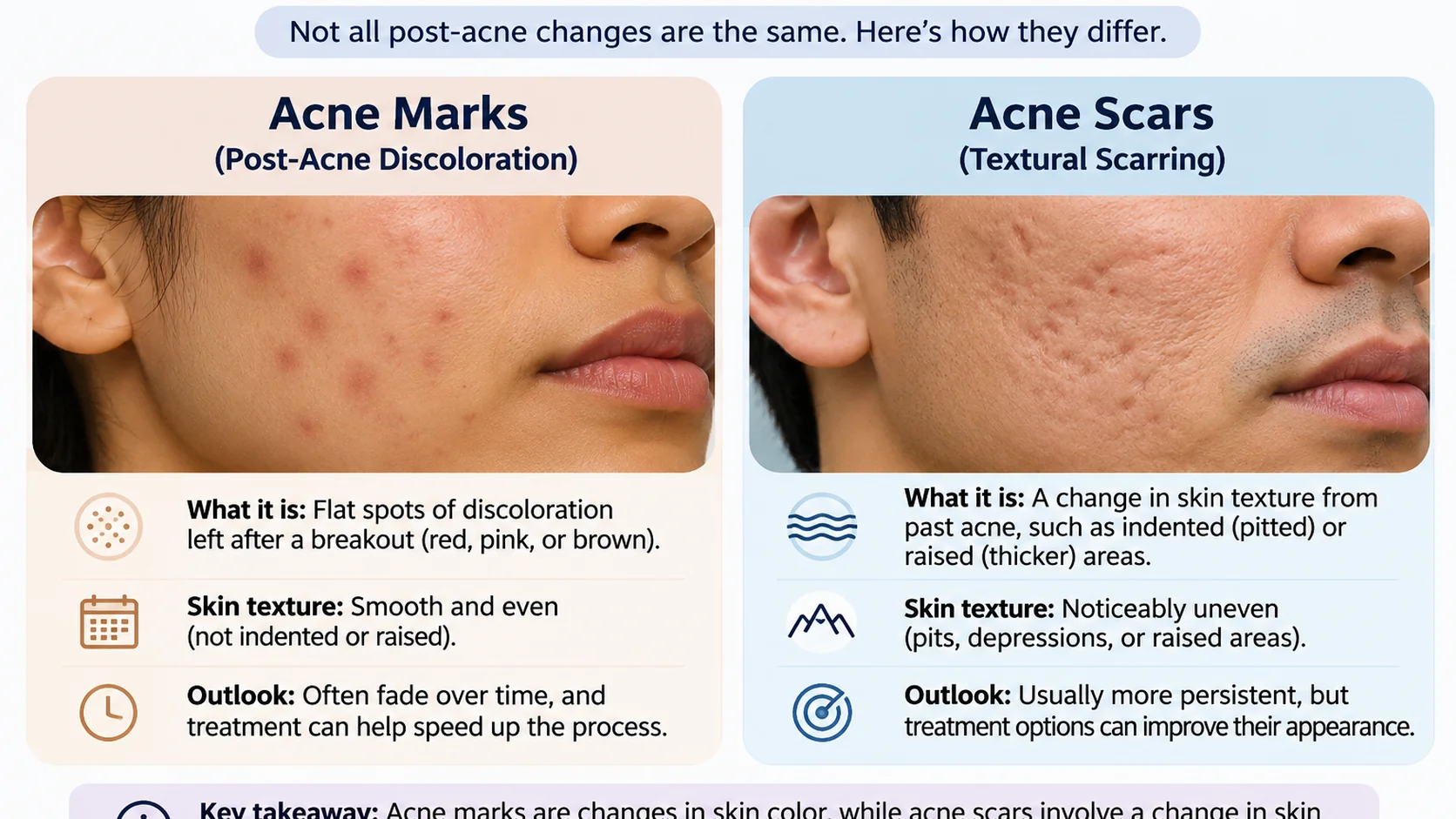
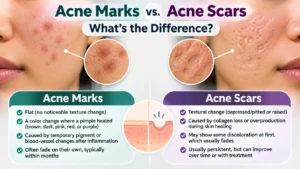
A lot of what people call acne scars are really post-inflammatory marks — flat spots of discoloration left behind after a pimple heals. The AAD draws this exact distinction: “If you see a flat spot of color on your skin when acne clears, this usually isn’t an acne scar” (AAD) — that’s typically post-inflammatory discoloration rather than a true scar. Even in the case of an actual scar, the color and the texture behave differently over time: the AAD notes that “the discoloration usually goes away” even though “the scar remains” (AAD). NIAMS notes that people with darker skin tones in particular “can develop skin discoloration after acne heals,” and that “your doctor can suggest a treatment approach that can fade existing dark spots” (NIAMS). The AAD similarly notes that certain topical treatments “can help lighten” dark spots left after acne clears (AAD).
True scarring is different — it involves an actual change in skin texture (indentations, raised tissue) rather than just color, and it’s generally more lasting: the AAD states plainly that “while acne scars can fade, they rarely go away completely on their own” (AAD). This is where timing matters most. Mayo Clinic states it clearly: “Early, effective treatment of acne reduces the risk of scarring and of lasting damage to your self-esteem” (Mayo Clinic), and lists “avoid scarring” among the things a dermatologist can help with. The AAD lists “prevent new scars” as one of the documented benefits of treating more severe acne (AAD).
What none of this means is that treatment guarantees scar-free skin. Reducing risk and preventing all scarring entirely are not the same claim, and no reputable source makes the second one. What’s genuinely true is that acne that’s left untreated for longer, or that’s severe enough to reach the nodular/cystic stage, carries a higher chance of leaving lasting marks — so earlier evaluation is a reasonable, evidence-backed reason to not put off an appointment, even if it can’t promise a specific outcome. If you’re trying to tell the difference between fading discoloration and something more permanent on your own skin right now, our guide to acne marks vs. acne scars walks through how to tell them apart.
Should Adults With Persistent Acne See a Dermatologist?
Yes — acne well past the teenage years is common enough that it’s worth taking seriously rather than assuming you’ve simply “aged out” of outgrowing it. Hormonal factors can play a role: NIAMS notes that diagnosis may include asking “for girls or women… about their menstrual cycles,” and that hormone therapy is used “primarily in women” as part of treatment (NIAMS).
It’s worth being careful here about what can and can’t be concluded from acne alone. Persistent adult acne can sometimes be connected to hormonal factors, but acne by itself isn’t enough to diagnose any specific hormonal condition — that requires a proper medical evaluation, not a guess based on breakout pattern alone. A dermatologist (or your primary care provider) can ask the right questions, and order lab work if needed, to figure out whether something else is contributing. NIAMS specifically notes that providers may “order lab work to determine if another condition or medical disorder is causing the acne” (NIAMS) as part of a routine workup — this is a normal, non-alarming part of evaluating persistent acne, not a sign that something is necessarily seriously wrong.
If your adult acne has been a frustrating cycle of switching products without a clear plan, it’s reasonable to want more structure than trial and error — a dermatologist can tailor a plan to what’s actually driving your breakouts rather than guessing. In the meantime, a consistent, non-irritating skincare routine can help reduce unnecessary irritation while you sort out next steps.
What Happens at Your First Acne Dermatologist Appointment?
Knowing roughly what to expect tends to make a first dermatology visit feel a lot less intimidating. Based on how Mayo Clinic and NIAMS describe the process, a first acne appointment generally includes:
A history. Expect questions along the lines of Mayo Clinic’s own examples: “When did you first develop this problem?”, “How is acne affecting your self-esteem and your confidence in social situations?”, “Do you have a family history of acne?”, and “What treatments and self-care steps have you tried so far? Have any been effective?” (Mayo Clinic). NIAMS adds that providers typically also ask about current or recently stopped medications (NIAMS).
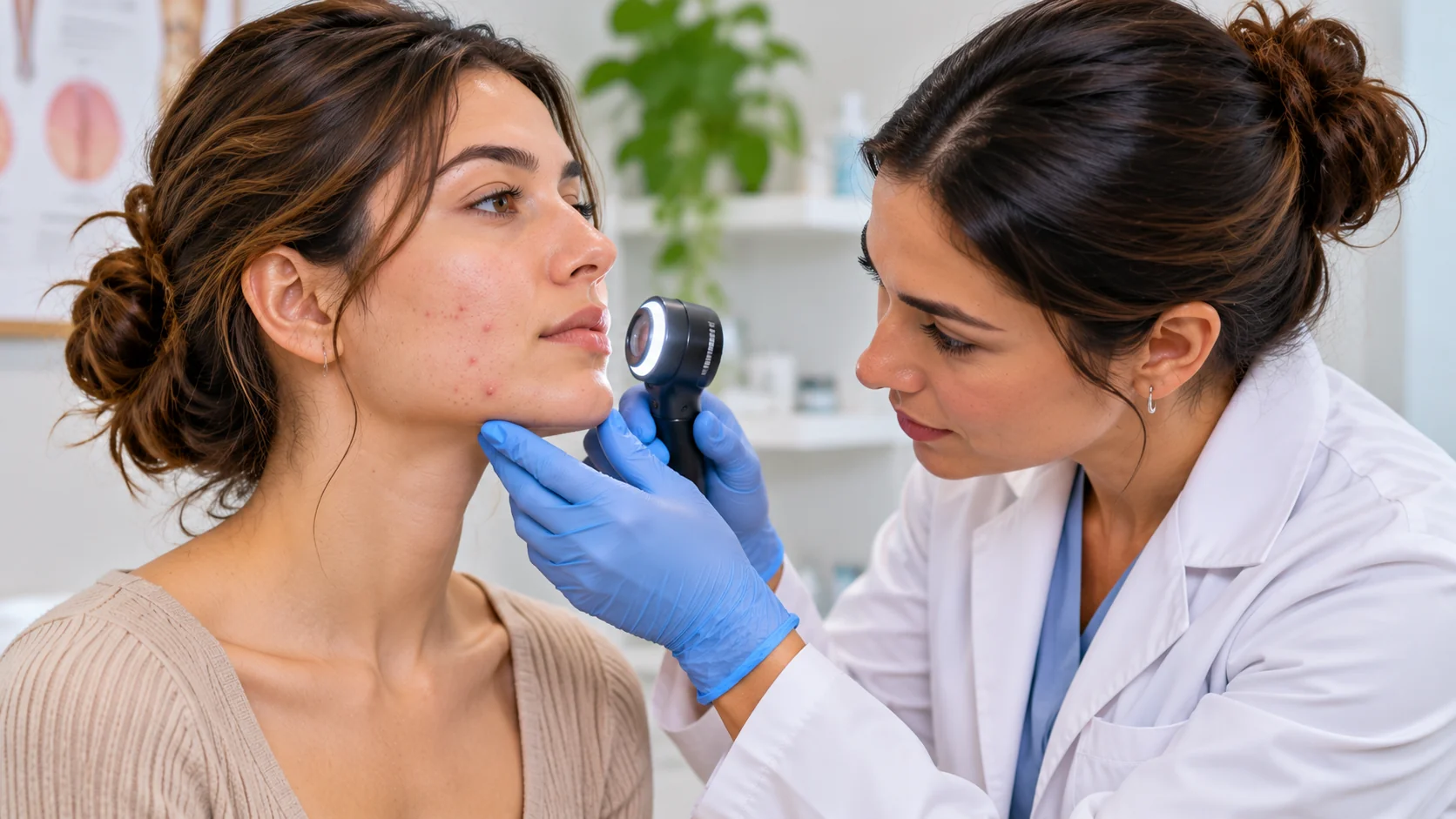
A skin exam. The provider looks closely at your skin to determine the type of acne lesion present and where it’s showing up, since different presentations call for different approaches (NIAMS; AAD).
Occasionally, lab work — not for everyone, but NIAMS notes it may be ordered “to determine if another condition or medical disorder is causing the acne” when something about the presentation suggests it’s worth ruling out.
A discussion of your treatment plan, built around your specific case rather than a one-size-fits-all approach — the AAD is explicit that “there is no one-size-fits-all acne treatment” (AAD).
A sense of what comes next. Mayo Clinic notes that after an initial exam, “your doctor may refer you to a specialist in the diagnosis and treatment of skin conditions (dermatologist)” if you started with a primary care visit, and that follow-up visits are typically spaced “every three to six months until your skin improves” once a prescription plan is underway (Mayo Clinic).
One visit rarely means an instant fix — it’s the start of a plan, not a one-time cure, and that’s normal.
How to Prepare for Your Acne Appointment
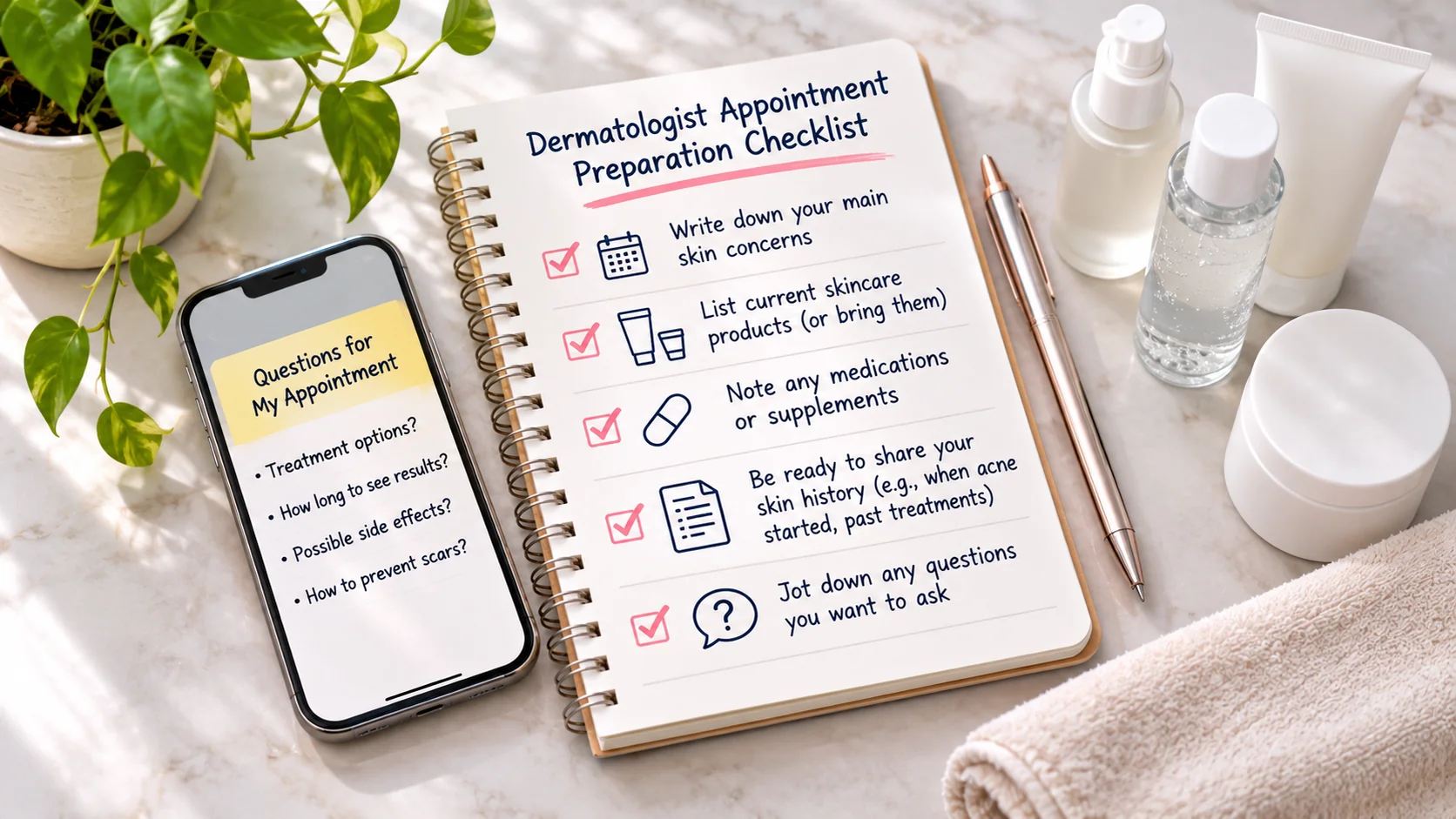
A little preparation goes a long way toward making the most of a limited appointment window. Based on the kinds of questions providers actually ask during intake, it helps to have on hand:
The skincare products you’re currently using (names, not just categories — “a cleanser” is less useful than the actual product).
Any over-the-counter or prescription medications and supplements you’re taking, including anything unrelated to your skin.
What you’ve already tried for your acne, and for roughly how long you tried each thing before stopping or switching.
Any reactions or side effects you noticed with past products or treatments (irritation, dryness, breakouts getting worse before better, etc.).
A general sense of when this started and whether anything seems to make it better or worse (stress, your cycle, certain products, specific foods you’ve noticed a pattern with).
Photos, if you have any from when your acne was more active — breakouts can calm down right before an appointment, and photos help a provider see the full picture.
Your questions, written down ahead of time so they don’t slip your mind once you’re in the room.
None of this needs to be perfect or complete — bringing a rough version of this list is still far more useful than showing up with nothing.
What If You Cannot See a Dermatologist Right Away?
Dermatology appointments aren’t always immediately available, and that’s a real, practical concern — not a reason to assume you’re stuck waiting it out alone. NIAMS confirms that dermatologists aren’t the only providers equipped to diagnose and treat acne: “primary health care providers, including family doctors, internists, or pediatricians” can also diagnose and treat it (NIAMS). Mayo Clinic describes a similar pathway, where a primary care visit can lead to a dermatologist referral if needed after an initial exam (Mayo Clinic).
In practice, that means a primary care appointment — often easier to schedule sooner — is a reasonable place to start if a dermatologist isn’t available right away, especially for guidance on next steps or a referral. This article can’t speak to what your specific insurance will or won’t cover, what a visit might cost, or how quickly you’ll be able to get in with any particular provider, since that varies enormously by plan and location — those are worth confirming directly with your insurance provider or the office you’re trying to book with.
FAQs
This article is for general educational purposes and isn’t a substitute for personalized medical advice. Only a qualified healthcare provider who examines your skin can diagnose your acne and recommend treatment that’s right for you.
No. The American Academy of Dermatology notes that many people with acne can benefit from a dermatologist’s input, severe or not. If OTC treatment hasn’t worked for you, or acne is bothering you, that’s reason enough on its own.
A general guideline is a few weeks to about two months of consistent use, based on Mayo Clinic and AAD guidance. But don’t treat that as a hard rule — painful, deep, scarring, or emotionally distressing acne is worth evaluating sooner, no matter how long you’ve technically been trying a product.
Cystic and nodular acne — the deep, painful kind — generally doesn’t respond well to over-the-counter products and is one of the clearer signs it’s time for a professional evaluation rather than more trial and error at home.
No, and it’s worth being skeptical of anything that claims otherwise. What the evidence supports is that earlier, effective treatment reduces the risk of scarring — it doesn’t eliminate that risk entirely. A dermatologist can also help treat existing marks and discoloration once they’ve appeared.
Acne well into adulthood is common. Hormonal factors can play a role, but acne in adulthood doesn’t automatically mean there’s an underlying hormonal condition. It’s reasonable to see a dermatologist or your regular doctor to get a proper evaluation — acne alone isn’t enough to diagnose a specific hormonal cause on your own, so it’s worth having that conversation with a provider rather than guessing.
A list of products and medications you’re currently using, what you’ve already tried and for how long, any reactions you’ve noticed, and, if you have them, photos from when your acne was more active. Written-down questions help too.
A primary care provider can also diagnose and treat acne, and can refer you to a dermatologist if needed. Starting there is a reasonable option if a dermatology appointment isn’t available right away.
Not necessarily. A dermatologist might recommend a different over-the-counter approach, a prescription option, or some combination, depending on what’s actually going on with your skin. OTC treatment not working doesn’t automatically mean you need a prescription — it means it’s time for a proper evaluation to figure out what will actually help.
References
American Academy of Dermatology. “Treating acne? Is it time to see a dermatologist?” https://www.aad.org/public/diseases/acne/diy/when-derm
American Academy of Dermatology. “What can clear severe acne?” https://www.aad.org/public/diseases/acne/derm-treat/severe-acne
American Academy of Dermatology. “Acne: Diagnosis and treatment.” Last updated 6/19/24. https://www.aad.org/public/diseases/acne/derm-treat/treat
American Academy of Dermatology. “Acne scars: Overview.” Last updated 12/8/23. https://www.aad.org/public/diseases/acne/derm-treat/scars
Mayo Clinic. “Acne: Diagnosis and treatment.” https://www.mayoclinic.org/diseases-conditions/acne/diagnosis-treatment/drc-20368048
National Institute of Arthritis and Musculoskeletal and Skin Diseases (NIAMS), National Institutes of Health. “Acne: Diagnosis, Treatment, and Steps to Take.” https://www.niams.nih.gov/health-topics/acne/diagnosis-treatment-and-steps-to-take