If you’ve cleared up a breakout only to be left staring at a dark or red spot where the pimple used to be, you’ve probably wondered: is this a scar, or will it go away?
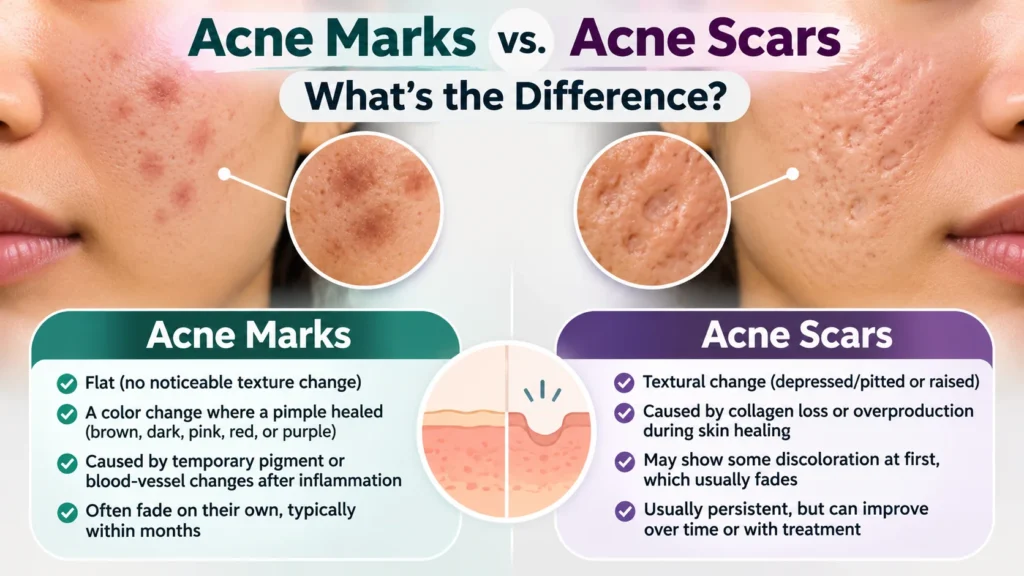
Short answer: flat discoloration generally points to an acne mark, which tends to fade on its own over time. A dip, bump, or other textural change usually means an acne scar, which typically needs more than time alone to improve.
The difference matters because the right approach for each is different, and treating one like the other wastes time and can irritate your skin. Below: how to tell them apart, the specific types of each, and what actually helps — according to the American Academy of Dermatology (AAD) and DermNet.
Acne marks are flat: run a finger over one and they usually feel flat, without a noticeable texture difference from the surrounding skin. They show up purely as a color change — brown, dark, pink, red, or purple — where a pimple used to be. That said, touch and appearance are clues, not a diagnostic test.
Marks form because inflammation from a breakout temporarily disrupts the skin’s pigment-producing cells or tiny blood vessels. Once the irritation settles, marks generally fade on their own, though it can take a while.
What Acne Scars Look and Feel Like
Acne scars change the skin’s structure. Per the AAD, a deep pimple or breakout can leave a scar as it clears, though not every breakout does. Most people who scar develop depressed scars, with a pitted or uneven texture; fewer develop raised scars.
A dip, pit, or raised area generally suggests a scar rather than a mark, though this is a clue, not a certainty. A scar often appears alongside some discoloration at first; the color usually fades, but the texture tends to be longer-lasting. DermNet notes acne scars are “usually permanent, although may improve spontaneously over time or with treatment” — so outcomes vary, and improvement doesn’t require full resolution.
Quick Comparison Table
Feature
Acne Marks
Acne Scars
Texture
Usually flat, with no noticeable texture change
Depressed (pitted) or raised
What causes it
Temporary pigment or blood-vessel changes after inflammation
Collagen loss or overproduction during skin healing
Color
Brown, dark, pink, red, or purple
May show some discoloration at first, which usually fades
Fades on its own?
Often yes, typically within months
Usually persistent — may improve spontaneously or with treatment
These are typical patterns, not strict rules — touch and appearance are clues, not diagnostic tests.
Types of Acne Marks
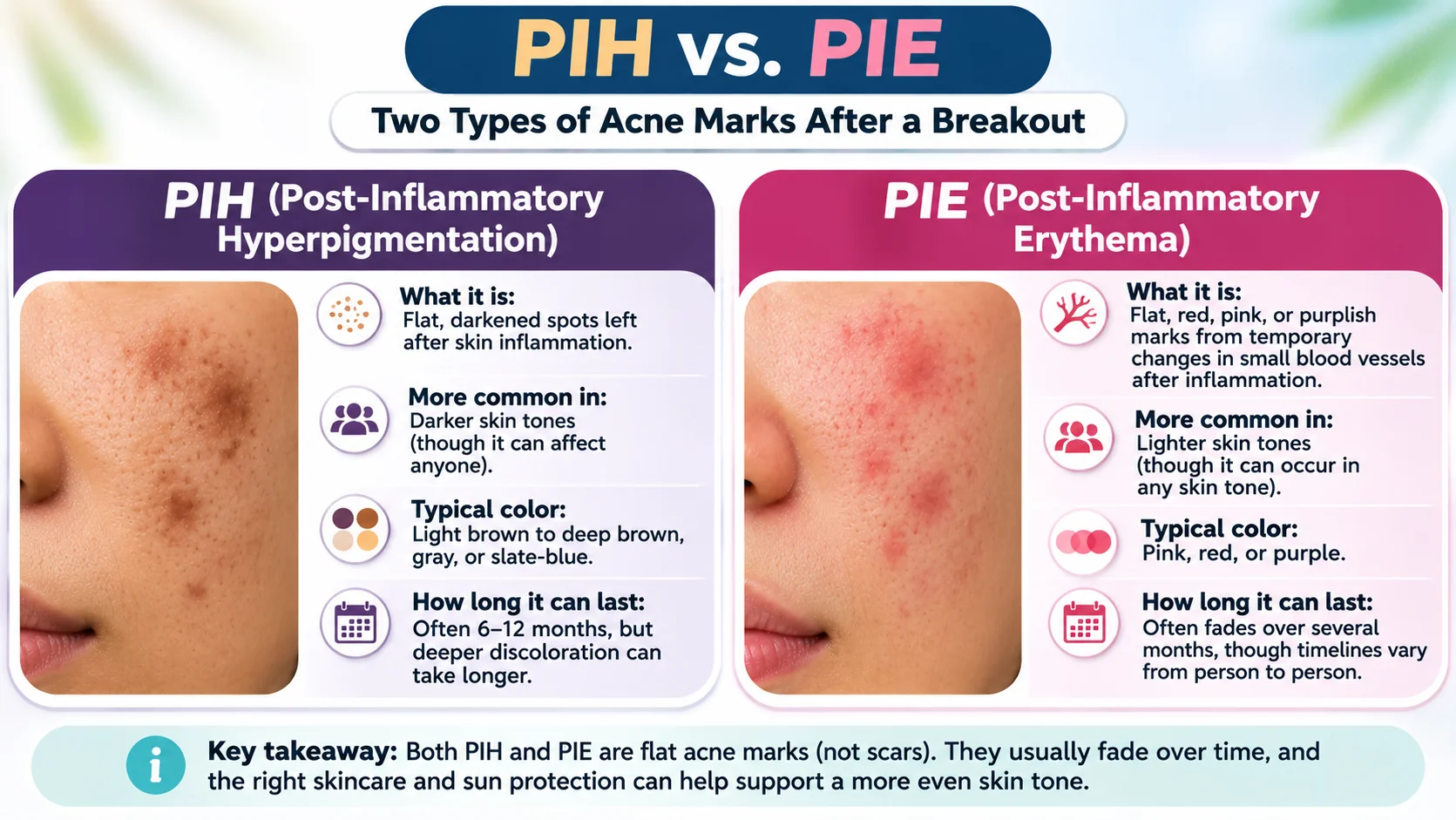
Post-Inflammatory Hyperpigmentation (PIH)
PIH is a flat, darkened patch that develops after a pimple (or another inflamed skin condition) heals. DermNet explains it “occurs due to the deposition of melanin within the keratinocytes of skin that had recent inflammatory damage,” and it’s more common in darker skin types. PIH can range from light brown to deep brown, gray, or slate-blue depending on how deep the pigment sits — deeper discoloration takes longer to fade.
Post-Inflammatory Erythema (PIE)
PIE is a flat pink, red, or purple mark left after a breakout. DermNet describes it as “more common in lighter skin,” attributing it to “microvascular changes and epidermal thinning of the skin during wound healing” — related to blood vessels rather than pigment.
Types of Acne Scars
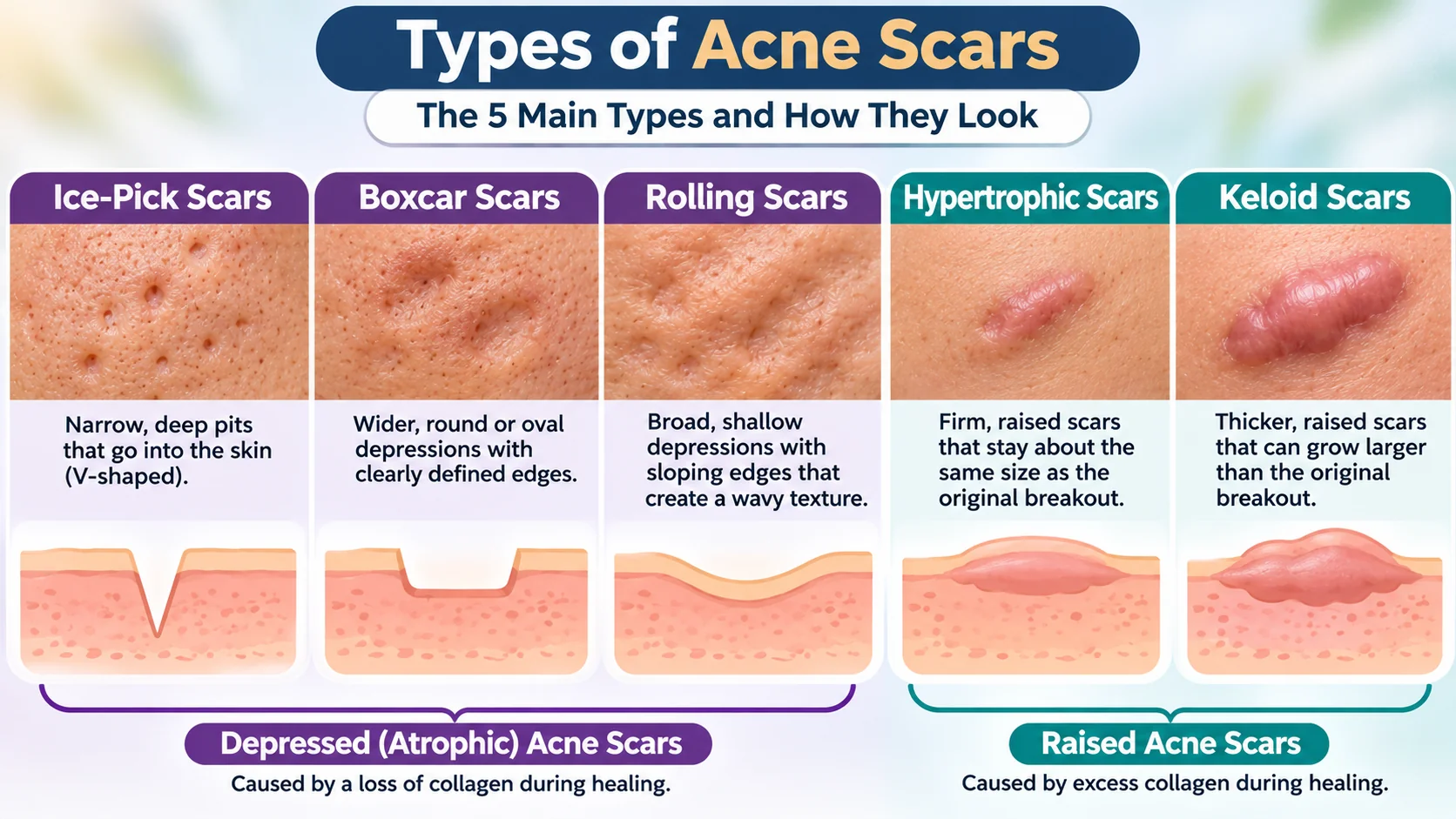
Most acne scars fall into one of three “depressed” categories, though some people develop raised scars instead.
Ice-Pick Scars
Ice-pick scars are the most common type of depressed acne scar. The AAD describes them as small but going deep into the skin, and DermNet adds that they’re “narrow, deeper than they are wide, and V-shaped with a sharp edge extending downwards into the deep dermis.” Because they’re narrow but deep, they tend to be stubborn to treat.
Boxcar Scars
Boxcar scars are round or oval depressions with clearly defined edges — wider than ice-pick scars but narrower than rolling scars, per the AAD; DermNet similarly notes their “distinct edges.”
Rolling Scars
Rolling scars are wide and shallow, with a sloped edge that DermNet notes “can be smoothed out if stretched.” When several appear together, the AAD notes the skin can look wavy and uneven.
Raised Scars: Hypertrophic and Keloid
Raised scars form when skin produces too much collagen while healing. They’re less common than depressed scars, and both the AAD and DermNet note they’re more frequent in darker skin tones.
Hypertrophic scars are firm and stay roughly the size of the original breakout, usually appearing on the jawline, chest, or back within one to two months after a breakout clears.
Keloid scars grow larger than the lesion that caused them. The first sign is often thickening skin, beginning three to twelve months after the acne clears — and DermNet notes keloids “can continue to evolve over time” and are “particularly prone to recur even after apparently successful treatment.”
A third, less common raised type — papular scars — can appear as small, skin-colored or lighter bumps, sometimes mistaken for acne itself.
How to Tell Whether You Have Marks or Scars
A few simple clues can point you in the right direction — but they’re clues, not diagnostic tests:
Look at it in good light. Flat color generally suggests a mark; a visible dip, bump, or texture difference suggests a scar.
Feel it gently. A dip, pit, or firm raised area under a clean fingertip points toward a scar — though some scars are subtle enough to be hard to judge on your own.
Think about timing. A mark from a recent breakout is probably still fading; a textural change still there many months later is more likely a scar.
Consider the original breakout. The AAD notes deep, painful breakouts (cysts or nodules) are more likely to scar than smaller surface pimples, which more often leave a mark — one more reason it helps to understand the different types of acne lesions you’re dealing with.
Subtle scars and some other skin conditions can look similar to the untrained eye. If you’re genuinely unsure, or something isn’t changing as expected, an in-person dermatologist exam is the most reliable way to know what you’re looking at.
How to Fade Acne Marks
Sun Protection
According to the AAD, “effective treatment for dark spots and patches begins with sunscreen.” Unprotected sun exposure can darken existing marks and trigger new ones. The AAD recommends SPF 30 or higher, broad-spectrum and water-resistant (non-comedogenic if you’re acne-prone), reapplied roughly every two hours outdoors and after sweating or swimming.
For darker skin tones, the AAD also recommends a tinted sunscreen with iron oxide, which blocks the visible light standard UV-only sunscreens miss. A wide-brimmed hat and avoiding peak sun hours (10 a.m.–2 p.m.) add extra protection.
Ingredients That Help Fade PIH
Once a mark’s trigger has cleared, certain over-the-counter ingredients can speed up fading. The AAD lists azelaic acid, glycolic acid, kojic acid, retinoids (retinol, tretinoin, or adapalene gel), and vitamin C as options that fade discoloration and, in some cases, slow pigment overproduction. If these don’t work after a reasonable trial, a dermatologist can prescribe something stronger.
One important caveat: the AAD advises stopping topical retinoids such as tretinoin and adapalene during pregnancy, since “most experts recommend stopping this treatment during pregnancy.” That guidance doesn’t directly address over-the-counter retinol, trying to conceive, or breastfeeding — ask your OB or dermatologist about those situations, and about any other ingredient above you’re unsure of.
Why Gentle Skincare Matters
It’s tempting to scrub at a stubborn dark spot, but harsh scrubbing and aggressive exfoliation worsen irritation, which can create new marks or deepen existing ones. Gentler products, often labeled “for sensitive skin” or “fragrance-free,” are less likely to irritate healing skin, and a product that burns or stings is a sign to stop.
If you’re unsure how to layer a fading ingredient like a retinoid or vitamin C in without overdoing it, our guide to how to build an acne skincare routine covers introducing new actives gradually.
How Long Marks Take to Fade
Per the AAD, a mark only a few shades darker than your natural tone usually fades within 6 to 12 months. Discoloration sitting deeper in the skin — often slate-blue to gray, or noticeably darker brown — can take years. Treatment speeds the process up, but marks don’t disappear overnight.
How Dermatologists Treat Acne Scars
Scars differ from marks because they change the skin’s structure rather than its color. Treatment isn’t necessary for everyone, but for those who want it, a dermatologist typically builds an individualized plan based on scar type and depth, number of scars, skin tone, whether acne is still active, relevant medical history, and goals and budget — usually starting once active acne is under control.
Treating Ice-Pick Scars
Because ice-pick scars are narrow and deep, they often need techniques built to reach that depth. One option is TCA CROSS — trichloroacetic acid chemical reconstruction of skin scars — which DermNet describes as “a specific chemical peel technique involving the application of high strength (65–100%) TCA” directly into the scar. TCA at that strength is corrosive, so this is strictly an in-office procedure performed by a dermatologist — not a home treatment. For milder scarring, the AAD notes a retinoid or salicylic acid applied to the skin can make it somewhat less noticeable, though that’s a more modest result than a procedure provides.
Treating Boxcar and Rolling Scars
Wider, shallower scars like these have more options, often combined:
Fillers, injected to add volume beneath the depression — the AAD notes most fillers give temporary results, typically lasting 3 months to 2 years, though some formulations can be permanent
Subcision, which DermNet describes as surgically dividing “the fibrous scar band under the targeted scar” so skin can rise back into place
Microneedling (collagen induction therapy) and radiofrequency treatments, including radiofrequency microneedling — both described by the AAD as safe for all skin tones
Laser resurfacing, chemical peels, and dermabrasion/microdermabrasion, which encourage the skin to rebuild collagen
Platelet-rich plasma (PRP) is sometimes added to microneedling; the AAD notes studies show this can lead to less visible scarring, though results vary and it isn’t guaranteed to outperform microneedling alone for everyone.
Treating Raised Scars
Hypertrophic and keloid scars are treated differently, since the goal is reducing collagen rather than adding volume. Options include corticosteroid injections, laser treatment, and prescription medication applied to the scar; keloids may also be surgically removed or frozen (cryotherapy).
Keloids deserve extra caution: both the AAD and DermNet note they’re prone to returning even after treatment that initially looked successful, which is why dermatologists often combine two or more approaches.
Why Combination Treatment May Be Necessary
No single procedure works equally well for every scar type, so dermatologists often combine techniques to address color, texture, and volume — for example, lifting a sunken scar surgically and adding filler, or pairing microneedling with radiofrequency, a chemical peel, or PRP. A recommendation for more than one treatment is normal, not a sign the first option failed.
Skin Tone and Safety Considerations
Marks and scars don’t affect every skin tone the same way:
PIH tends to be more noticeable and longer-lasting in darker skin tones — part of why the AAD has specific guidance for skin of color.
Sunscreen is one of the most effective ways to prevent marks from getting darker or more stubborn, regardless of skin tone.
Be cautious with aggressive at-home treatments. The AAD warns that for darkly pigmented skin, even at-home chemical peels, microdermabrasion devices, and laser tools “can cause side effects like permanent dark marks and light spots.” Professional supervision is safer — though the AAD describes professional microneedling and radiofrequency microneedling as safe for all skin tones.
If you’re pregnant, the AAD advises stopping topical retinoids such as tretinoin and adapalene (see the pregnancy note above) — and if you’re using over-the-counter retinol, trying to conceive, or breastfeeding, talk with your OB or dermatologist, since that guidance doesn’t specifically cover those situations.
How to Prevent New Marks and Scars
The best way to avoid new marks and scars is to keep acne from becoming inflamed, since both form as a reaction to inflammation:
Treat acne as soon as it starts. Early treatment can prevent progression to the deeper, more inflamed breakouts most likely to scar — which connects back to what causes acne and inflammation.
Don’t pick, pop, or squeeze breakouts, and avoid touching your face unnecessarily — both increase inflammation, and the AAD is explicit that more inflammation raises scarring risk.
Use proven acne-treatment ingredients consistently rather than switching products often. Our acne treatment ingredient comparison breaks down two of the most widely recommended options.
Know your risk factors. The AAD notes you’re more likely to scar with deep, painful breakouts or a close relative who scars — not something you can change, but a good reason to treat your acne proactively.
When to See a Dermatologist
It’s worth making an appointment if a mark hasn’t faded after several months of sun protection and gentle skincare; if you notice a textural change rather than just color; if your acne isn’t responding to over-the-counter treatment; if you’re considering a scar procedure and want to know which options suit your scar type; or if you’ve developed, or are prone to, keloid scarring.
As the AAD puts it, with a dermatologist’s help, the large majority of acne and most dark spots can be successfully treated — and for established textural scars, dermatologist-directed procedures generally offer the most meaningful improvement.
Frequently Asked Questions
No. Acne marks are flat color changes left after a breakout heals. Acne scars are a change in skin texture — a depression or raised area — from collagen changes during healing. Marks typically fade on their own; scars usually need treatment.
Flat color generally means a mark; any dip, pit, or raised texture suggests a scar. This is a helpful clue, not a diagnostic test — subtle scars can be hard to judge on your own, so if you’re unsure, a dermatologist can examine it in person.
Often, yes. Once the underlying trigger is addressed, most flat discoloration fades over time. Sun protection, gentle skincare, and ingredients like azelaic acid, vitamin C, or a retinoid can speed it up.
Per the AAD, a spot only a few shades darker than your natural skin tone usually fades within 6 to 12 months. Discoloration that sits deeper in the skin can take years instead. Treatment can speed this up, but it’s rarely instant.
Not fully. Over-the-counter skincare can’t rebuild the collagen needed to fill in a depressed scar, though the AAD notes a retinoid or salicylic acid can make very mild scarring somewhat less noticeable. For scars that bother you, procedures like fillers, laser resurfacing, microneedling, or subcision generally offer more meaningful improvement.
PIH (post-inflammatory hyperpigmentation) is a flat brown, dark, or gray mark from extra pigment, more common in darker skin tones. PIE (post-inflammatory erythema) is a flat pink, red, or purple mark related to blood-vessel changes, more common in lighter skin tones. Both typically fade over time.
Keloid scars are among the most stubborn, since they’re prone to returning even after treatment that initially looks successful. Deep ice-pick scars can also be hard to fully treat because of how far they extend into the skin.
Yes. The AAD states effective treatment for dark marks begins with sunscreen, since unprotected sun exposure can darken existing marks and trigger new ones. Daily broad-spectrum sunscreen supports fading and helps prevent marks from becoming more stubborn.
The Takeaway
Most of the time, a dark or red spot left after a pimple is an acne mark — a temporary color change that fades with time, sun protection, and gentle skincare. A true acne scar is different: a lasting texture change that generally needs professional treatment to meaningfully improve.
The best way to avoid both is to treat active acne promptly, resist picking or popping, and stay consistent with a gentle, appropriate routine — our complete acne-prone skincare routine guide is a good place to start. And if you’re ever unsure whether you’re dealing with a mark or a scar, a dermatologist can tell you exactly what you’re looking at and which options make sense for it.