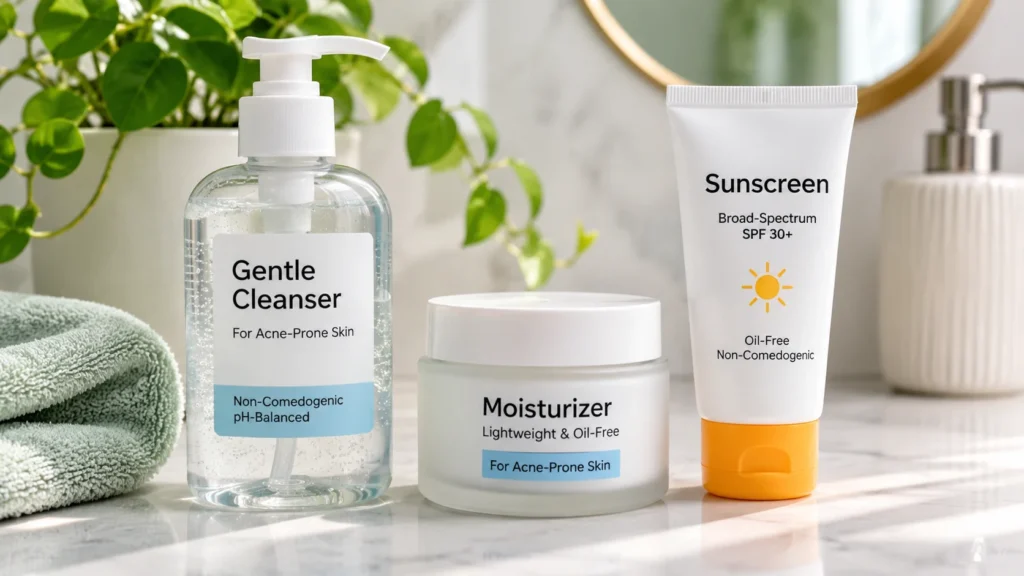
If you’re starting acne treatment for the first time, the simplest approach is also the safest one: build your routine in stages instead of all at once. Start with a basic cleanser, moisturizer, and sunscreen for a week or two, then add one acne treatment at a time, giving each one several weeks before judging it or adding another. This makes it far easier to tell what’s actually working — and what’s just irritating your skin. If you want the complete step-by-step AM and PM routine with specific product types for every step, our full acne-prone skincare routine guide covers that in detail. This guide focuses on something different: how to actually build that routine without overwhelming your skin.
In This Guide
- Start With the Basics Before Adding Any Treatment
- Add One Active Ingredient at a Time
- A Simple Week-by-Week Ramp-Up Timeline
- Troubleshooting Dryness, Peeling, and Irritation
- Adjusting the Build for Your Skin Type
- Common Mistakes When Building a New Acne Routine
- Acne Treatments During Pregnancy and Breastfeeding
- When to Stop Self-Managing and See a Dermatologist
- Frequently Asked Questions
- The Takeaway
Start With the Basics Before Adding Any Treatment
Before adding any acne treatment, it helps to get your skin used to three basic products: a gentle cleanser, a moisturizer suited to acne-prone skin, and a broad-spectrum sunscreen. A basic, non-medicated version of these products doesn’t replace an acne treatment — but it supports the rest of your routine in two important ways. First, it establishes a baseline — if your skin reacts to something after you add a treatment, you’ll know the treatment is the likely cause rather than a new cleanser or moisturizer you introduced at the same time. Second, it supports your skin’s barrier, which makes it more tolerant of the treatment you add next. (Note: some cleansers have acne-fighting ingredients like salicylic acid or benzoyl peroxide built in — if yours does, treat it as your first active rather than a neutral basic, and apply the one-at-a-time approach below.)
A practical approach many beginners find useful is to use just these three products for a week or two before introducing anything else. This isn’t a strict medical rule — there’s no clinical requirement that you wait exactly 14 days — but it’s a reasonable, low-risk way to make sure your basic routine agrees with your skin before you add an active ingredient into the mix.
Look for a cleanser that doesn’t leave your skin feeling tight or stripped, and a moisturizer and sunscreen labeled “oil-free,” “non-comedogenic,” or “won’t clog pores.” The American Academy of Dermatology (AAD) notes that these labels mean a product is unlikely to cause breakouts in most people, even on oily or acne-prone skin.
Add One Active Ingredient at a Time
Once your basic routine feels comfortable, it’s time to introduce an acne treatment — but only one at a time. This matters for a simple reason: if you start two or three new products in the same week and your skin gets irritated, you have no way of knowing which one caused it. It also helps to understand that different treatments work through different mechanisms — our guide to what actually causes acne covers how clogged pores, oil, bacteria, and inflammation each play a role, which is part of why one ingredient alone rarely addresses everything at once. The National Institute for Health and Care Excellence (NICE) acne guideline recommends introducing topical treatments like benzoyl peroxide or retinoids gradually, starting with alternate-day or short-contact application and progressing to standard use only if your skin tolerates it. That same logic applies to introducing ingredients one at a time rather than together.
Which treatment should you start with? That depends on what your acne mostly looks like.
- Salicylic acid tends to be most relevant for clogged pores, blackheads, and whiteheads. It works down inside the pore to loosen the buildup that forms these lesions. If you’re not sure what type of breakout you’re dealing with, our guide to the different types of acne lesions can help you tell them apart. For more on how and when to use it, see our guide to salicylic acid benefits and how to use it.
- Benzoyl peroxide has stronger evidence behind it for red, inflamed pimples, since it targets the bacteria involved in that kind of breakout.
- Topical retinoids (like adapalene) help unclog pores and can reduce new breakouts over time. They’re a legitimate option for many beginners, not an automatically later-stage treatment — but they do tend to cause more noticeable dryness and peeling when first introduced, so they often benefit from a more gradual introduction than some other actives. They also carry specific pregnancy precautions, covered later in this article.
There’s no single active ingredient that’s the right starting point for every beginner. Which one makes the most sense first depends on your acne type, how your skin tends to tolerate new products, and what you need the treatment to do — so think of this as a choice based on your own situation rather than a fixed order everyone should follow.
If you’re weighing salicylic acid against benzoyl peroxide specifically, our in-depth comparison of the two walks through how each one works, what it’s best for, and whether they can be combined.
Many acne medications are intended to be applied as a thin layer across your acne-prone skin — forehead, cheeks, chin — rather than just on individual pimples, since treating only visible blemishes can fail to prevent new breakouts forming underneath the skin’s surface, per the AAD. That’s not true of every formulation, though — some spot treatments are specifically designed for targeted, pimple-by-pimple use. Check your product’s own directions to see which kind you have, and apply it accordingly.
A Simple Week-by-Week Ramp-Up Timeline
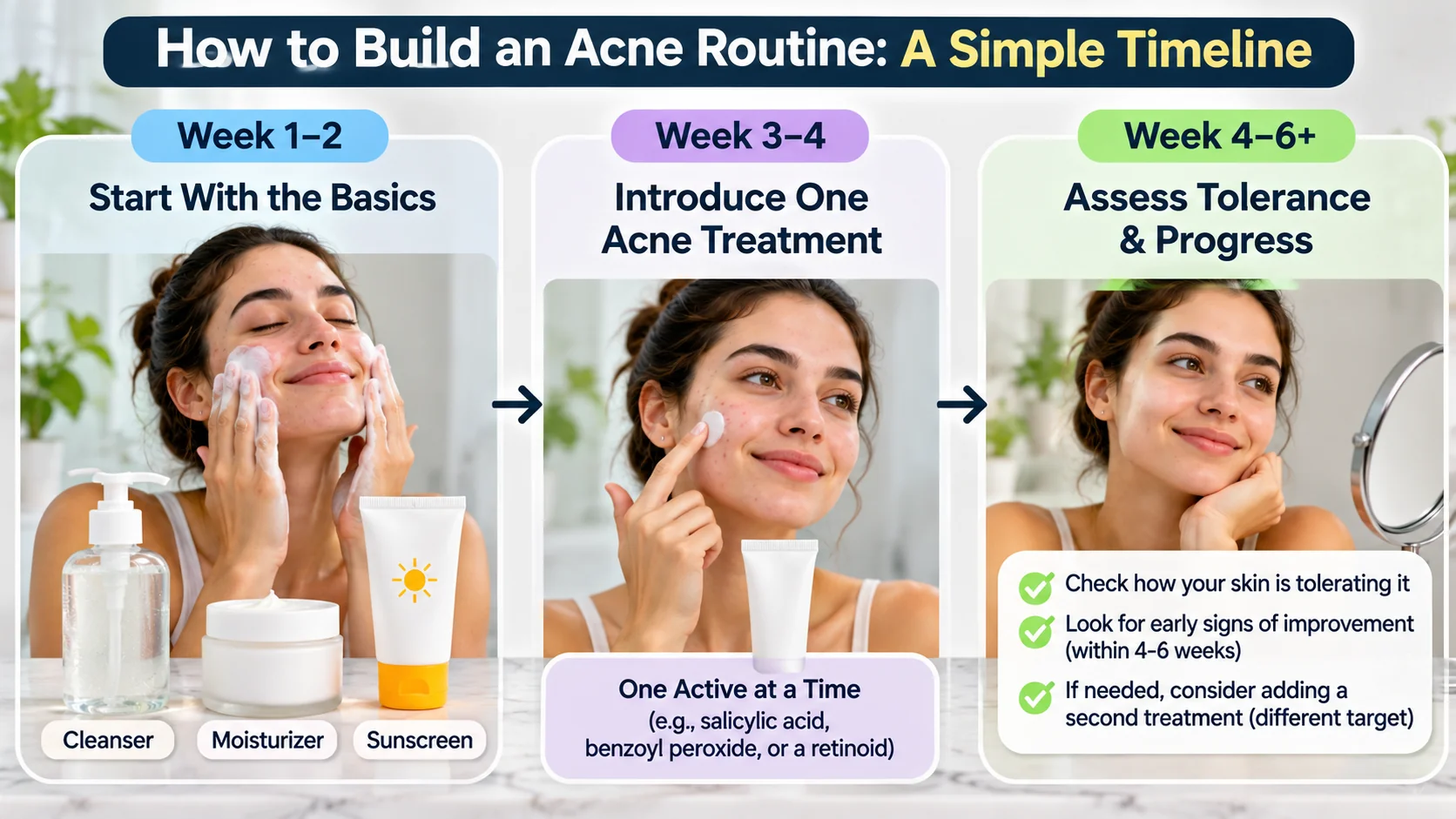
There’s no single universal schedule that works for everyone, but the following framework reflects how dermatology sources generally describe a reasonable, low-irritation way to build a routine.
Weeks 1–2: Establish Your Basic Routine
Use your cleanser, moisturizer, and sunscreen on their own. Get a feel for how your skin responds to washing twice a day (morning and night, plus after sweating) without yet adding a treatment.
Next: Introduce Your First Acne Treatment
Some treatments can reasonably be introduced gradually — for example, an alternate-day schedule rather than jumping straight to daily use — when that fits the specific product and your skin’s tolerance. For benzoyl peroxide specifically, a patient medication guide from MedlinePlus suggests testing it on one or two small areas for about three days first, then starting with once-daily use and moving up to twice daily only if your skin tolerates it well. In the UK, NICE’s acne guideline for prescribed topical treatments describes a related principle: alternate-day or short-contact application (for example, washing it off after an hour), progressing to standard use once skin adjusts. These are examples of gradual introduction working for some products and skin types — not a rule for every treatment. Always follow your product’s own label directions, or a healthcare provider’s guidance, since some products are meant to be used at full frequency from the start.
Around Weeks 4–8: Check Your Progress
Give your first treatment real time to work before judging it. The AAD’s guidance varies a little depending on the source: one AAD resource notes you should give a treatment at least 4 weeks, with improvement often visible in 4 to 6 weeks and continued clearing over 2 to 3 months or longer; another AAD page frames it as 6 to 8 weeks for noticeable improvement, with complete clearing generally taking 3 to 4 months. The practical takeaway is the same either way: don’t expect a fast transformation, and don’t swap products out after just a few days of use. If you’ve given a single treatment at least 4 to 6 weeks with no improvement at all, that’s a reasonable point to consider adding a second product that works through a different mechanism, rather than switching entirely.
Troubleshooting Dryness, Peeling, and Irritation
What Can Be Expected and What Is a Warning Sign?
Some dryness, peeling, warmth, tingling, or slight stinging is a commonly reported, mild side effect when starting an acne treatment, according to MedlinePlus. These effects often ease up as your skin adjusts. It’s different, though, from burning, blistering, significant redness or swelling of the treated area, or a rash — those are signs to stop the product and get medical advice. Symptoms like hives, intense itching, throat tightness, difficulty breathing, or swelling of the eyes, face, lips, or tongue need prompt medical attention, since they can indicate an allergic reaction rather than ordinary irritation.
What to Do When Your Skin Becomes Irritated
If you’re dealing with ordinary dryness or peeling rather than a more serious reaction, a few adjustments can help:
- Cut back on how much you’re using. A pea-sized amount is generally enough to cover the whole face.
- MedlinePlus notes that, for certain acne treatments, reducing application to every other day or every third day may help the skin adjust. Check your product’s instructions or ask a healthcare provider before changing its frequency.
- Wait 10 to 15 minutes after washing your face before applying your treatment, which can reduce stinging for some people.
- Lean on your moisturizer. Applying it after washing, while skin is still slightly damp, helps your skin tolerate a drying treatment.
- Don’t add anything else irritating in the meantime — this isn’t the moment to also start an exfoliating scrub or a second active ingredient.
- Resume your normal frequency only once your skin feels back to baseline, and go by your product’s label or a clinician’s advice rather than guessing.
- If irritation is severe or doesn’t improve, stop the product and talk to a healthcare provider or dermatologist.
Adjusting the Build for Your Skin Type
The pace of introducing a new treatment can reasonably shift depending on your skin type.
Oily Skin
It can be tempting to skip moisturizer altogether, but the AAD notes that letting skin get too dry can actually trigger more oil production, which can clog pores further. A lightweight, oil-free, non-comedogenic moisturizer still belongs in your routine — just don’t wash your face more than twice a day trying to control shine, since that tends to irritate skin rather than help it. For gel-specific options, see our gel moisturizers for acne-prone oily skin comparison.
Dry Skin
If your skin already runs dry, a gradual introduction — such as starting every other or every third day rather than daily, when your product’s directions allow for it — may make more sense than it would for oilier skin, along with leaning more heavily on moisturizer right after each wash. Pay closer attention to peeling, since dry skin can show irritation sooner.
Combination Skin
If some areas of your face are oilier and others drier, you don’t necessarily need to treat every area identically. It’s reasonable to apply your acne treatment across all acne-prone areas as directed, while adjusting how often you moisturize specific drier patches, rather than assuming one intensity level fits your whole face.
Sensitive Skin
If your skin tends to react easily to new products in general, consider starting any new active at a lower frequency when your product’s directions allow for it, and give it extra time between introducing one product and the next. If you notice ongoing stinging, redness, or discomfort that doesn’t settle down after a reasonable adjustment period, it’s worth checking in with a dermatologist rather than continuing to push through it.
Common Mistakes When Building a New Acne Routine
- Starting several active ingredients at once. If your skin reacts, you won’t know which product caused it.
- Increasing frequency too quickly. If you’re easing into a new treatment gradually, moving up to full frequency before your skin has adjusted raises your odds of irritation.
- Switching products before giving them enough time. Trying a new product every few days can itself irritate skin and make acne worse, according to the AAD, on top of never giving any one product a fair chance.
- Over-washing or scrubbing. Washing more than twice a day, or scrubbing rather than washing gently, tends to irritate acne-prone skin rather than clear it faster.
- Skipping moisturizer because your skin feels oily. As noted above, this can backfire by triggering more oil production.
- Ignoring sunscreen. Some acne treatments can increase sun sensitivity, which is one more reason daily sunscreen matters once you start treatment, not less.
- Treating only the pimples you can see. Applying treatment to the whole acne-prone area, not just individual blemishes, helps prevent the breakouts that haven’t surfaced yet.
Acne Treatments During Pregnancy and Breastfeeding
Pregnancy safety isn’t the same across every acne ingredient, so it’s worth treating this question carefully rather than assuming one answer covers everything.
Topical retinoids are the clearest case: NICE guidance lists topical retinoids as contraindicated during pregnancy and when a person is planning a pregnancy. A MotherToBaby fact sheet on topical tretinoin notes that proper topical use results in only small amounts being absorbed into the bloodstream — less than with oral isotretinoin — but that lower absorption hasn’t been established as proof of safety, and the available evidence has real limitations. The same fact sheet also points to case reports of birth defects after topical use during pregnancy resembling those seen with oral isotretinoin. Taken together, most guidance recommends avoiding topical retinoids throughout pregnancy. Anyone who is pregnant or planning pregnancy should discuss acne treatment options with their healthcare provider.
Other ingredients, like benzoyl peroxide and salicylic acid, don’t have the same clear-cut contraindication in the sources reviewed for this article — but that doesn’t mean they’re automatically fine for everyone, either. The honest answer is that safety can depend on the specific product, how much is used, and individual circumstances. If you’re pregnant, trying to conceive, or breastfeeding, the most reliable step is to bring your full routine — including any OTC acne treatments — to your healthcare provider or OB-GYN before starting or continuing it, rather than relying on general guidance alone.
When to Stop Self-Managing and See a Dermatologist
Most mild-to-moderate acne can be managed with the gradual approach described above, but there are situations where it’s time to bring in a dermatologist rather than keep adjusting things on your own:
- Your acne includes deep, painful cysts or nodules, which carry a higher risk of scarring.
- Acne is getting worse despite consistent use of an appropriate OTC treatment.
- Scarring is starting to develop as your skin clears.
- Acne hasn’t improved after a reasonable trial of OTC treatment.
- Acne is causing you real emotional distress, even if it isn’t severe by clinical standards — that alone is a valid reason to seek help sooner rather than later.
A dermatologist can also help if you’re unsure which active ingredient fits your skin, or if you’ve already tried a couple of OTC options without success.
Frequently Asked Questions
Start with a basic cleanser, moisturizer, and sunscreen on their own for a week or two, then add one acne treatment at a time, giving each one several weeks before adding anything else.
It depends on your acne type, skin tolerance, and treatment goals rather than one universal order: salicylic acid is more suited to clogged pores, blackheads, and whiteheads; benzoyl peroxide has stronger evidence for red, inflamed pimples; and topical retinoids like adapalene are a legitimate option too, though they often benefit from a more gradual introduction because of dryness, and they come with specific pregnancy precautions.
The AAD recommends giving a single treatment at least 4 weeks to work, with improvement often becoming noticeable within 4 to 6 weeks; if there’s still no improvement after that, it’s reasonable to add a second product that targets a different mechanism.
Mild dryness, peeling, warmth, or stinging is a commonly reported side effect as skin adjusts to a new treatment, according to MedlinePlus. For some treatments, it can help to reduce frequency or amount (check your product’s instructions) and lean on a moisturizer, though more severe reactions like blistering or swelling need medical attention.
It’s generally better to introduce them one at a time rather than together, especially as a beginner, since combining two drying ingredients early on makes irritation more likely and harder to trace back to a specific cause.
Oily skin still needs a lightweight, non-comedogenic moisturizer to avoid triggering extra oil production; dry and sensitive skin often benefit from introducing a new treatment less frequently at first, when the product’s directions allow it; combination skin can apply treatment uniformly while adjusting moisturizer use by area.
Topical retinoids are generally avoided during pregnancy and when planning a pregnancy, per NICE and MotherToBaby guidance. Other ingredients vary by product, so it’s best to review your full routine with a healthcare provider if you’re pregnant, trying to conceive, or breastfeeding.
If appropriate OTC treatment hasn’t helped after a reasonable trial — generally in the range of several weeks to a couple of months — or if you have painful cysts, scarring, or acne that’s affecting you emotionally, it’s a reasonable time to see a dermatologist rather than keep adjusting on your own.
The Takeaway
Building an acne skincare routine isn’t about finding one perfect product — it’s about introducing things gradually enough that you can actually tell what’s helping and what’s irritating your skin. Start simple, add one active at a time, give each one real time to work, and pay attention to how your skin responds along the way. If you’re not sure where your current routine stands, our complete AM and PM acne-prone skincare routine guide can help you fill in the specifics, and a dermatologist is always a reasonable next step if you’re not seeing the progress you’d expect.
More In Skincare



Why You Can Trust This Guide
Research-InformedGrounded in established, mainstream guidance — not trends.
Editorial ProcessSee how we write and review guides.
Read our Review Policy for a plain explanation of what our review process does — and doesn't — mean for health-adjacent content.