If you’ve spent any time looking for a drugstore moisturizer, you’ve almost certainly run into CeraVe Moisturizing Cream — the cream that keeps showing up on best moisturizers for beginners lists and skincare forums alike. It’s easy to find at most U.S. pharmacies and grocery stores, and it’s built around ingredients — ceramides, hyaluronic acid — that genuinely have a place in dermatology.
But popular and right for your skin aren’t the same thing. This review looks at what CeraVe Moisturizing Cream actually contains, what the brand and independent sources can verify about it, and — just as importantly — where real users report it falling short, especially on the face and for acne-prone skin. The short version: it’s a well-supported choice for normal-to-dry skin, body use, and eczema-prone skin, but it’s not the right moisturizer for everyone, and CeraVe’s own guidance agrees.
This article contains affiliate links. If you buy through them, AvaFitCare may earn a commission at no extra cost to you. See our Affiliate Disclosure for details. Our editorial judgment isn’t influenced by affiliate relationships.
Intended skin type: Brand-positioned for normal-to-dry skin
Face and body: Labeled for use on both
Fragrance: Fragrance-free (manufacturer claim)
Listing covered in this review: 19 oz jar
Key limitations: Not marketed for oily or acne-prone skin — CeraVe’s own guidance points those users to a lighter formula instead; some reviewers report breakouts on the face even though the product is labeled non-comedogenic; contains no SPF
Short verdict: A well-formulated option if your skin is normal-to-dry, but not an automatic pick if you’re oily, acne-prone, or just want something lightweight for daytime face use
What Is CeraVe Moisturizing Cream?
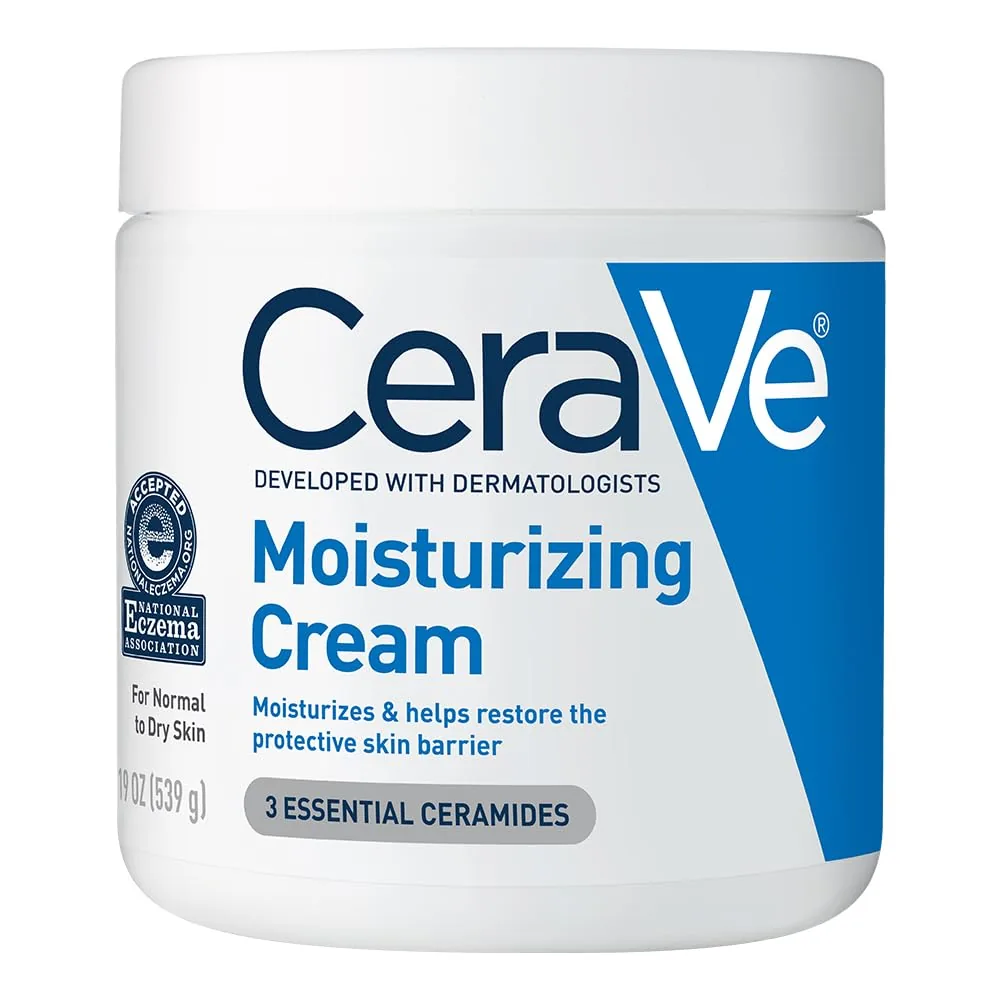
CeraVe Moisturizing Cream is a cream-format moisturizer from CeraVe, developed with dermatologist input and formulated around three ingredients the brand leans on across its moisturizer line: ceramides, hyaluronic acid, and the company’s MVE (Multivesicular Emulsion) delivery technology. CeraVe positions it for normal-to-dry skin and labels it for use on both the face and body, for adults and children ages 3 and up.
It carries the National Eczema Association’s Seal of Acceptance — a designation independently listed on the NEA’s own product directory, not just claimed by the brand — which signals that the formula meets NEA’s criteria as a product reasonable for eczema-prone skin to consider. That’s a meaningful, verifiable credential, though it’s worth being precise about what it does and doesn’t mean (more on that below).
Key Ingredients and What They Do
CeraVe Moisturizing Cream’s ingredient story is fairly simple, and that’s largely the point:
Ceramide NP, AP, and EOP — three “essential ceramides” that are naturally occurring lipids in skin. Ceramide-containing moisturizers are a well-established category in dermatology for helping support the skin’s outer barrier, which is the layer that keeps moisture in and irritants out.
Sodium hyaluronate — the salt form of hyaluronic acid, a humectant that helps draw and hold water in the skin’s outer layers. For a closer look at this ingredient on its own, see our guide to hyaluronic acid benefits and how to use it.
Petrolatum — an occlusive ingredient that forms a physical layer on the skin’s surface, helping reduce water loss. It’s one of the most well-studied occlusives in skincare.
Dimethicone — a silicone-based ingredient that contributes to the cream’s smooth, non-greasy-feeling finish.
MVE delivery technology — CeraVe’s proprietary emulsion system, which the brand describes as releasing moisturizing ingredients into the skin over time rather than all at once.
A few honest caveats worth stating plainly: CeraVe does not publish an exact concentration for any of these ingredients in this specific product, so claims about “how much” ceramide or hyaluronic acid is doing the work aren’t verifiable from public information. And while ceramide- and hyaluronic-acid-containing moisturizers are broadly supported by dermatology literature as a category, that general research doesn’t itself prove a specific outcome for this exact finished formula — it supports the ingredient choices, not a guaranteed result for every user.
Is CeraVe Moisturizing Cream Good for Dry Skin?
This is the use case CeraVe built the product for, and it’s the one best supported by both the brand’s own positioning and real user feedback. The combination of a humectant (hyaluronic acid) to draw in moisture and an occlusive (petrolatum) to help hold it there is a standard, dermatology-supported approach for dry skin, and it lines up with general guidance on how to pick a moisturizer for dry skin types. For a fuller routine built around this skin type rather than just this one product, see our skincare routine for dry skin.
The independent reviews found during research back this up as the product’s strongest use case: recurring positive themes include relief for very dry or flaky skin, comfortable use during the kind of dryness that comes with Accutane or other drying acne treatments, and a texture that many reviewers describe as absorbing without feeling heavy or greasy, despite being a thicker cream. If your skin regularly feels tight, flaky, or rough — especially on the body, or on drier areas of the face — this is squarely the situation CeraVe Moisturizing Cream is designed for.
Is It Suitable for Sensitive or Eczema-Prone Skin?
CeraVe Moisturizing Cream carries the National Eczema Association’s Seal of Acceptance, which is independently confirmed on NEA’s own eczema-friendly product directory — not just a claim on CeraVe’s packaging. That’s a genuinely useful signal: it means the formula has been evaluated against NEA’s criteria for products reasonable to consider if you have eczema.
It’s important to be precise about what that seal does and doesn’t mean, though. It does not mean the product treats or cures eczema — it’s a cosmetic moisturizer, not a medical treatment, and no cosmetic moisturizer should be described that way. It also doesn’t mean universal tolerance: individual reports vary, and skin that’s actively flaring, broken, or highly reactive can respond differently than skin that’s simply dry. If you have diagnosed eczema or another ongoing skin condition, it’s worth checking with a dermatologist about whether this specific formula fits your situation, rather than relying on the seal alone.
For general sensitive skin — skin that’s reactive to fragrance or prone to irritation without a formal diagnosis — the fragrance-free formulation and dermatologist-developed positioning make this a reasonable option to consider, with the usual caveat that any new product is worth patch-testing first.
Can You Use CeraVe Moisturizing Cream on Your Face?
Yes — CeraVe labels the product for both face and body use, and a number of reviewers use it that way without issue, particularly on drier areas like the cheeks. But this is also where feedback is more divided.
A recurring pattern in the independent reviews found during research is that the same cream can behave differently depending on where it’s applied: some reviewers report it works well on dry cheeks or body skin but causes congestion or breakouts specifically on the forehead, chin, or other oilier parts of the face. That’s a genuinely useful distinction — “can you use it on your face” and “will it agree with every part of your face” aren’t quite the same question, and the honest answer depends on how oily or acne-prone your facial skin runs, independent of how your body skin behaves.
Is It Good for Oily or Acne-Prone Skin?
This is the single area where it’s most important to be upfront, because CeraVe’s own guidance is clear here: the brand’s FAQ specifically recommends its lighter CeraVe Daily Moisturizing Lotion over this cream for people with oily or acne-prone skin. That’s not a knock on the product — it’s simply a richer, more occlusive formula than an oily or breakout-prone complexion typically needs.
CeraVe does label the cream “non-comedogenic,” which is the manufacturer’s own classification, based on CeraVe’s testing, indicating the formula isn’t expected to clog pores. But that’s a brand classification, not a universal guarantee — and real-world feedback reflects that nuance. In the independent reviews examined for this piece, including an aggregated sample of reviews on acne.org, clogged pores and breakouts were the complaint mentioned most often, concentrated specifically on facial use rather than body use. Some reviewers describe this plainly: fine on the body, but not worth the risk on an acne-prone face.
None of this means the cream definitively causes acne — individual skin chemistry varies enormously, and plenty of people with normal-to-combination skin use it on their face without any issue. But if you already know your skin runs oily or breaks out easily, it’s reasonable to start with CeraVe’s own recommended alternative — the Daily Moisturizing Lotion — rather than this richer cream, or to test this product on a small area first.
Texture, Finish, and How It Feels
CeraVe describes the cream as rich but non-greasy, absorbing without a sticky or heavy residue. That manufacturer description is echoed in a number of the independent reviews examined for this piece, where “thick but not greasy” and “absorbs better than expected for how rich it feels” are recurring descriptions. Because this is a research-based review and AvaFitCare has not personally tested this product, these texture notes reflect the brand’s own description plus a pattern seen across the independent reviews examined for this piece — not a first-hand account.
A few reviewers do describe it as needing more time to rub in than a lighter lotion, which tracks with it being a genuinely thicker formula than, say, CeraVe’s own Daily Moisturizing Lotion. If you dislike the feel of richer creams in general, that’s worth factoring in regardless of how well-reviewed this specific one is.
How to Use CeraVe Moisturizing Cream
CeraVe’s own instructions are straightforward: apply liberally to the face and/or body, as often as needed, morning or night.
A few practical notes worth adding:
Layering order: moisturizer typically goes after cleanser (and after any serums or treatment products), and before sunscreen or makeup.
Under sunscreen: this product is a moisturizer, not a sunscreen, and contains no SPF — it should be paired with a separate broad-spectrum sunscreen for daytime use, applied after the moisturizer has settled in.
Under makeup: some reviewers report it works fine as a base under makeup, though its richer texture may need a few extra minutes to absorb before applying foundation, compared to a lighter lotion.
How much to use: CeraVe doesn’t specify an exact amount; a general rule for cream moisturizers is to use enough to cover the area in a thin, even layer without leaving excess residue sitting on the skin.
Morning and night: it’s labeled for use at either time, so the deciding factor is more about your skin’s needs (e.g., a lighter product by day under sunscreen and makeup, this cream at night) than any restriction from the brand.
If dehydration — rather than dryness — better describes what your skin is dealing with, our skincare routine for dehydrated skin walks through how a hydrating step like this one fits into a fuller routine.
Pros and Cons
Pros:
Contains three ceramides plus hyaluronic acid, a well-supported combination for barrier support and hydration
Fragrance-free, which matters for reducing irritation risk, especially on sensitive skin
Carries the independently verified NEA Seal of Acceptance
Developed with dermatologist input
Works on both face and body
Available in a 19 oz jar — a size that may appeal to people who want one moisturizer for both face and body
Widely available at major U.S. retailers
Cons:
Not recommended by the brand itself for oily or acne-prone skin
“Non-comedogenic” doesn’t prevent breakouts for every user — clogged pores and breakouts on the face were the complaint mentioned most often in the independent reviews examined for this piece
Rich texture may feel too heavy for some users, especially by day or in warmer climates
No SPF — needs a separate sunscreen
No published ingredient concentrations or specific hydration-duration claims, so some marketing language (like “long-lasting”) can’t be independently verified
Jar packaging means repeated hand contact with the product, which some reviewers note as a hygiene consideration — though this isn’t unique to this product, and it doesn’t mean contamination is inevitable
CeraVe Moisturizing Cream vs. Daily Moisturizing Lotion
These two products share CeraVe’s core ceramide-and-hyaluronic-acid approach, and both carry the NEA Seal of Acceptance — but they differ in formulation, not just texture. The Daily Moisturizing Lotion is labeled oil-free by the brand and is lightweight and fast-absorbing, which makes it the better fit for naturally oily skin, daytime use, warmer weather, or layering under makeup and sunscreen without feeling heavy. The Moisturizing Cream, by contrast, isn’t labeled oil-free — it includes petrolatum and dimethicone for a richer, more occlusive feel — which makes it better suited to drier skin, colder months, nighttime use, or pairing with a retinoid or other actives that can be drying. If you’re unsure which one your skin needs, CeraVe’s own guidance is a reasonable starting point: richer cream for dry skin, lighter lotion for oilier or combination skin.
CeraVe Moisturizing Cream vs. CeraVe PM
CeraVe PM Facial Moisturizing Lotion is a different product with a different intended role: it’s a lightweight, oil-free nighttime facial lotion built around ceramides, niacinamide, and hyaluronic acid, labeled by the brand for use at night. CeraVe markets PM for all skin types rather than specifically for oily or combination skin, though its lighter, oil-free texture is a common reason people with oilier or combination skin choose it over the richer Moisturizing Cream. If a dry body plus an oilier or combination face describes your skin, it’s common to see people pair the Moisturizing Cream for the body with something like CeraVe PM for the face, rather than using the richer cream everywhere. We cover CeraVe PM in full in our CeraVe PM Facial Moisturizing Lotion review.
CeraVe Moisturizing Cream vs. Cetaphil Moisturizing Cream
Cetaphil’s Moisturizing Cream occupies similar territory — a rich, fragrance-free cream built around petrolatum for dry to very dry skin. The clearest ingredient difference is that Cetaphil’s cream doesn’t contain ceramides, relying instead on a simpler, petrolatum-based emollient formula, while CeraVe’s cream adds its three-ceramide blend plus hyaluronic acid as additional barrier-support ingredients. Neither is objectively “better” — the right choice often comes down to which formula your skin responds to, and both are reasonable, dermatologist-aligned options for dry skin.
CeraVe Moisturizing Cream vs. Vanicream
Vanicream takes a more minimalist approach: its Moisturizing Cream is fragrance-free, dye-free, built around petrolatum, and — per the manufacturer’s FAQ — contains no ceramides. Vanicream’s own product page states it also carries the National Eczema Association Seal of Acceptance, and the brand positions it specifically for sensitive skin and conditions like eczema, psoriasis, and ichthyosis. CeraVe’s formula adds more active barrier-support ingredients — ceramides, hyaluronic acid, cholesterol — along with additional emollients and preservatives that Vanicream’s shorter ingredient list leaves out. For many people, that added complexity isn’t an issue, but a shorter ingredient list doesn’t guarantee a lower reaction risk for every individual — if you have a history of reacting to multiple skincare products, Vanicream’s shorter list is often considered a more conservative starting point, and it’s worth discussing with a dermatologist if you’re trying to rule out specific ingredient triggers.
Who Should Buy It — and Who Should Skip It?
Likely a good fit if you:
Have normal-to-dry skin on your face, body, or both
Deal with eczema-prone or very reactive skin and want a fragrance-free, dermatologist-developed option with an independently verified eczema-friendly credential
Want one moisturizer you can use on both face and body
Are looking for a richer nighttime option, especially alongside drying actives like retinoids
Probably worth skipping, or trying cautiously, if you:
Know your skin runs oily or breaks out easily — CeraVe’s own guidance points you to the Daily Moisturizing Lotion instead
Want a single lightweight product for daytime use under sunscreen and makeup
Have a history of reacting to multiple skincare products and want the shortest possible ingredient list (worth comparing against Vanicream)
Are looking for sun protection in the same step — this product doesn’t include SPF
Final Verdict: Is It Worth It?
For the audience CeraVe built it for — normal-to-dry skin, body use, or eczema-prone skin looking for a fragrance-free option — CeraVe Moisturizing Cream holds up well. The ingredient choices are sound, the NEA seal is independently verifiable rather than just a marketing claim, and the independent reviews found during research lean positive specifically for dry-skin and body use.
Where it’s worth being careful is exactly where CeraVe itself is careful: this isn’t the brand’s own pick for oily or acne-prone skin, and the independent reviews examined for this piece back that caution up, especially for facial use. It’s also not a sunscreen replacement, and it won’t suit anyone who specifically wants the shortest possible ingredient list. If your skin is dry and you want a well-supported, fragrance-free cream for your face and body, this is a reasonable one to try. If you’re oily, acne-prone, or just want something lighter for daytime, CeraVe’s own Daily Moisturizing Lotion — or a dedicated oil-free option — is the more sensible starting point.
Yes — this is the use case it’s built and marketed for. Its combination of ceramides, hyaluronic acid, and petrolatum follows a well-supported approach for dry-skin hydration and barrier support, and it’s the strongest recurring theme in the independent reviews examined for this piece.
The brand labels it for daily face and body use. Whether it’s the right daily pick for your face specifically depends on your skin type — it tends to work well on dry or normal facial skin, while oily or acne-prone skin may find it too rich for everyday use.
It’s labeled non-comedogenic by the manufacturer, based on CeraVe’s own testing — but that’s a brand classification, not a universal guarantee. In the independent reviews examined for this piece, clogged pores and breakouts — particularly on the face — were the complaint mentioned most often, so individual results clearly vary.
CeraVe’s own guidance recommends its lighter Daily Moisturizing Lotion instead for oily or acne-prone skin. This cream is positioned for normal-to-dry skin, and its richer, non-oil-free texture is more likely to feel heavy on oilier skin types.
Yes, per the manufacturer’s own product information.
Yes — it carries the NEA Seal of Acceptance, which is independently confirmed on the National Eczema Association’s own product directory, not just claimed by CeraVe. That means it’s been evaluated against NEA’s criteria; it doesn’t mean it treats or cures eczema.
Both share the same core ceramide-and-hyaluronic-acid ingredients and the NEA seal, but the Lotion is also labeled oil-free, lighter, and faster-absorbing — suited to oilier skin and daytime use — while the Cream is thicker, contains petrolatum, and is more occlusive, suited to drier skin and nighttime use.
CeraVe PM is a lightweight, oil-free facial lotion built with ceramides and niacinamide, labeled by the brand for nighttime use and marketed for all skin types, though its lighter texture makes it a common choice for oilier or combination skin. The Moisturizing Cream is a richer, face-and-body cream positioned for normal-to-dry skin.
Yes, after letting it absorb. Keep in mind this product contains no SPF on its own, so daytime use still requires a separate broad-spectrum sunscreen.
Not definitively — each uses a different ingredient approach. CeraVe and Vanicream both carry the NEA Seal of Acceptance on this type of product. CeraVe adds active barrier-support ingredients like ceramides and hyaluronic acid; Cetaphil offers a similar rich-cream category built on a simpler, ceramide-free base; Vanicream uses the shortest, most minimalist ingredient list of the three, often recommended for very sensitive or reaction-prone skin. Which is “best” depends on your skin’s specific needs rather than one product outranking the others.