Retinol is one of the most studied ingredients in skincare, but a surprising number of the problems people run into with it aren’t about the ingredient itself — they’re about how it’s used. Starting too aggressively, applying too much, stacking it with every other active in the cabinet, or quitting the moment skin looks worse before it looks better: these are the patterns that turn a genuinely useful ingredient into a source of redness, flaking, and frustration.
This guide is specifically about over-the-counter cosmetic retinol — not prescription tretinoin, adapalene, tazarotene, or trifarotene, which are regulated, more potent medications with their own labeling and their own rules. Where a prescription retinoid’s instructions are relevant for context, that’s called out explicitly, because casually applying prescription-drug directions to a cosmetic product (or the reverse) is itself one of the more common sources of confusion. If you’re looking for the basics of how to start retinol as a beginner, see our full guide to starting retinol; if you’re trying to sort out retinol from the rest of the retinoid family, see retinol vs. retinoid. This article assumes you already have some familiarity with retinol and focuses specifically on the mistakes that cause irritation, waste product, or lead people to quit before it has a chance to work.
Most retinol problems come down to a handful of avoidable patterns: starting too often or using too much, stacking it with several other strong actives at once, pushing through significant irritation instead of scaling back, assuming every breakout afterward is “purging,” skipping moisturizer or daytime sunscreen, assuming a higher percentage works faster, and expecting visible results before retinol has had enough time to work. None of these mean retinol is “wrong for you” — they’re usually fixable by slowing down, simplifying your routine, and following your specific product’s own directions rather than a generic internet rule.
Why These Mistakes Matter
Retinol works gradually, through effects on skin cell turnover and collagen-related activity, and it’s genuinely capable of mild-to-moderate irritation while skin adjusts. That combination — slow benefits, fast-enough irritation — is exactly what makes it easy to misuse: people either escalate too quickly because they’re not seeing results, or they quit the moment skin reacts because they assume something’s gone wrong. Most of the mistakes below aren’t about a defective product or a particularly sensitive person; they’re about mismatched expectations and avoidable overload. Correcting them usually doesn’t mean switching products — it means changing how you use the one you already have.
1. Starting Too Often
A common beginner pattern is jumping straight to nightly use in the first week, assuming more frequent application will speed things up. Dermatology sources consistently recommend the opposite approach — starting with infrequent use, such as every other night or a few nights a week, and increasing gradually as skin builds tolerance — though there isn’t one single universal number every source agrees on. What is consistent across sources is the direction: slower is safer, and there’s no real reward for rushing.
Part of why a universal schedule doesn’t exist is that over-the-counter retinol isn’t a standardized drug. The FDA doesn’t require OTC cosmetic retinol products to disclose their percentage or concentration on the label, and these products aren’t put through the same safety and effectiveness testing prescription retinoids are — which means two products both marketed as “retinol” can behave very differently. That’s exactly why your specific product’s own directions should carry more weight than a generic frequency rule, including the general guidance in this article.
2. Using More Than Your Product Directs
“Pea-sized amount” shows up constantly in skincare advice, and it is a commonly cited dermatologist rule of thumb — but it isn’t a standardized, concentration-agnostic law handed down for every OTC retinol product. Because formulations and strengths vary so much (see Mistake 1), the more reliable guidance is to use a thin, even layer sufficient to cover the areas you’re treating, and to follow the amount your specific product’s label recommends rather than assuming one fixed quantity applies universally. Using more than directed doesn’t improve results faster — it mainly adds unnecessary dryness and flaking.
3. Assuming a Higher Percentage Is Automatically Better
Higher retinoid concentrations are associated with more irritation — this is a well-documented, dose-dependent effect. What’s less obvious, and more useful to know, is that a higher percentage doesn’t reliably buy you better or faster visible results. A controlled 12-week study comparing 0.3% and 0.5% retinol serums found both concentrations produced comparable improvement in wrinkles and skin tone — the higher-strength version mainly produced more irritation (more peeling and itching), not meaningfully better outcomes. Treating “higher percentage” as a shortcut to faster progress is one of the more common ways people end up with more irritation and the same results they’d have gotten from a gentler formula.
4. Applying Retinol to Irritated or Compromised Skin
Starting (or continuing) retinol on skin that’s already irritated — from recent over-exfoliation, a reaction to another product, sunburn, or a skin condition flare — tends to make things worse rather than better. This isn’t about self-diagnosing a “damaged skin barrier”; it’s simpler than that: if your skin is already uncomfortable, reactive, or visibly irritated for any reason, that’s a reasonable signal to let it settle before introducing or continuing an active ingredient, rather than adding retinol on top of an existing problem.
5. Pushing Through Significant Irritation Instead of Scaling Back
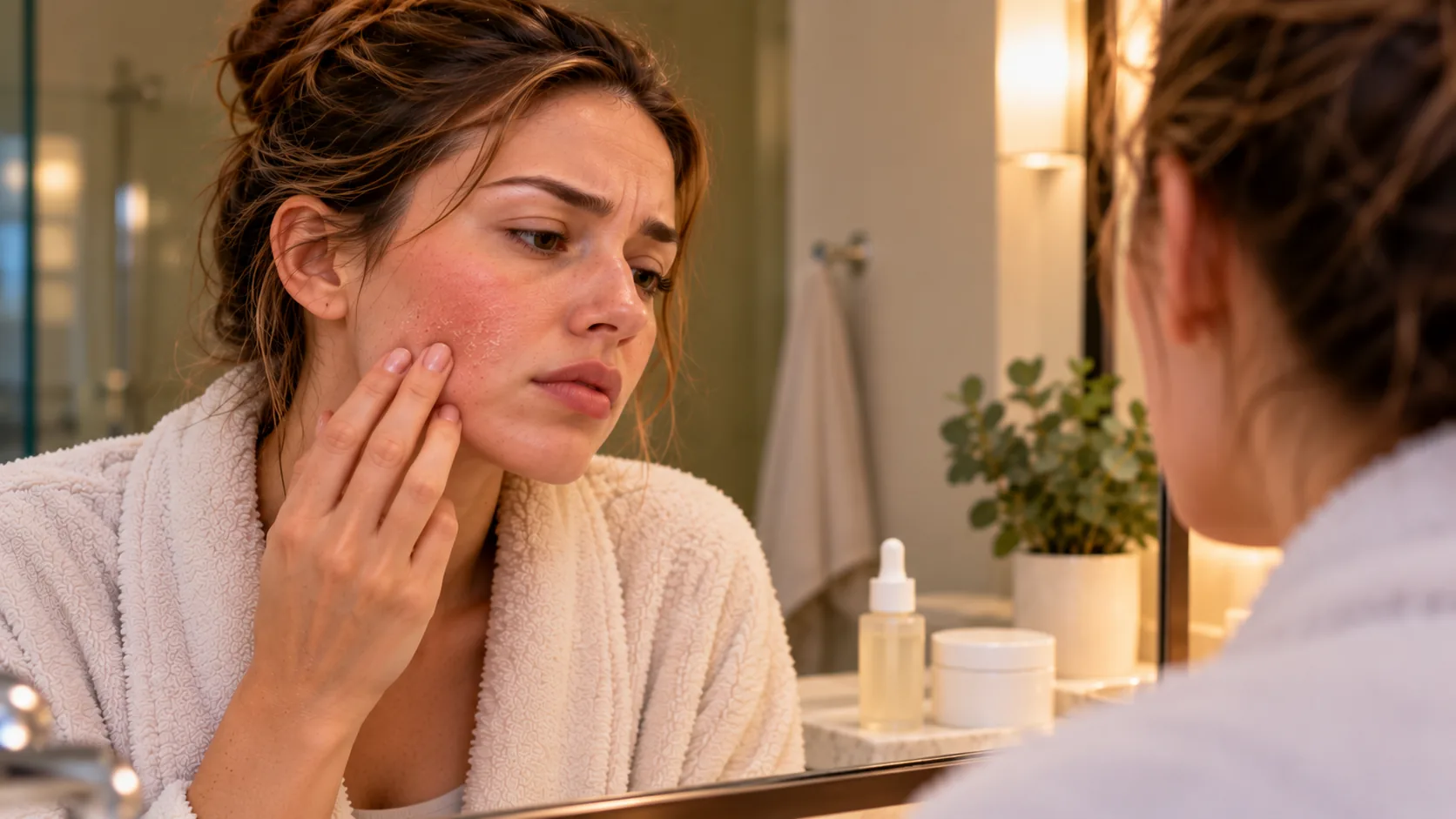
Mild dryness, redness, peeling or flaking, and some stinging or burning are common as skin adjusts to retinol, and they typically fade with continued, consistent use. That’s genuinely normal — but “normal adjustment” has limits, and pushing through anything beyond mild irritation isn’t a sign of commitment, it’s a sign to back off.
Blistering, significant swelling, oozing, a rash that spreads beyond where you applied the product, or signs of infection are not part of ordinary adjustment, and they’re a reasonable point to stop use and check in with a dermatologist or other healthcare provider. Swelling of the lips or mouth, or trouble breathing, can indicate a serious allergic reaction and warrants emergency care. None of this means retinol is unsafe for most people — it means severe symptoms are a stop sign, not a “working harder” sign, and they should never be interpreted as proof the product is doing its job.
6. Treating Every Breakout as “Purging”
“Purging” is a term you’ll see constantly in skincare content, but it isn’t a formal medical diagnosis — it doesn’t appear in the American Academy of Dermatology’s retinoid guidance or in the peer-reviewed retinoid-irritation literature reviewed for this guide. Even sources that acknowledge the phenomenon tend to describe it loosely — a general “it might look worse for a couple of months” rather than a precise, universal rule — and there’s no authoritative source for the specific “4 to 6 weeks” timeline that circulates online, so this guide doesn’t repeat it as fact.
The practical risk with “purging” as an explanation is that it’s comforting, and comforting explanations get used to justify continuing something that genuinely isn’t agreeing with your skin. A temporary uptick in breakouts that gradually improves with continued use is consistent with an adjustment period. Breakouts that keep getting worse, become painful, or don’t improve over time deserve a second look — not an assumption that things will eventually “purge” their way to clear.
7. Combining Too Many Irritating Actives at Once
This is less about any single ingredient being unsafe with retinol and more about total irritation load. It’s worth separating three different things that tend to get lumped together online: genuine chemical incompatibility (rare), increased irritation potential when multiple actives are layered or used together (common), and outdated internet rules that were never well-supported in the first place.
What Can You Use With Retinol?
Ingredient
Can they coexist?
Main concern
What the evidence actually shows
AHAs (glycolic, lactic acid)
Yes
Additive dryness/irritation, not a chemical reaction
No incompatibility found; alternating nights or using one AM and one PM is a reasonable way to reduce irritation risk, not a required safety rule
BHA / salicylic acid
Yes, for cosmetic retinol
Additive irritation
No OTC-specific warning exists. Prescription tretinoin’s own labeling specifically advises against combining it with salicylic acid, benzoyl peroxide, or sulfur, with a suggested one-hour buffer — that’s a prescription-drug instruction, not an AAD or FDA statement about OTC retinol, though applying the same caution to cosmetic retinol is reasonable
Benzoyl peroxide
Workable with timing separation
Historically, benzoyl peroxide can chemically degrade tretinoin under certain formulation and light conditions; modern stabilized prescription combination products have resolved this for tretinoin. No published stability data exists either way for OTC retinol + benzoyl peroxide specifically
Using them at separate times of day (for example, benzoyl peroxide in the morning, retinol at night) is a sensible precaution given the evidence gap, not a proven requirement for cosmetic retinol
A clinical trial combining retinol with one specific vitamin C derivative, sodium ascorbyl phosphate, found the combination more effective for acne than either ingredient alone — evidence against a blanket “never mix vitamin C and retinol” rule, but specific to that formulation, not proof every vitamin C product (including plain L-ascorbic acid serums) performs identically with retinol. The common AM-vitamin-C / PM-retinol split is more about formulation stability and daytime antioxidant support than a documented safety requirement
Niacinamide
Yes
None
A study found that a niacinamide-containing moisturizer — which also contained other ingredients, not niacinamide alone — was associated with measurably reduced irritation when used alongside a retinoid. The study doesn’t isolate niacinamide by itself as the specific cause, but it does show niacinamide isn’t subject to a blanket “avoid with retinol” rule
Hyaluronic acid
Yes
None
A hydrating humectant, not an exfoliating acid despite the name — commonly used specifically to help offset retinol-related dryness
Ceramides
Yes
None
A recognized, dermatology-studied way to help buffer retinoid irritation, not an internet trend
Moisturizer
Yes
None (see Mistake 9)
Supports tolerability; does not cancel out retinol’s effects
Sunscreen
Yes — and necessary
None
Essential daytime pairing (see Mistake 10)
The practical takeaway for beginners and anyone troubleshooting irritation: if you’re using more than one strong active (retinol plus an exfoliating acid, plus a high-strength vitamin C, for example), introduce them one at a time, and consider alternating nights or splitting actives between morning and evening rather than layering everything into one routine. For a broader look at where different actives fit in a full routine, see our guide to layering skincare products in the right order.
8. Applying Retinol to Damp or Wet Skin
This is one of the most widely repeated claims in skincare content, and it’s worth being precise about where it actually comes from. Prescription tretinoin’s FDA label specifically instructs patients to wait 20 to 30 minutes after washing and make sure skin is completely dry before applying, stating this helps minimize irritation.
What the label does not say — and what no study located for this guide confirmed — is a specific mechanism, such as water increasing how much product penetrates the skin. And critically, this is a prescription-drug labeling instruction, not a finding from research on over-the-counter cosmetic retinol specifically. No dedicated study comparing damp-skin versus dry-skin application for OTC retinol was found. That doesn’t mean the advice is wrong — applying to clean, dry skin is a reasonable, low-risk habit, consistent with the official guidance for the closely related prescription ingredient — but it isn’t an established, universal rule proven for every retinol product, and claims that “water makes retinol stronger” or meaningfully changes how it works aren’t supported by the evidence reviewed here.
9. Skipping Moisturizer and Barrier-Supportive Basics
Moisturizer isn’t an optional add-on to a retinol routine — it’s functionally part of it. Research on moisturizer use before and during retinoid treatment has found it can help with irritation and comfort, without evidence that it makes retinol stop working. The idea that moisturizer “cancels out” retinol isn’t supported.
One preliminary laboratory study, presented at a 2025 American Academy of Dermatology meeting, looked specifically at moisturizer placement. Working with donated human skin tissue — not a clinical trial on living people, and from a single donor — it found that applying moisturizer on only one side of retinol (before it, or after it, but not both) appeared to preserve more of retinol’s measured activity in that lab setting than applying moisturizer on both sides (a full “sandwich”: moisturizer, then retinol, then moisturizer again), which showed reduced measured activity by comparison. It’s worth being clear about what kind of evidence this actually is: it’s early-stage, ex-vivo laboratory evidence, not a clinical trial showing worse real-world skin outcomes in actual people, and it was funded by a company that sells moisturizer and retinol products, with a study author in a leadership role there — both relevant to how much weight to put on the finding. It does not establish that sandwiching “makes retinol ineffective,” and it doesn’t mean moisturizing before retinol is the wrong approach — plenty of people reasonably moisturize before retinol specifically to buffer irritation, and that remains a sensible way to manage tolerability. If you’re specifically trying to preserve as much of retinol’s measured activity as possible and your skin tolerates it well, this preliminary data is one reason to consider moisturizing on just one side rather than both; if your skin needs more buffering than that, or your product’s own directions say otherwise, prioritize comfort and your product’s instructions over this one early finding.
10. Skipping Daytime Sun Protection
Retinoids, including OTC retinol, can make skin more sensitive to sun — this is part of why they’re generally used at night in the first place. Daily broad-spectrum sunscreen isn’t a separate, optional recommendation layered on top of a retinol routine; it’s a standard part of one. Sunscreen reduces risk, but it doesn’t eliminate it entirely, and it isn’t a substitute for the nighttime-use pattern retinol is typically built around. If you need help choosing a daily sunscreen, see our best sunscreens for beginners guide and our breakdown of how much sunscreen you actually need on your face.
11. Ignoring Product-Specific Directions
This might be the single most practically important mistake on this list, because it underlies several of the others. Over-the-counter retinol isn’t one standardized formula — concentration isn’t required to be disclosed, products aren’t tested for safety and effectiveness the way prescription retinoids are, and formulation (stabilization, base ingredients, delivery system) varies enormously between brands. A generic rule — including the general guidance in this article — is a reasonable starting point, but your specific product’s own label is the more reliable source when the two conflict. If a product tells you to use it differently than general advice suggests, that’s not a contradiction to resolve in favor of the internet; it’s a reason to follow the label.
12. Expecting Results Too Quickly
Retinol doesn’t work on one universal timeline, and expecting it to is one of the more common reasons people either give up early or push frequency and strength too hard trying to force faster progress.
How long it takes to notice a difference depends on the formulation, the concentration, what you’re actually trying to improve, how consistently you use it, and your own skin — there isn’t one single number that applies across every product and every concern, and results from one study or one formulation shouldn’t be read as a promise for every OTC retinol product. As one example, a pooled analysis of six studies and 471 participants using one specific stabilized 0.1% retinol formulation found statistically significant improvement over a non-active vehicle in overall photodamage, wrinkles, and tone as early as four weeks, continuing through twelve weeks — but that result is specific to that formulation and that set of studies, not a universal timeline. Different concerns also tend to move at different speeds relative to each other: acne and pigmentation/uneven tone generally take longer to judge than overall texture or fine lines, and pigmentation in particular is also the outcome most affected by ongoing, unprotected sun exposure — which can visibly re-darken skin and look like “the product isn’t working” when the real issue is unprotected UV exposure undoing progress, not retinol failing.
What ties all of this together is that none of it is a fixed, universal number — it depends on concentration, formulation, the specific concern you’re tracking, how consistently you use it, and individual response. Dermatologists commonly describe a related behavioral pattern worth naming directly: when results don’t show up as fast as expected, people often respond by either increasing frequency or strength beyond what their skin has adjusted to, or by quitting before retinol has had a reasonable amount of time to work. Neither response tends to help — the more reliable path is consistent, moderate use over a period of months, not an intensity escalation in the first few weeks and not a fixed day-count deadline for judging whether it’s “working.”
13. Using Retinol During Pregnancy Without Medical Guidance
This is an area where caution matters more than general skincare advice, and it deserves a direct, separate discussion rather than being folded into a general ingredients caveat.
Oral retinoids (like isotretinoin, used for severe acne) are well-established to cause serious birth defects and are strictly contraindicated during pregnancy. This part isn’t nuanced or debatable.
Topical retinoids and pregnancy are a more complicated picture. Research specific to topical tretinoin shows low systemic absorption when used as directed. A small number of case reports have described birth defects following topical tretinoin use during pregnancy, but larger prospective studies — following 96 and 106 women through their first trimester — did not find an increased risk of major birth defects. A broader systematic review and meta-analysis of topical retinoid exposure in the first trimester (654 exposed pregnancies compared with 1,375 unexposed controls) similarly found no statistically significant increase in major congenital malformations, spontaneous abortion, low birthweight, or prematurity, with the reviewing authors concluding this “may be used primarily in reassuring women who were inadvertently exposed to topical retinoids during their pregnancy” while also stating plainly that the statistical power isn’t adequate to justify deliberately using topical retinoids during pregnancy. Despite that reassuring pattern, authoritative guidance still generally recommends avoiding topical retinoids during pregnancy as a precaution — and it’s worth being direct about a limitation here: most of this specific research concerns prescription tretinoin, not every over-the-counter retinol product on the market, so “OTC retinol must be safer because it’s weaker” isn’t a conclusion this evidence actually supports.
Breastfeeding guidance isn’t automatically the same as pregnancy guidance. For topical tretinoin specifically, it’s generally considered low risk to a nursing infant because it’s poorly absorbed, though there’s little published data on how much actually reaches breast milk, and general guidance recommends avoiding direct application to the nipple and areola and preventing infant skin contact with treated areas. As with pregnancy, this research is specific to tretinoin, not every retinol product.
If you’re pregnant, trying to become pregnant, or breastfeeding, the safest course is to talk to your OB-GYN, dermatologist, or another qualified healthcare provider about your specific product and situation, rather than relying on general skincare guidance — including this article — to make that decision for you.
When Should You Stop and Ask a Dermatologist?
A few situations are worth a dermatologist’s input rather than more trial and error:
Irritation that’s severe, painful, blistering, or spreading, or that doesn’t improve after scaling back frequency
Breakouts that keep getting worse over time instead of gradually settling
You’re pregnant, trying to become pregnant, or breastfeeding and want product-specific guidance
You’re already using a prescription acne or retinoid treatment and are considering adding OTC retinol on top of it
You have a diagnosed skin condition (eczema, rosacea, psoriasis) and aren’t sure how retinol fits with it
You’ve made several of the adjustments in this guide and your skin still isn’t tolerating retinol after a reasonable amount of time
This list is meant to help you recognize when professional input is especially useful — it isn’t a diagnostic tool, and it isn’t a substitute for actually talking to one.
Frequently Asked Questions
Nothing is strictly off-limits with over-the-counter cosmetic retinol based on the evidence reviewed here, but combining it with other strong actives — exfoliating acids, high-strength vitamin C, benzoyl peroxide — raises total irritation potential. Timing separation (alternating nights, or splitting actives between morning and night) is a reasonable precaution, not a universal safety rule. See the compatibility table above for ingredient-by-ingredient detail.
Some people eventually tolerate nightly use well, but there’s no requirement to work up to it, and starting there is one of the more common mistakes in this guide. Building up gradually from less frequent use is the more consistently recommended approach.
Yes — using more than a thin, even layer, or your product’s directed amount, doesn’t speed up results and is a common, avoidable cause of unnecessary dryness and flaking.
This is specifically prescription tretinoin’s labeling instruction, not a rule independently established for OTC cosmetic retinol. Applying to clean, dry skin is a reasonable, low-risk habit, but no study confirms damp skin meaningfully changes how retinol performs.
Either can work, and moisturizing before retinol specifically to buffer irritation is a reasonable, common approach — it isn’t “wrong.” One preliminary, industry-funded lab study using donated human skin tissue (not a clinical trial on real people) found that moisturizing on only one side of retinol preserved more of its measured activity than a full moisturizer-retinol-moisturizer “sandwich” did in that lab setting. It’s early, ex-vivo evidence, not a proven real-world outcome — worth knowing if you’re trying to maximize retinol’s effect, but not a reason to avoid the sandwich method if that’s what your skin needs for comfort.
There’s no good basis for a blanket rule against combining them. One clinical trial combining retinol with a specific vitamin C derivative, sodium ascorbyl phosphate, found the combination more effective than either ingredient alone for acne — but that’s evidence about that particular formulation, not a guarantee for every vitamin C product, including plain L-ascorbic acid serums. Many people still prefer a vitamin C morning / retinol night split, mainly for formulation-stability and sun-protection reasons rather than a documented safety requirement.
For OTC cosmetic retinol, there’s no specific warning against it, though combining two actives raises irritation potential, so alternating nights is a reasonable approach. Note that prescription tretinoin’s own labeling does specifically advise against combining it with salicylic acid — that’s a prescription-specific instruction, not a statement about OTC retinol.
There’s no blanket rule against it. Research has found that a niacinamide-containing moisturizer — which also contained other supportive ingredients, not niacinamide in isolation — was associated with reduced irritation when used alongside a retinoid. That doesn’t prove niacinamide alone is responsible for the effect, but it does support that niacinamide isn’t something to avoid pairing with retinol.
“Purging” is a popular term, not a formal medical diagnosis, and there’s no authoritative, universal timeline for it. A temporary increase in breakouts that gradually improves with continued use is consistent with an adjustment period; breakouts that keep getting worse deserve a closer look rather than an assumption that they’ll eventually resolve on their own.
Mild dryness, redness, flaking, and stinging are common and typically improve with continued use. Blistering, significant swelling, a spreading rash, or signs of infection are not normal and are a reasonable point to stop use and contact a dermatologist; swelling of the lips or mouth or trouble breathing warrants emergency care.
This is a question for your OB-GYN, not a skincare article. Oral retinoids have well-established, serious pregnancy risks. The evidence on topical retinoids is more reassuring but incomplete, and most of it concerns prescription tretinoin specifically rather than every OTC retinol product. Authoritative sources still generally recommend avoiding topical retinoids during pregnancy as a precaution — talk to your provider about your specific product.
Bottom Line
Most retinol problems aren’t about retinol being wrong for your skin — they’re about pace, amount, and expectations. Start less often than feels necessary, use less product than you’d guess, introduce other actives one at a time, don’t mistake every breakout for “purging,” keep moisturizer and sunscreen as non-negotiable parts of the routine, and give it months rather than weeks before judging whether it’s working. Follow your specific product’s directions over any general rule, including the ones in this guide, and when irritation goes beyond mild and temporary, that’s a reasonable point to scale back or check in with a dermatologist rather than push through it.
This guide was researched using current U.S. authoritative sources, including the FDA, the American Academy of Dermatology, peer-reviewed dermatology journals (including a pooled photoaging analysis, a concentration-comparison RCT, an acne-ingredient-combination RCT, and a formulation-irritation review), NIH/NCBI pregnancy and lactation resources, and reputable academic medical institutions including Cleveland Clinic and Mayo Clinic. Where a popular online claim lacked real evidence — a specific purge timeline, a damp-skin mechanism, or a “higher percentage without more benefit” framing — that claim was either removed or explicitly flagged as unsupported rather than repeated. This guide does not claim clinical or dermatologist review, and it is not a substitute for personalized advice from a dermatologist, OB-GYN, or other qualified healthcare professional — particularly around pregnancy, breastfeeding, persistent irritation, or combining retinol with a prescription treatment.
Medical Disclaimer IncludedClearly marked below — this guide is educational, not personalized medical advice.
Read our Review Policy for a plain explanation of what our review process does — and doesn't — mean for health-adjacent content.
Sources & Further Reading
U.S. Food and Drug Administration / DailyMed — Tretinoin prescribing and medication guide labeling Narsa et al. — “A Comprehensive Review of the Strategies to Reduce Retinoid-Induced Skin Irritation in Topical Formulation,” Dermatology Research and Practice, 2024 Zasada, Budzisz & Erkiert-Polguj — split-face comparison of 0.3% and 0.5% retinol, Skin Pharmacology and Physiology, 2020 Pooled vehicle-controlled analysis of topical 0.1% stabilized retinol for photoaging (6 studies, 471 participants), Journal of Drugs in Dermatology, 2024 Sodium ascorbyl phosphate, retinol, and combination therapy RCT for acne, 2009 (PubMed 19134126) Draelos, Ertel & Berge — “Facilitating Facial Retinization Through Barrier Improvement,” Cutis, 2006 2025 AAD-meeting moisturizer-layering/retinoid-bioactivity study, as reported by Dermatology Times
Affiliate Disclosure: This article does not currently contain any affiliate links.
This article is for general informational and educational purposes only and is not a substitute for professional medical advice, diagnosis, or treatment. It does not create a doctor-patient relationship. Always seek the advice of a dermatologist, physician, OB-GYN, pediatrician, or other qualified healthcare provider with any questions you may have regarding a medical condition, a prescription medication, or use of any product during pregnancy or breastfeeding. Never disregard professional medical advice or delay seeking it because of something you read here.
Get New Guides in Your Inbox
No spam, no filler — just new articles as we publish them.