Short answer: retinol is a retinoid — it’s just one specific, milder member of a much larger family. “Retinoid” is the umbrella term for every vitamin A–based ingredient used in skincare and medicine, from cosmetic retinol you can buy at a drugstore to prescription medications like tretinoin. Retinol isn’t a competing category to “retinoid” — it’s inside it.
That distinction gets flattened online constantly, usually into something like “retinoid = strong prescription stuff, retinol = the gentle drugstore version.” That’s close enough to be dangerous: it’s true often, but not always, and the exception — adapalene, which is sold both over the counter and by prescription in the U.S. — is exactly the kind of detail that matters if you’re trying to actually understand what you’re putting on your face. This guide sorts out the terminology, the current U.S. rules for what you can buy without a prescription, and how the main retinoid types actually compare, so you know what you’re choosing between — not just what to do with retinol day to day. For the practical side of that (how to start, how often to use it, what to expect), see our full guide to starting retinol as a beginner.
Retinoid is the umbrella category: every vitamin A derivative used in skincare and medicine falls under it. Retinol is one specific retinoid — an over-the-counter cosmetic ingredient that has to be metabolized through a couple of steps inside your skin before it activates retinoid receptors. Tretinoin is a prescription retinoid that’s chemically identical to that fully active form, so it engages those receptors with no conversion needed. Tazarotene and trifarotene are also prescription retinoids, but they’re synthetic molecules that bind retinoid receptors directly through their own chemistry, not by traveling through the same retinol-to-retinoic-acid pathway. That direct receptor engagement — shared by tretinoin, tazarotene, and trifarotene, each by its own route — is a large part of why prescription retinoids tend to work faster and cause more irritation than retinol. Adapalene is the one ingredient that crosses the OTC/prescription line both ways — it’s available over the counter at 0.1% strength (including in a newer OTC adapalene/benzoyl peroxide combination gel) and by prescription at 0.3% or in other combination products. So: is retinol a retinoid? Yes. Is every retinoid retinol? No.
Retinol vs. Retinoid at a Glance
Retinoid (the category)
Retinol (one member of it)
What it is
The umbrella term for all vitamin A–based ingredients used on skin
One specific, milder retinoid
U.S. availability
Ranges from OTC to prescription, depending on which specific retinoid
Over the counter, no prescription needed
Includes
Retinol, retinaldehyde, tretinoin, adapalene, tazarotene, trifarotene (topical) and isotretinoin (oral)
Just itself
How active it is on application
Varies — tretinoin needs no conversion; synthetic retinoids (adapalene, tazarotene, trifarotene) bind receptors directly; precursor forms need metabolic conversion
Needs to be metabolized through retinaldehyde to active retinoic acid
Typical use
Depends on the specific compound and its approved use
General cosmetic use for texture, tone, and fine lines
What Is a Retinoid?
“Retinoid” is a category, not a single ingredient. According to the American Academy of Dermatology, “the term ‘retinoids’ is a catch-all for an array of vitamin A-based products used on skin.” That category spans a wide range — from cosmetic ingredients you can buy without a prescription to regulated medications used to treat acne and other skin conditions.
What unites them is the receptor system they ultimately act on, not strength or availability: every retinoid works by activating retinoid receptors in skin cells (more on that below), even though compounds differ a lot in how they get there — some are metabolized into their active form first, others are built to engage those receptors directly — and in how they’re regulated and marketed.
What Is Retinol?
Retinol is one specific retinoid — a form of vitamin A that’s sold over the counter in a huge range of serums, creams, and other cosmetic products. It’s arguably the most recognizable name in the whole retinoid family, which is part of why it sometimes gets used loosely as a stand-in for the entire category.
Retinol itself has only weak, indirect activity in the form you apply it. Inside skin cells, it’s metabolized — first to retinaldehyde, then to retinoic acid, the form that actually binds and activates nuclear retinoid receptors (more on this conversion process below). That extra metabolic step is a meaningful part of why retinol tends to be gentler and slower-acting than tretinoin, which already is retinoic acid. Other prescription retinoids, like adapalene and tazarotene, aren’t part of this same conversion chain at all — they’re separate synthetic molecules built to bind retinoid receptors directly (more on that distinction below).
Is Retinol a Retinoid?
Yes. This is worth stating plainly because it’s one of the most common points of confusion: retinol is not a separate thing from “retinoid” — it’s a member of the retinoid family, specifically the most common over-the-counter one. Every retinol product is a retinoid product. Not every retinoid product is retinol.
Common Types of Retinoids Explained
Retinyl Esters
Retinyl esters (like retinyl palmitate) are the storage form of vitamin A and sit at the very start of the conversion chain toward the active form — they require the most metabolic steps (to retinol, then retinaldehyde, then retinoic acid) before they can activate retinoid receptors. They’re sometimes found in cosmetic products and are mentioned here mainly for completeness — they’re not a major focus of most beginner or comparison discussions.
Retinol
Covered above. The most common OTC retinoid, requiring conversion through retinaldehyde to become active.
Retinal (Retinaldehyde)
Retinaldehyde — often marketed as “retinal” — is one metabolic step closer to retinoic acid than retinol, needing only a single further conversion to become active. Some dermatology literature reasons from this that retinaldehyde may be more potent than retinol on a like-for-like basis, but that’s a mechanistic inference from the conversion pathway, not a well-established head-to-head clinical finding, and it doesn’t reliably predict how any specific retinaldehyde product will compare to any specific retinol product. It’s also sold as its own cosmetic ingredient and has a smaller, but real, body of clinical research behind it, including recent published work on retinaldehyde formulations for skin texture and visible signs of photoaging. As with the rest of this family, formulation and concentration affect real-world performance as much as which specific molecule is used.
Retinoic Acid / Tretinoin
Retinoic acid is the fully active form of vitamin A at the cellular level — the form every precursor retinoid (retinyl esters, retinol, retinaldehyde) ultimately has to convert into to activate retinoid receptors. Tretinoin is the pharmaceutical name for topical retinoic acid, and it’s a prescription medication in the United States. Because it doesn’t need to be converted, it engages retinoid receptors directly, which is a major reason it has the deepest, most established clinical evidence base of any topical retinoid — and also why it tends to cause more irritation, especially early on.
Adapalene
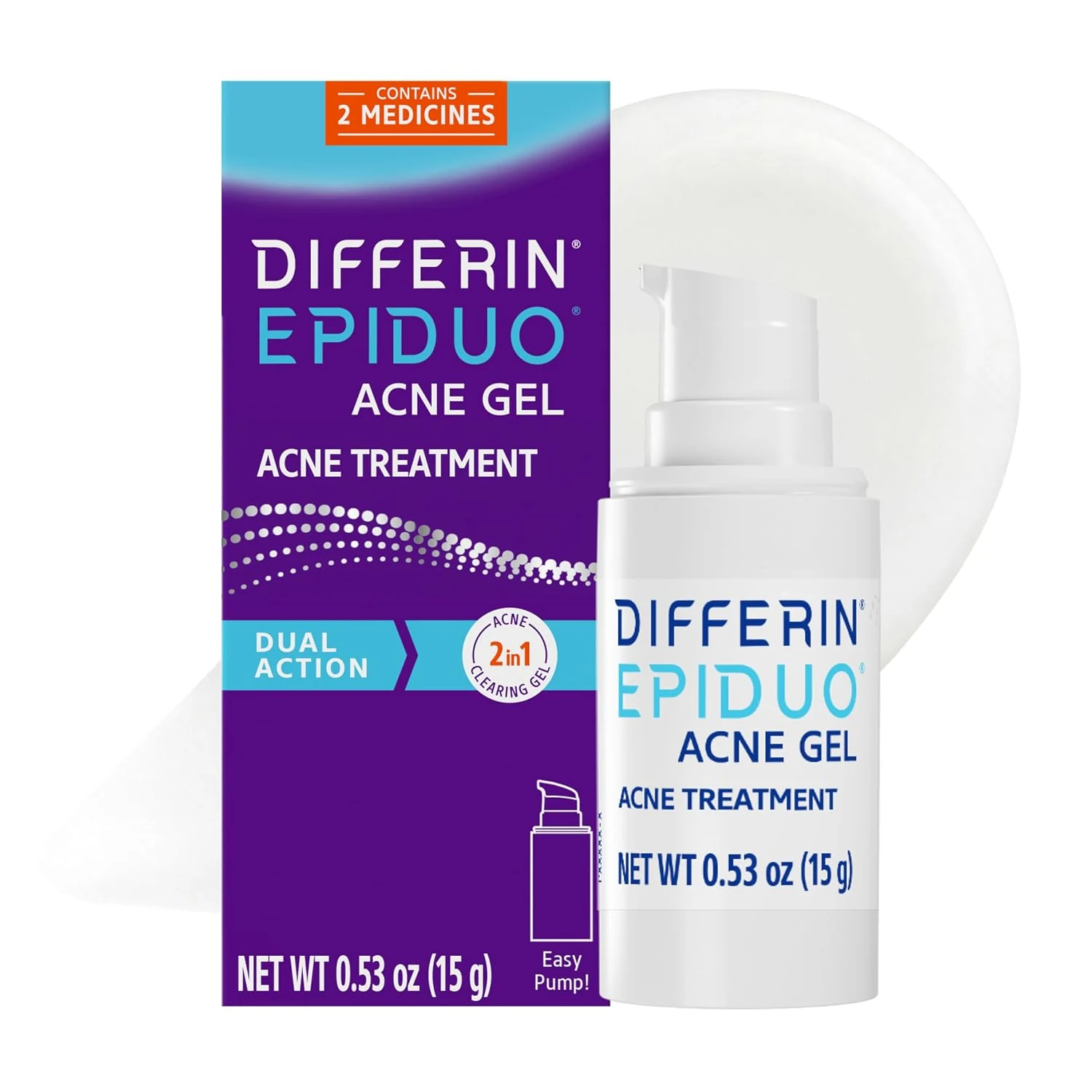
Adapalene is a synthetic retinoid and the one genuine exception to a clean “OTC vs. prescription” split. Unlike retinol, it isn’t metabolized through the retinyl-ester-to-retinoic-acid pathway — it’s a separate molecule that binds retinoid receptors directly. In the U.S., adapalene 0.1% (the ingredient in Differin Gel) has been available over the counter since 2016 — it was the first retinoid ever approved for OTC use. In 2026, the FDA also approved an OTC combination gel pairing adapalene 0.1% with benzoyl peroxide 2.5% (Differin Epiduo Acne Gel), the first OTC retinoid-plus-benzoyl-peroxide product. Higher-strength adapalene 0.3%, and adapalene 0.3% combined with benzoyl peroxide (Epiduo Forte), remain prescription-only. In other words: knowing that “adapalene is OTC” isn’t quite enough — the concentration and formulation matter.
Tazarotene
Tazarotene is a synthetic prescription retinoid, sold under brand names including Tazorac, Arazlo, and Fabior. It’s used for both acne and psoriasis, depending on the formulation, and is prescription-only in the U.S.
Trifarotene
Trifarotene is a newer synthetic retinoid, FDA-approved in 2019 under the brand name Aklief, as a 0.005% cream for acne. It’s also prescription-only.
(Isotretinoin — an oral prescription medication for severe acne, not a topical product — is a different category altogether and isn’t covered in depth here. It’s mentioned only because it’s sometimes confused with topical retinoids: the two have very different risk profiles, especially around pregnancy, which is covered further down.)
How Retinoids Work
The cosmetic precursor forms of vitamin A — retinyl esters, retinol, and retinaldehyde — follow the same basic conversion pathway inside skin cells: retinyl esters → retinol → retinaldehyde → retinoic acid. Retinoic acid is the form that actually binds and activates nuclear retinoid receptors in skin cells, driving the visible effects associated with retinoid use — improvements in the appearance of texture, tone, and fine lines over time, largely through effects on cell turnover and collagen-related activity. Tretinoin skips this conversion process entirely, since it already is retinoic acid.
Synthetic prescription retinoids — adapalene, tazarotene, and trifarotene — work differently. Rather than being metabolized through that same precursor chain, they’re distinct molecules engineered to bind directly to specific retinoid receptor subtypes, each with its own receptor-selectivity profile. So “more conversion steps to reach retinoic acid” isn’t a framework that applies to every retinoid — it describes the vitamin A precursor pathway specifically, not the synthetic retinoid drugs built to bypass it.
Within the precursor pathway itself, it’s tempting to turn conversion-step-counting into a simple rule — “fewer steps means stronger” — but that’s an oversimplification worth resisting. Real-world performance also depends on concentration, how the product is formulated and stabilized, how well it penetrates skin, and how your own skin responds. A well-formulated retinol product and a poorly formulated one can behave very differently even though they contain the “same” ingredient on paper.
Retinol vs. Tretinoin
Both are retinoids, but they sit at different points on the same pathway. Retinol is an OTC cosmetic ingredient that needs to convert to retinoic acid before it’s active. Tretinoin is retinoic acid — a prescription medication that engages the pathway directly, without that conversion step.
That difference shows up practically: tretinoin has the most extensive clinical evidence of any topical retinoid, particularly for acne and photoaging, and it tends to work faster — but it also tends to cause more irritation, especially while skin is adjusting. Retinol has a real, but comparatively smaller and more mixed, evidence base, and it’s generally gentler and slower to show visible effects.
Neither is simply “the weak one” or “the strong one” in every sense — formulation and individual tolerance matter, and this isn’t a comparison that reduces cleanly to “weak vs. strong.” What’s clear is that they’re not interchangeable, and evidence generated for one shouldn’t be assumed to apply equally to the other. This article won’t tell you which one you personally should use — that’s a formulation, tolerance, and (for tretinoin) prescribing decision, and a dermatologist is the right person to help you make it if you’re considering a prescription option.
Retinol vs. Retinal
Retinal (retinaldehyde) sits one metabolic step closer to retinoic acid than retinol does — it skips the retinol-to-retinaldehyde conversion and needs only one further step to become active. It’s commonly discussed as a middle-ground option, and there’s a real, if still relatively small, body of clinical research behind it specifically, including recent published work on retinaldehyde serums and skin texture.
That said, “one step closer to active” is a biochemical fact, not a verified clinical-performance ranking. It doesn’t translate into a guaranteed, universal potency or tolerability edge over every retinol product, or a reliably “gentler than tretinoin” position — those are comparisons that would need dedicated head-to-head studies, which aren’t well established for retinaldehyde today. Concentration, formulation, and stability all vary by product, and individual results vary too. If you’re comparing a specific retinol product to a specific retinal product, the honest answer is that you’d need to look at both formulations, not just the base ingredient name.
Retinol vs. Adapalene
Both fall under the retinoid umbrella, but adapalene is a synthetic retinoid originally developed and studied specifically for acne, while cosmetic retinol has a broader, more general marketing footprint covering texture, tone, and fine lines. Adapalene 0.1% is available over the counter in the U.S., which makes it easy to assume it’s roughly interchangeable with retinol — but it isn’t. Adapalene’s acne-specific evidence base doesn’t automatically transfer to every OTC retinol product, and the two ingredients aren’t studied, formulated, or indicated in exactly the same way. If you’re specifically trying to address acne, that distinction is worth understanding rather than assuming “they’re both OTC retinoids, so they’ll do the same thing.” This article isn’t the place for an individualized treatment recommendation — if acne is your main concern, a dermatologist can help you weigh adapalene, tretinoin, or another option against your specific skin.
OTC vs. Prescription Retinoids
Retinoid
U.S. status (as of this writing)
Retinol (any concentration)
Over the counter; no required concentration disclosure
A word of caution about that “adapalene is OTC” line, since it’s easy to overstate: only the 0.1% single-ingredient formulation and the newer 0.1%/benzoyl-peroxide-2.5% combination gel are available without a prescription. The higher-strength 0.3% formulation — alone or combined with benzoyl peroxide — remains a prescription medication. Regulatory status can also change over time, so treat this table as a current snapshot (accurate as of this writing) rather than a permanent rule.
Examples of Over-the-Counter Retinoid Products
Seeing real products can make the terminology easier to follow. The three examples below illustrate different over-the-counter retinoid categories covered in this guide — a cosmetic retinol serum, a cosmetic retinaldehyde serum, and an OTC combination acne drug containing adapalene. They are not ranked, and the right choice depends on your skin, your goals, your tolerance, and — for drug treatments — appropriate medical guidance.
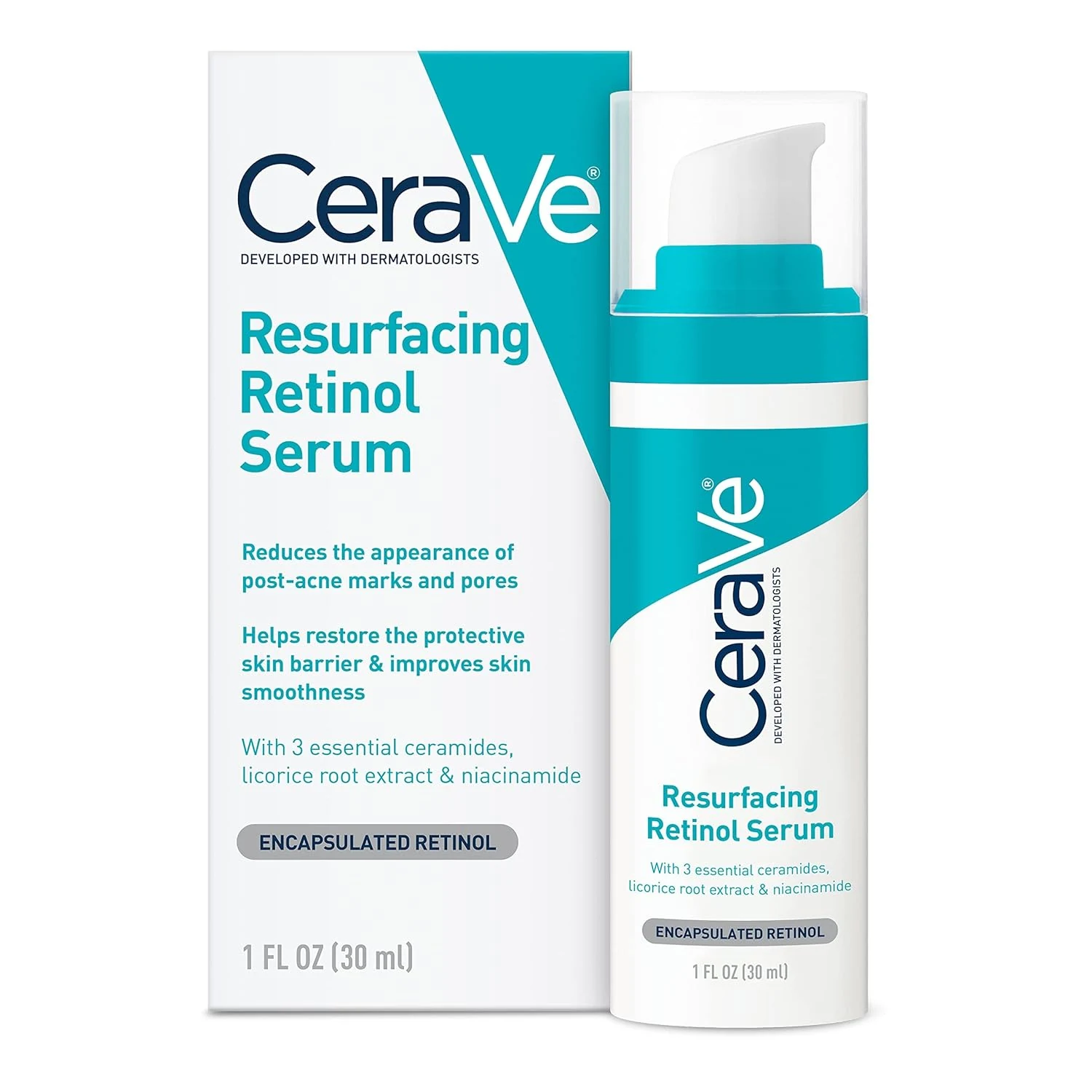
CeraVe Resurfacing Retinol Face Serum with Niacinamide — Retinol Example
This is an OTC cosmetic skincare example of the retinol category described earlier in this guide. CeraVe’s official product page lists encapsulated retinol, niacinamide, and three ceramides as key ingredients, and positions the serum for smoothing skin texture and softening the look of post-acne marks and enlarged pores. CeraVe does not publish a specific retinol percentage for this product, so none is stated here.
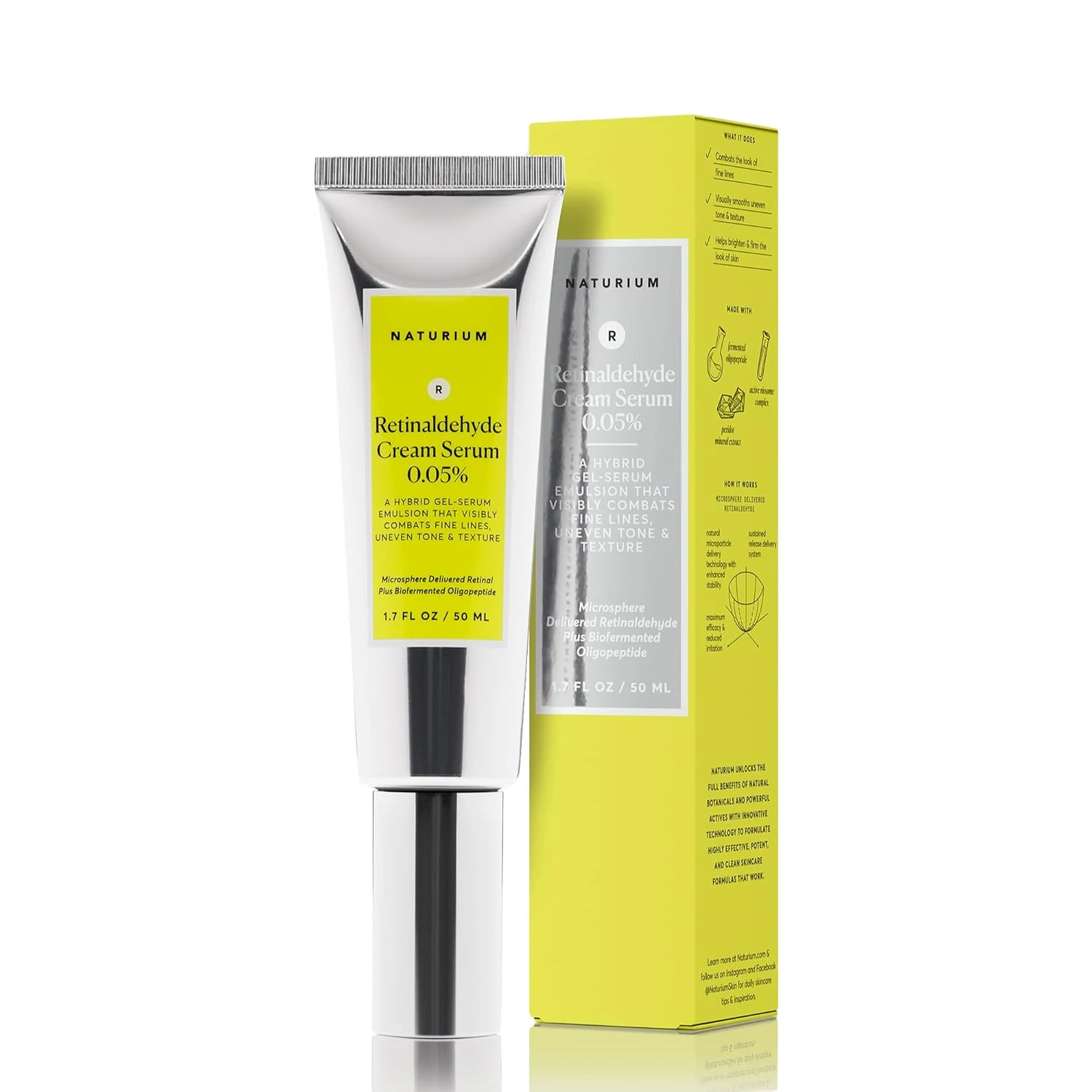
Naturium Retinaldehyde Cream Serum 0.05% — Retinal Example
Retinaldehyde — also called retinal — is a separate retinoid, one metabolic step closer to the active form (retinoic acid) than retinol, as explained earlier in this guide. This product is an OTC cosmetic example of that category, formulated at 0.05% per Naturium’s official product page (the brand also sells 0.10% and 0.15% versions). Naturium markets it for the appearance of fine lines, uneven tone, and texture. As covered earlier in this guide, that one-step biochemical difference is a mechanistic fact, not a verified head-to-head performance ranking against retinol or tretinoin, so no such comparison is made here.
Differin Epiduo Acne Gel — Adapalene + Benzoyl Peroxide OTC Drug Example
This is an OTC acne-treatment drug, not a cosmetic retinoid serum. It combines two active ingredients: adapalene 0.1%, the synthetic retinoid discussed throughout this guide, and benzoyl peroxide 2.5%, a separate acne-treatment ingredient that is not itself a retinoid. The FDA approved this specific combination gel for over-the-counter use on May 22, 2026, for acne in adults and children ages 12 and older — confirmed directly against the FDA’s Prescription-to-Nonprescription Switch List and the product’s DailyMed drug label. It’s a different product from plain Differin Gel (adapalene 0.1% alone, without benzoyl peroxide); see the OTC vs. Prescription Retinoids table above for how it fits alongside the other adapalene formulations.
Retinoids as a category are associated with improvements in several visible skin concerns, but the strength of evidence varies significantly by which specific retinoid you’re talking about — and none of them offer guaranteed or permanent results.
Acne. Prescription topical retinoids (tretinoin, adapalene, tazarotene, trifarotene) are a well-established, foundational part of standard acne treatment, and OTC adapalene 0.1% carries that same underlying evidence for its approved use. Cosmetic OTC retinol has a much smaller, less acne-specific evidence base and is generally better understood as a supporting ingredient for clogged pores than a primary acne treatment. It isn’t a substitute for an actual acne treatment plan if that’s your main concern. For more on building a routine around acne-prone skin, see our skincare routine for acne-prone skin.
Photoaging and fine lines. Tretinoin has the longest and most robust clinical-trial history for photoaging specifically. Cosmetic retinol has real, but more modest, supporting evidence for the appearance of fine lines and texture — this isn’t a wrinkle-removal treatment for either ingredient, and results build gradually with consistent use rather than showing up quickly. For a broader look at building a routine for mature or aging skin, see our skincare routine for mature skin.
Uneven pigmentation and texture. Retinoids broadly — both OTC and prescription — are associated with improvements in the appearance of texture and some forms of discoloration over time, generally as part of a longer-term routine rather than a stand-alone treatment. See our skincare routine for dark spots if that’s your main concern.
None of this amounts to a promise: no retinoid cures acne outright, reverses wrinkles, permanently shrinks pores, or guarantees collagen increases or dark-spot removal. These are ingredients associated with gradual, variable improvement — not fixes.
What About Side Effects and Irritation?
Dryness, redness, peeling or scaling, and burning or stinging are common, well-documented effects across the retinoid family. How pronounced they are depends on the specific molecule, its concentration, the formulation, how often it’s applied, and individual skin tolerance — prescription-strength retinoids are often more irritating than OTC retinol, but this isn’t a strict universal rule, since a poorly tolerated OTC product can still cause real irritation and a prescription product introduced cautiously can be reasonably well tolerated. An initial adjustment period — sometimes called “retinization” — is common and generally mild, typically improving within the first few weeks of consistent use.
That said, “normal adjustment” has limits. Significant pain, swelling, blistering, or a rash that spreads beyond where you applied the product isn’t ordinary irritation, and it isn’t something to push through. If a reaction is severe or doesn’t improve after scaling back frequency, that’s a reasonable point to check in with a dermatologist rather than waiting it out. If you already know you have sensitive or reactive skin, see our skincare routine for sensitive skin for a gentler foundation to build any retinoid use on top of.
Can Retinoids Cause “Purging”?
“Purging” is a widely used skincare term for a temporary increase in breakouts some people report after starting a retinoid or another ingredient that speeds up cell turnover. It’s a popular, plausible explanation rather than a precisely defined medical diagnosis — and it’s worth being cautious about assuming every worsening breakout must be “purging” just because that’s a comforting explanation. Doing so can lead someone to keep using a product that genuinely isn’t agreeing with their skin.
What generally distinguishes a purge from a problem is direction and severity, not a fixed calendar. A purge is generally described as temporary and gradually improving with continued, consistent use. Worsening, persistent, painful, or significantly irritated skin is not automatically normal adjustment just because “purging” is a comforting label — that pattern points more toward an actual adverse reaction, regardless of what you call it. If you’re not sure which one you’re dealing with, scaling back use and, if it doesn’t improve, checking in with a dermatologist is a more reliable approach than trying to self-diagnose.
Do Retinoids Make Skin More Sensitive to the Sun?
According to the American Academy of Dermatology, retinoids “can make skin more sensitive to sun” — which is the main reason they’re generally recommended for nighttime use, paired with daily sun protection. This isn’t a reason for alarm, but it is a reason sunscreen isn’t optional in a retinoid routine: broad-spectrum SPF 30 or higher during the day is standard guidance alongside any retinoid, OTC or prescription. Sunscreen reduces risk — it doesn’t eliminate it entirely, and it isn’t a substitute for the nighttime-use guidance in the first place. See our sunscreen for beginners guide if you need help choosing and applying one day to day.
Pregnancy and Breastfeeding
This section is meant to inform, not to replace a conversation with your own healthcare provider — particularly here, where the stakes are genuinely higher than with most skincare decisions.
Oral retinoids (like isotretinoin, used for severe acne) are well-established to cause serious birth defects and are strictly contraindicated during pregnancy. This isn’t a nuanced point — it’s settled and shouldn’t be treated as debatable.
Topical retinoids and pregnancy are a more nuanced picture, and it’s worth resisting the urge to round it off in either direction. Systemic absorption through intact skin is low — research on topical tretinoin specifically describes only a small amount being absorbed when used as directed. A small number of case reports have described birth defects consistent with retinoid-related effects following topical tretinoin use during pregnancy, but larger prospective studies (following 96 and 106 women through their first trimester) did not find an increased risk of major birth defects. Despite that reassuring larger-study data, the authoritative, conservative conclusion from reproductive-health and medical sources is still to avoid topical retinoids during pregnancy where possible. Importantly, this evidence is specific to tretinoin — it hasn’t been established that the same low-absorption, low-risk picture applies equally to every OTC retinol product, so “OTC retinol is safe because it’s weaker” isn’t a claim this article can responsibly make. If you’re pregnant or trying to become pregnant, stopping use and talking to your OB-GYN or another qualified healthcare provider is the safest course.
Breastfeeding guidance isn’t automatically the same as pregnancy guidance, and it’s worth not assuming otherwise. For topical tretinoin specifically, it’s generally considered low risk to a nursing infant because it’s poorly absorbed — though there’s little published data on how much actually ends up in breast milk, and general guidance recommends avoiding direct application to the nipple and areola and preventing infant skin contact with treated areas. As with pregnancy, this specific research is about tretinoin, not every retinol product on the market. If you’re breastfeeding, ask your OB-GYN, dermatologist, or pediatrician about your specific situation rather than assuming general guidance applies the same way to your product.
For a fuller discussion of retinol specifically during pregnancy and breastfeeding, see the pregnancy and breastfeeding section in our retinol for beginners guide.
Which Type Should a Beginner Understand First?
For beginners trying to understand the terminology, retinol is often the most familiar place to start conceptually — it’s the most widely available OTC form, and the one this whole family of ingredients is most often associated with in mainstream skincare. Understanding that it’s a retinoid, not a separate category, is mainly useful because it helps you make sense of stronger options later — adapalene if you’re specifically dealing with acne, or a prescription retinoid if you and a dermatologist decide that’s the right next step for a specific concern.
This isn’t a recommendation for which specific product or medication you personally should use — that depends on your skin, your goals, and in the case of prescription options, a conversation with a healthcare provider. It’s meant to help you understand the landscape well enough to ask better questions, whether you’re talking to a dermatologist or just reading a product label.
How Retinoids Fit Into a Beginner Skincare Routine
This is intentionally brief — for the full step-by-step routine, application order, frequency guidance, and ingredient-pairing detail, see our complete guide to starting retinol as a beginner, which covers exactly that in depth.
The short version: retinoids are typically introduced gradually (often two to three nights a week to start), applied to clean, dry skin, followed by a moisturizer, and paired with daily sunscreen. They generally fit at a specific point in a broader routine rather than being used in isolation — see our guide to layering skincare products in the right order if you’re combining a retinoid with other active ingredients and aren’t sure how to sequence everything.
When to Talk to a Dermatologist
A dermatologist’s input is particularly useful if you’re dealing with:
Persistent or severe acne that hasn’t responded to OTC options
Significant irritation that doesn’t improve after scaling back frequency
Questions about whether a prescription retinoid (tretinoin, adapalene 0.3%, tazarotene, or trifarotene) makes sense for your specific skin
Pregnancy, planning a pregnancy, or breastfeeding, if you’re weighing whether and how to use any retinoid
Eczema, rosacea, or another skin condition that might complicate how your skin tolerates a retinoid
Uncertainty about combining a retinoid with other active ingredients you’re already using
This list is meant to help you recognize when professional input is particularly useful — it isn’t a diagnostic tool, and it isn’t a substitute for actually talking to one.
FAQs
No — retinol is one specific type of retinoid. “Retinoid” is the broader category; retinol is a member of it, not a synonym for it.
Yes. Every retinol product is a retinoid product, though not every retinoid is retinol.
This isn’t quite a fair comparison, since retinol is itself a retinoid — the real comparison is retinol against other retinoids, like tretinoin or adapalene. Generally, prescription retinoids (tretinoin especially) are more potent and better-studied for specific medical uses than OTC retinol, but “stronger” depends on formulation and concentration too, not just which compound is used.
Yes — adapalene is a synthetic retinoid. In the U.S., adapalene 0.1% is available over the counter, including an OTC 0.1% adapalene + 2.5% benzoyl peroxide combination gel approved in 2026. Adapalene 0.3%, alone or combined with benzoyl peroxide, remains prescription-only.
Yes. Tretinoin is the pharmaceutical name for topical retinoic acid — the fully active form that precursor retinoids (retinyl esters, retinol, retinaldehyde) ultimately convert into. Other prescription retinoids, like adapalene and tazarotene, are synthetic molecules that activate the same receptors through their own chemistry rather than converting into retinoic acid. Tretinoin itself is prescription-only in the U.S.
No, though they’re closely related. Retinal (retinaldehyde) is a separate retinoid, one conversion step closer to the active form (retinoic acid) than retinol.
According to the American Academy of Dermatology, retinoids can make skin more sensitive to sun, which is why they’re generally used at night and paired with daily sunscreen.
This is a question for your OB-GYN, not a skincare article. Oral retinoids have well-established, serious pregnancy risks and are strictly avoided. For topical products, the picture is more reassuring but still incomplete — and most of what’s actually been studied is specific to prescription topical tretinoin, not OTC retinol. That tretinoin research shows low skin absorption and no increased risk of major birth defects in the larger available studies, yet authoritative sources still generally recommend avoiding topical retinoids during pregnancy as a precaution, since the evidence gap for non-tretinoin products hasn’t closed. Talk to your OB-GYN about your specific product rather than assuming this general guidance applies the same way to it.
Bottom Line
Retinol is a retinoid — one specific, OTC, gentler member of a family that also includes retinal, tretinoin, adapalene, tazarotene, and trifarotene. They all ultimately act on the same retinoid receptor system in skin cells, but they reach it differently — some through a multi-step metabolic conversion, others by binding receptors directly — and they differ meaningfully in how active they are on application, how they’re regulated in the U.S., and how much evidence supports their use for a given concern. Knowing where retinol sits in that family won’t tell you exactly which product to buy or whether you need a prescription — but it will help you understand what you’re actually choosing between, and ask better questions if you’re deciding whether a stronger option makes sense for you.
This guide was researched using current, authoritative U.S. sources — including the American Academy of Dermatology, FDA drug-approval and regulatory records, a peer-reviewed clinician’s guide to topical retinoid pharmacology, NIH/NCBI resources (MotherToBaby and LactMed), and a peer-reviewed medical review of skincare safety in pregnancy — and written with a beginner-friendly editorial approach that prioritizes accuracy and appropriate caution over hype. This guide does not claim clinical or dermatologist review, and it is not a substitute for personalized advice from a dermatologist, OB-GYN, or other qualified healthcare professional — particularly around prescription treatments, pregnancy, or breastfeeding.
Medical Disclaimer IncludedClearly marked below — this guide is educational, not personalized medical advice.
Read our Review Policy for a plain explanation of what our review process does — and doesn't — mean for health-adjacent content.
Sources & Further Reading
Affiliate Disclosure: This article contains affiliate links. AvaFitCare may earn a commission from qualifying purchases made through these links, at no additional cost to you.
This article is for general informational and educational purposes only and is not a substitute for professional medical advice, diagnosis, or treatment. It does not create a doctor-patient relationship. Always seek the advice of a dermatologist, physician, OB-GYN, pediatrician, or other qualified healthcare provider with any questions you may have regarding a medical condition, a prescription medication, or use of any product during pregnancy or breastfeeding. Never disregard professional medical advice or delay seeking it because of something you read here.
Get New Guides in Your Inbox
No spam, no filler — just new articles as we publish them.