Workout Routine for Beginners: A Complete Beginner’s Guide
September 12, 2026
If you’ve tried to figure out how to start working out by searching online, you already know the problem: everyone has a different opinion. One site tells you to train six days a week. Another says three is plenty. Influencers post hour-long routines with equipment you’ve never heard of, and somewhere in the middle of all that noise is a simple question you just want answered — what do I actually do?
Here’s the good news: a good beginner workout routine is not complicated. You don’t need a dozen exercises, a garage full of equipment, or two hours a day. You need a handful of effective movements, a realistic schedule, and enough consistency to let your body adapt over a few weeks. That’s genuinely most of it.
This guide walks through a complete workout routine for beginners — how often to train, exactly which exercises to do and how to do them, how many sets and reps make sense, how long a session should take, and how to progress once the basics start to feel easy. By the end, you should have a plan you can actually follow instead of another routine to feel overwhelmed by.
Quick answer: There’s no single frequency or set of numbers that’s right for every beginner — it depends on things like your current activity level, how well you recover, and how a routine fits into your schedule. That said, a simple, practical starting example for many beginners is 2–3 full-body strength sessions a week, with rest or lighter activity in between while your body adapts. Each session typically covers the major movement patterns — a squat, a hip hinge, a push, a pull, a glute-focused move, and some core work — often somewhere in the range of 2–3 sets of roughly 8–12 reps per exercise, though the right numbers can vary by exercise and by person. Sessions typically take 30–45 minutes, including a short warm-up. From there, progress happens gradually: better technique first, then more reps, then more resistance.
Disclosure: This article contains affiliate links. If you make a purchase through these links, AvaFitCare may earn a commission at no extra cost to you.
A workout routine, in the simplest sense, is just a plan you repeat — the same handful of exercises, done in a set order, a few times a week, so your body has a consistent stimulus to adapt to. That’s really the whole idea. It’s not a secret formula; it’s structure.
For someone just starting out, the biggest advantage of having a routine isn’t the specific exercises — it’s not having to reinvent your workout from scratch every time you show up. Decision fatigue is a real reason people quit. If you have to figure out what to do each time you exercise, it’s a lot easier to skip the whole thing on a tired day.
This is also where beginners tend to overcomplicate things. It’s tempting to think a “real” program needs ten or fifteen different exercises, split across specific days for specific muscles. In practice, a beginner gets the vast majority of the benefit from a small set of full-body movements performed consistently. Complexity isn’t the goal — adaptation is, and adaptation comes from doing manageable work often enough for your body to respond to it.
Consistency also matters more than any single workout’s details. A simple full-body routine you actually do three times a week will get you further, faster, than a complicated split you only manage once or twice before burning out. The routine in this guide is built with that in mind: few enough moving parts that it’s easy to stick with, and complete enough to build real, noticeable strength.
How Often Should Beginners Work Out?
For most beginners, 2 to 4 workout days per week is a reasonable starting range, with rest or lighter activity on the days in between. There’s no single number that’s correct for everyone — it depends on your schedule, your current activity level, and how your body responds in the first few weeks.
What matters more than hitting a specific number of days is starting at a pace you can sustain. If you’ve been mostly sedentary, jumping straight into daily training is one of the more common ways beginners end up sore, discouraged, or hurt. It’s generally better to start with 2–3 sessions a week, see how your body responds, and add a day later once that feels manageable.
The Physical Activity Guidelines for Americans, from the U.S. Department of Health and Human Services, recommend that adults get muscle-strengthening activity involving all major muscle groups on 2 or more days per week, alongside at least 150 minutes of moderate-intensity aerobic activity spread across the week (CDC). That’s a helpful general benchmark, not a strict rule — the right frequency for you is the one you can actually keep up.
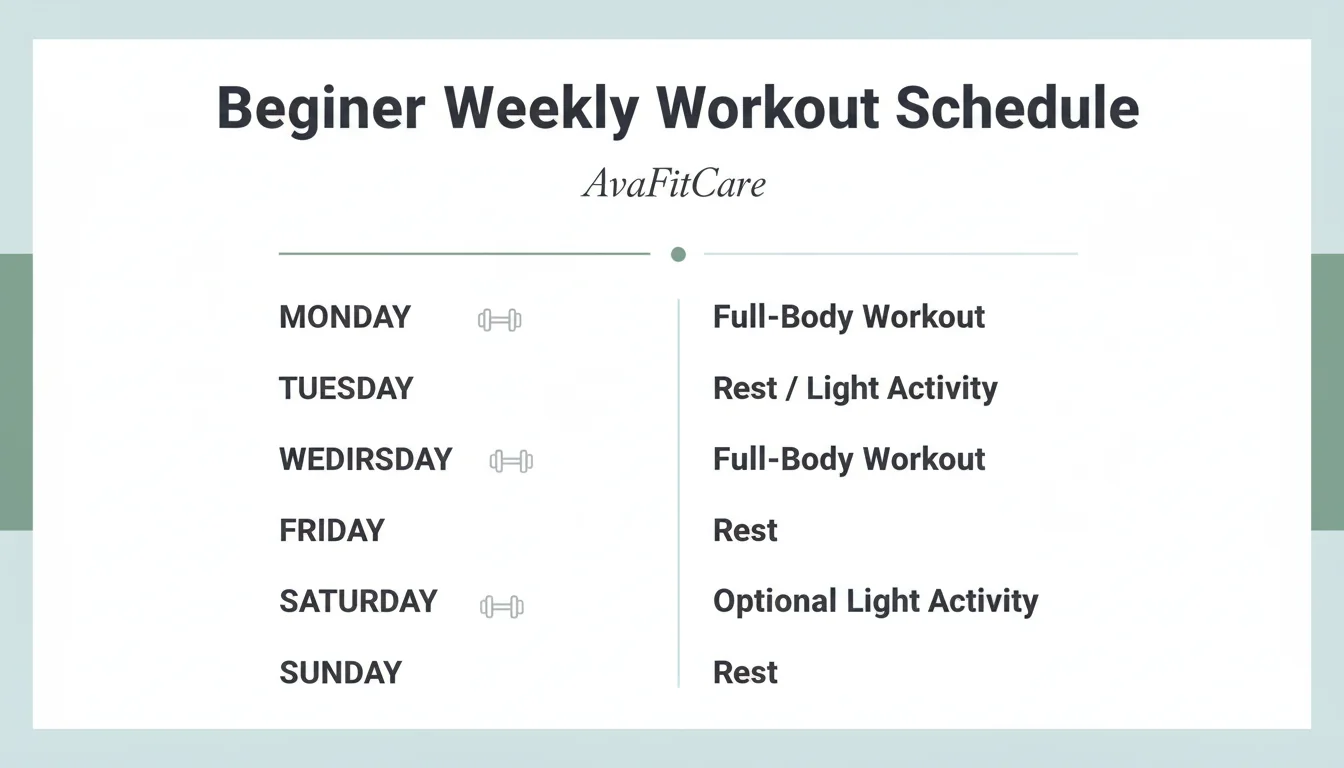
Here’s an example of what a beginner week might look like:
Day
Focus
Monday
Full-body workout
Tuesday
Rest or light activity (walking, stretching)
Wednesday
Full-body workout
Thursday
Rest
Friday
Full-body workout
Saturday
Optional light activity
Sunday
Rest
This is an example, not a universal prescription. Some people do well with two sessions a week when they’re starting out; others prefer four shorter ones. What matters is spacing your workouts so you’re not training the same muscles two days in a row while you’re still adapting, and giving yourself real rest days rather than treating every day as a workout day.
A quick safety note: if you have an injury, a chronic health condition, are pregnant or recently gave birth, have any concerning symptoms during activity, or have been advised by a healthcare provider to limit physical activity, talk to that provider before starting or changing an exercise routine. This guide is general fitness education, not individualized medical advice, and a professional who knows your specific situation can tell you what’s appropriate for you (CDC).
The Beginner Full-Body Workout Routine
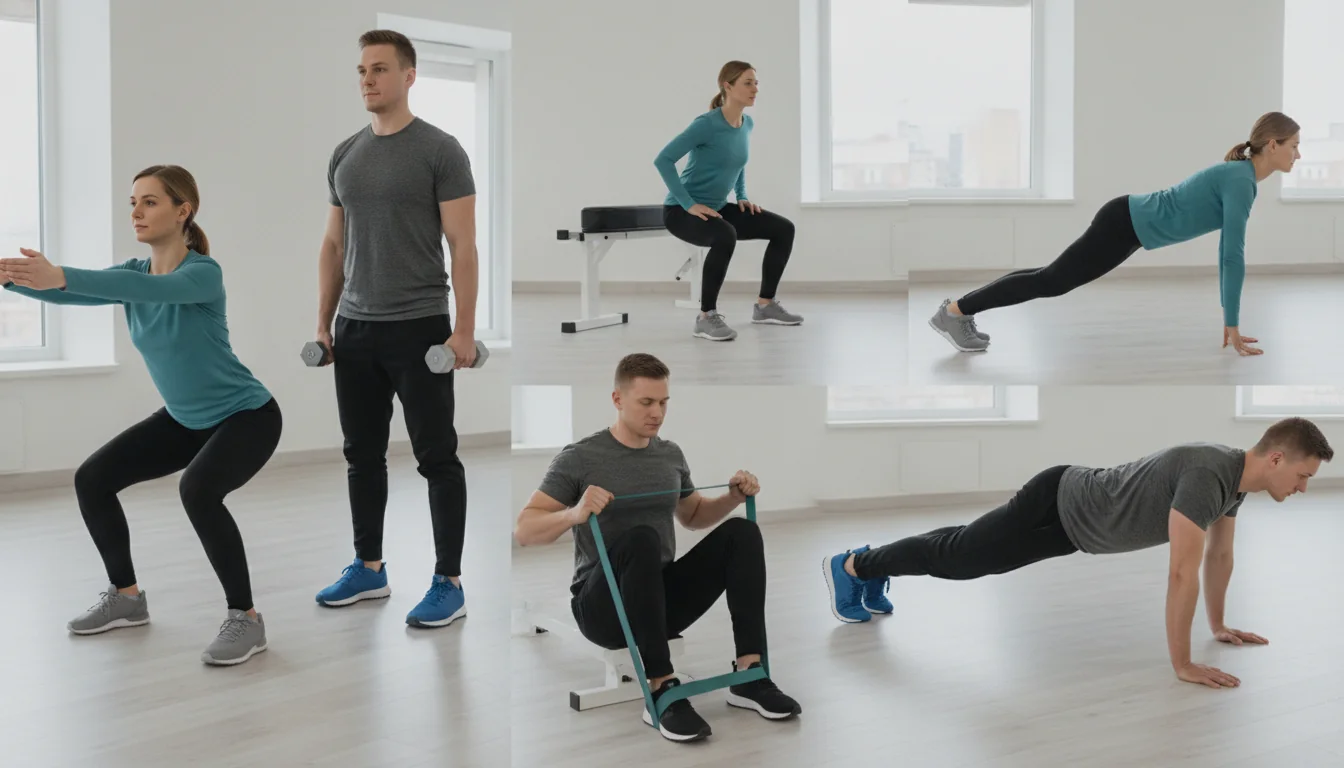
This routine is built around six basic movement patterns: a squat, a hip hinge, a push, a pull, a glute-focused movement, and core work. Covering these patterns means you’re training your whole body in one session, without needing a long list of exercises.
Exercise
Sets
Reps
Rest
Main Muscles / Movement
Bodyweight Squat (or Goblet Squat)
2–3
8–12
60–90 sec
Quads, glutes, core (squat pattern)
Romanian Deadlift (dumbbell or bodyweight hip hinge)
2–3
8–12
60–90 sec
Hamstrings, glutes, lower back (hip hinge)
Push-Up (knee or incline variation if needed)
2–3
6–12
60–90 sec
Chest, shoulders, triceps (push)
Seated or Standing Row (band or dumbbell)
2–3
8–12
60–90 sec
Upper back, biceps (pull)
Glute Bridge
2–3
10–15
45–60 sec
Glutes, hamstrings
Plank
2–3
20–40 sec hold
45–60 sec
Core (anti-extension)
A few notes on this table. First, these are beginner-friendly versions of each pattern, not the most advanced ones — a bodyweight squat and a barbell back squat train the same basic movement, but you don’t need to start with the harder version. Second, every exercise here has a way to make it easier if needed (more on that in the next section), so nobody should feel stuck if a movement feels too difficult on day one.
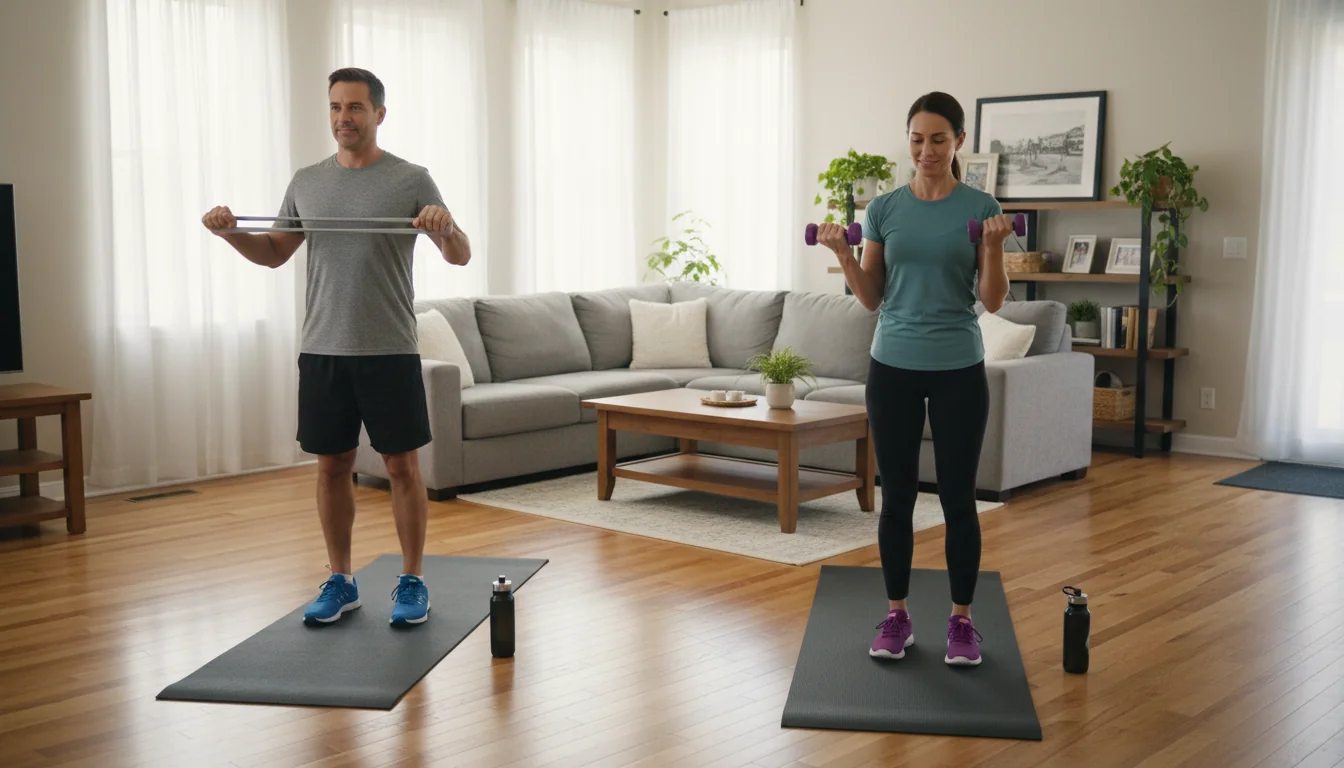
Choosing resistance: if an exercise uses weight (like the Romanian deadlift or row), pick a load that lets you complete all the reps with good form and still feel like you could do 1–2 more. That’s a reasonable, sustainable way to select weight as a beginner — it’s far more important than trying to lift as much as possible right away. If you don’t have dumbbells, resistance bands or household objects (a full water jug, a backpack with books) can work as a stand-in.
Optional Beginner Equipment
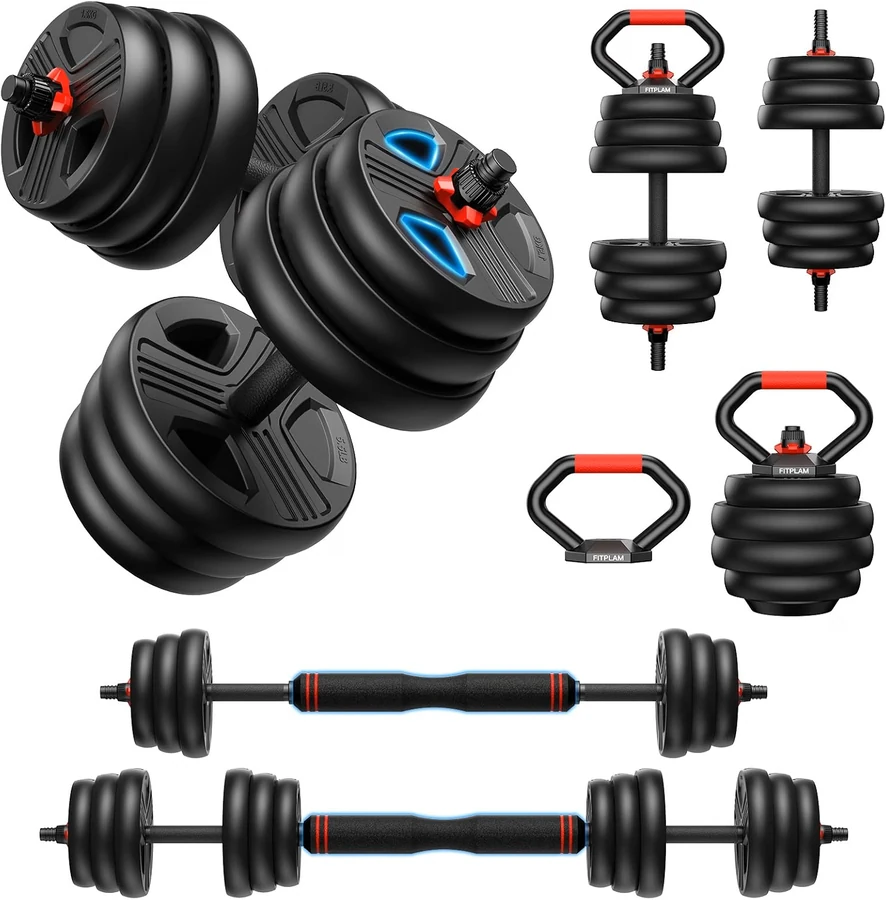
Adjustable Dumbbell
If you’d rather not collect several pairs of fixed dumbbells as you get stronger, an adjustable dumbbell is a space-saving way to change resistance gradually. It’s entirely optional — every dumbbell exercise in this routine also has a bodyweight or resistance-band alternative described above.
No equipment at all? Most of this routine has a true bodyweight-only option — bodyweight squats, bodyweight Romanian deadlifts (single-leg or slow tempo), and push-ups all work well without any equipment. The pulling movement is the exception: a fully equipment-free row is hard to do safely, since it usually depends on improvised setups — an unsecured door, a towel looped over something, or furniture that isn’t built to hold body weight — that can slip or give way. A resistance band with a proper door anchor is an inexpensive, low-risk way to add a real pulling movement at home. If you’d rather stay fully equipment-free for now, a prone back raise (lying face down and lifting your arms and chest slightly off the floor, then lowering with control) is a reasonable substitute — it works some of the same upper-back muscles, though it’s a lighter stimulus than a loaded row and isn’t a full replacement for one.
Optional Beginner Equipment
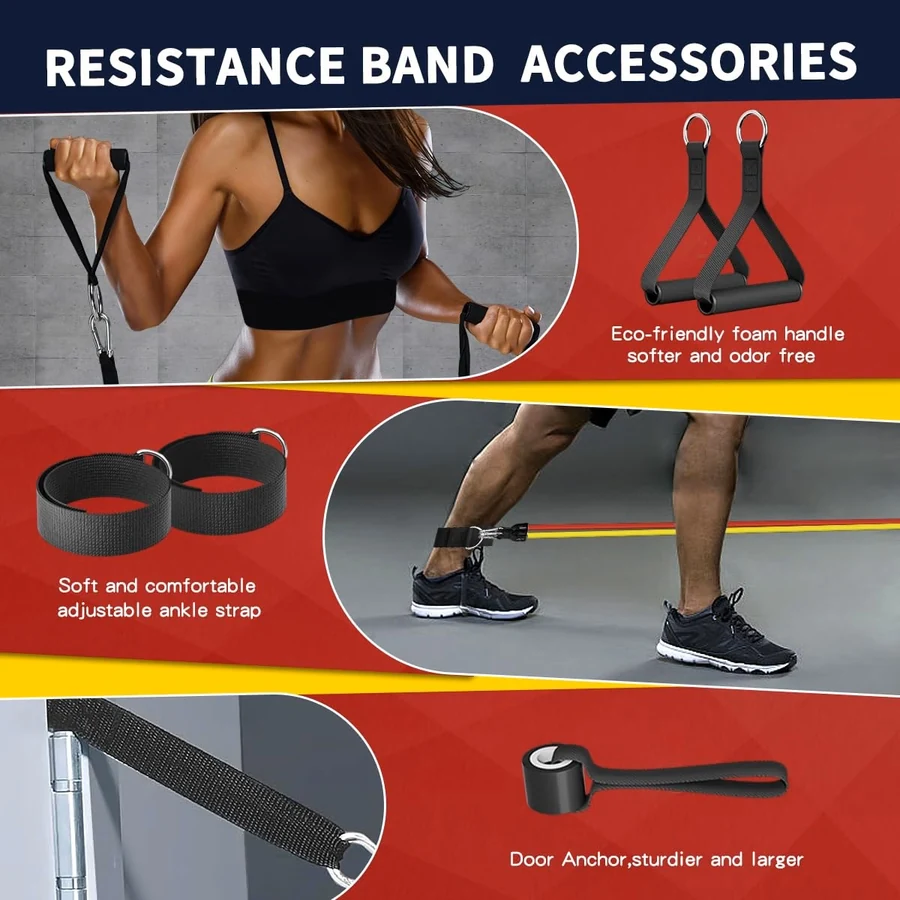
WHATAFIT Resistance Bands with Handles
A set of resistance bands with handles can be a practical, budget-friendly way to do rows and other pulling exercises at home. For anchored exercises, only use a secure anchor system designed for resistance-band training and follow the manufacturer’s setup instructions. Never attach resistance bands to unstable furniture or improvised anchor points.
The instructions below are meant to get you started safely with good general form. They’re not a replacement for in-person coaching — if something feels off or painful (beyond normal muscle effort), it’s worth having a qualified trainer or physical therapist take a look.
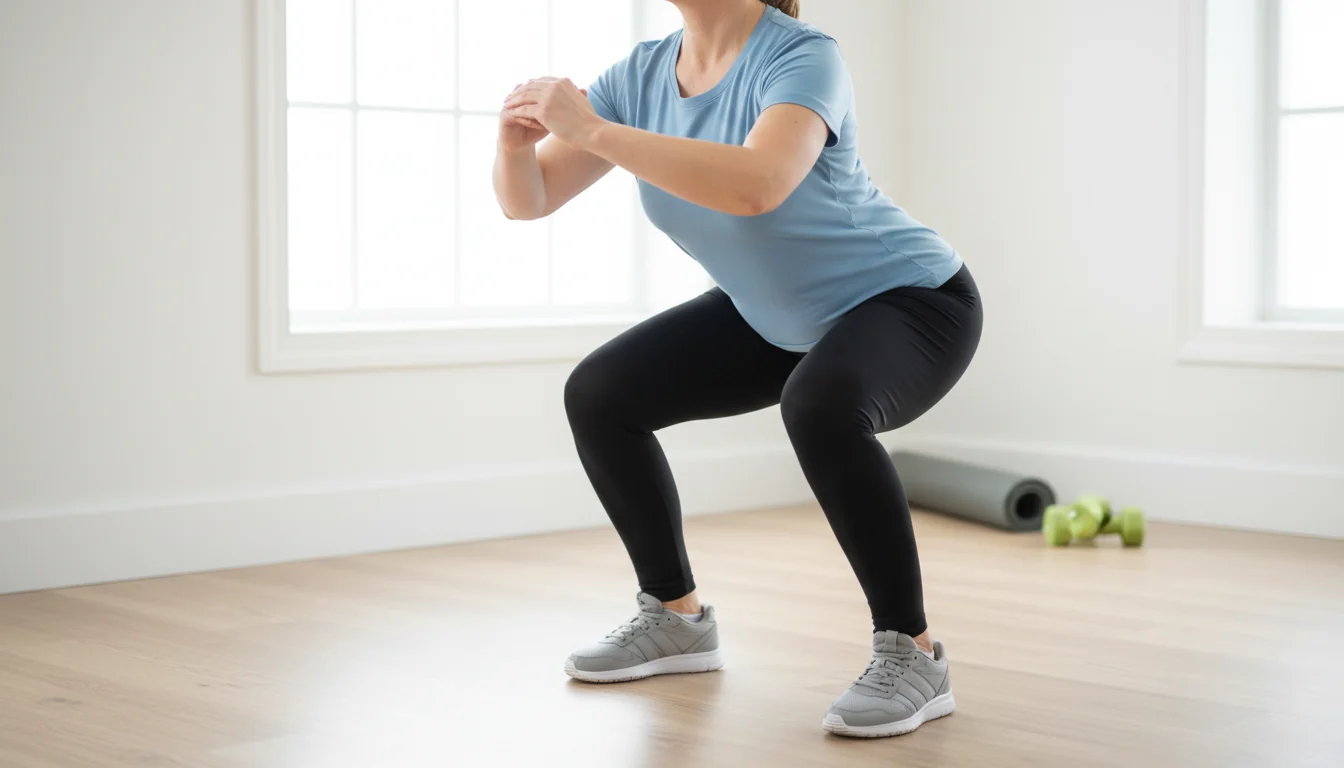
Bodyweight Squat
Starting position: Stand with feet roughly shoulder-width apart, toes pointed slightly outward.
Movement: Push your hips back and bend your knees to lower down, as if sitting into a chair, keeping your chest relatively upright. Lower until your thighs are around parallel to the floor, or as low as feels comfortable, then push through your feet to stand back up.
Breathing: Inhale as you lower, exhale as you stand up.
Common mistake: Letting the knees cave inward, or rising onto the toes. Keep weight through the whole foot and knees tracking roughly over your toes.
Easier modification: Squat down to a sturdy chair or bench, lightly tap it, and stand back up — this limits the range of motion and adds confidence.
Romanian Deadlift (Hip Hinge)
Starting position: Stand with feet hip-width apart, holding a dumbbell in each hand (or no weight to start) in front of your thighs.
Movement: With a slight bend in the knees, push your hips backward and lower the weight along your legs, keeping your back naturally straight rather than rounding. You should feel a stretch in your hamstrings. Reverse the motion by driving your hips forward to stand back up.
Breathing: Inhale as you lower, exhale as you return to standing.
Common mistake: Rounding the lower back or bending the knees too much, turning it into a squat instead of a hinge.
Easier modification: Reduce the range of motion — lower only until you feel a mild hamstring stretch, rather than reaching all the way down.
Push-Up
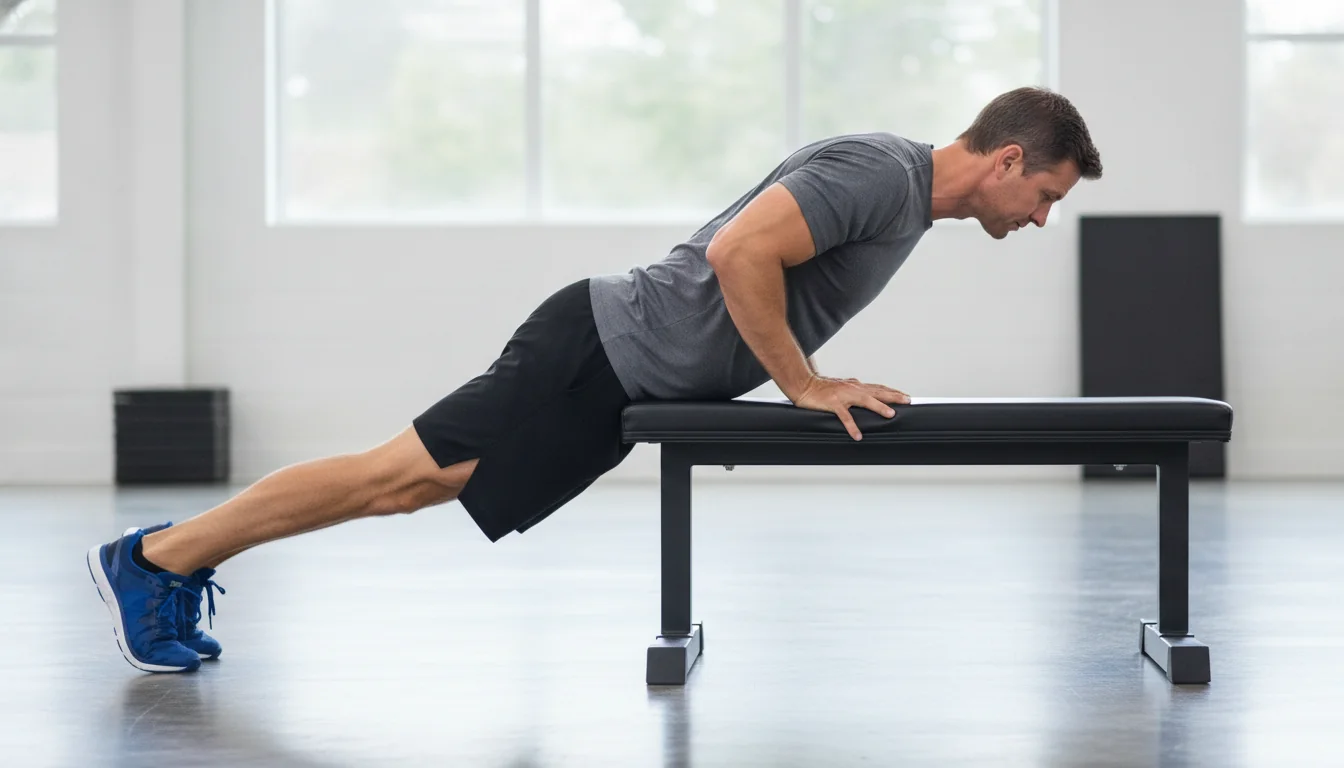
Starting position: Hands slightly wider than shoulder-width on the floor (or on a raised surface like a bench for an easier angle), body in a straight line from head to heels.
Movement: Lower your chest toward the floor by bending your elbows, keeping your core engaged so your hips don’t sag, then push back up to the starting position.
Breathing: Inhale as you lower, exhale as you push up.
Common mistake: Letting the hips sag or piking the hips up, which reduces how much work the chest and shoulders are doing.
Easier modification: Do the push-up with your hands on a bench, countertop, or wall — the more upright the angle, the easier the movement — or perform it from your knees instead of your toes.
Seated or Standing Row
Starting position: Anchor a resistance band securely at chest height using a proper door anchor attachment (not the door itself or a towel), or loop it around a genuinely fixed, load-rated point like a squat rack upright. Hold one end in each hand with arms extended.
Movement: Pull your hands toward your torso by squeezing your shoulder blades together and bending your elbows, then slowly return to the starting position with control.
Breathing: Exhale as you pull, inhale as you release.
Common mistake: Using momentum or leaning back excessively instead of controlling the movement with your back muscles.
Easier modification: Use a lighter resistance band or reduce the range of motion, focusing on the squeeze at the end of the pull rather than full extension. If you don’t have a band or a secure anchor point available, a prone back raise (described above) is a safer stand-in until you do.
Glute Bridge
Starting position: Lie on your back with knees bent, feet flat on the floor, hip-width apart, arms at your sides.
Movement: Push through your heels to lift your hips off the floor until your body forms a straight line from shoulders to knees, squeezing your glutes at the top, then lower back down with control.
Breathing: Exhale as you lift, inhale as you lower.
Common mistake: Overarching the lower back at the top instead of squeezing the glutes to do the lifting.
Easier modification: Reduce how high you lift, focusing on a smaller, controlled range of motion.
Plank
Starting position: Forearms on the floor, elbows under shoulders, body in a straight line from head to heels, legs extended behind you.
Movement: Hold the position, keeping your core braced and hips level — not sagging down or piking up — for the target time.
Breathing: Breathe steadily throughout; don’t hold your breath.
Common mistake: Letting the hips sag toward the floor, which shifts strain to the lower back.
Easier modification: Perform the plank from your knees instead of your toes, or shorten the hold time and build up gradually.
How Many Sets and Reps Should Beginners Do?
A rep (repetition) is one complete movement of an exercise — one full squat, one full push-up. A set is a group of reps done back-to-back before you rest — for example, 10 squats in a row is one set of 10 reps.
Beginners generally don’t need high training volume to make progress. 2–3 sets of 8–12 reps per exercise is a practical, well-supported starting point for most of the movements in this routine. That’s enough stimulus to build strength and technique without leaving you so fatigued that recovery becomes difficult, or so sore that you dread the next session.
Picking the right resistance matters more than chasing a specific number. If you can breeze through 12 reps with a lot left in the tank, the exercise is probably too easy to keep helping you improve. If you’re straining or breaking form well before the target rep count, it’s too heavy or too hard, and it’s worth dialing it back. A good rule of thumb: the last couple of reps of a set should feel challenging, but your form shouldn’t fall apart to get there.
Good technique is worth prioritizing over adding more weight or reps early on. Practicing a movement correctly at a manageable difficulty builds a foundation that lets you progress safely later — rushing that step tends to create bad habits (and sometimes injuries) that are harder to undo than they were to avoid.
How Long Should a Beginner Workout Be?
Most beginner workouts take about 30 to 45 minutes, including a short warm-up, the exercises themselves, and rest between sets.
That number can vary based on a few things: how long you warm up, how many exercises you’re doing, how much rest you take between sets, and your current fitness level. Someone doing six exercises for three sets each, with 90 seconds of rest between sets, will naturally need more time than someone doing four exercises for two sets with shorter rest periods.
Longer isn’t automatically better. A well-structured 30-minute session that hits the major movement patterns with reasonable effort can be just as useful for a beginner as a 90-minute session — often more useful, since it’s easier to actually fit into a normal week and stick with over time.
How Much Rest Should You Take Between Sets?
For most of the exercises in this routine, 60 to 90 seconds of rest between sets is a reasonable default, with shorter rest (45–60 seconds) for lighter movements like glute bridges or planks.
The point of resting between sets is to let your muscles recover enough to perform the next set with reasonably good form and effort — not to rush through the workout as fast as possible, and not to rest so long that the session drags on unnecessarily. If you’re still breathing hard or your form would clearly suffer, it’s fine to take a bit longer. If you feel ready sooner, you don’t need to watch the clock obsessively.
Rushing through sets with too little rest tends to hurt your technique on later sets, especially early on when your body is still learning the movements. There’s no need to treat every rest period as time being wasted — it’s part of how the workout actually works.
Warm-Up Before Your Workout
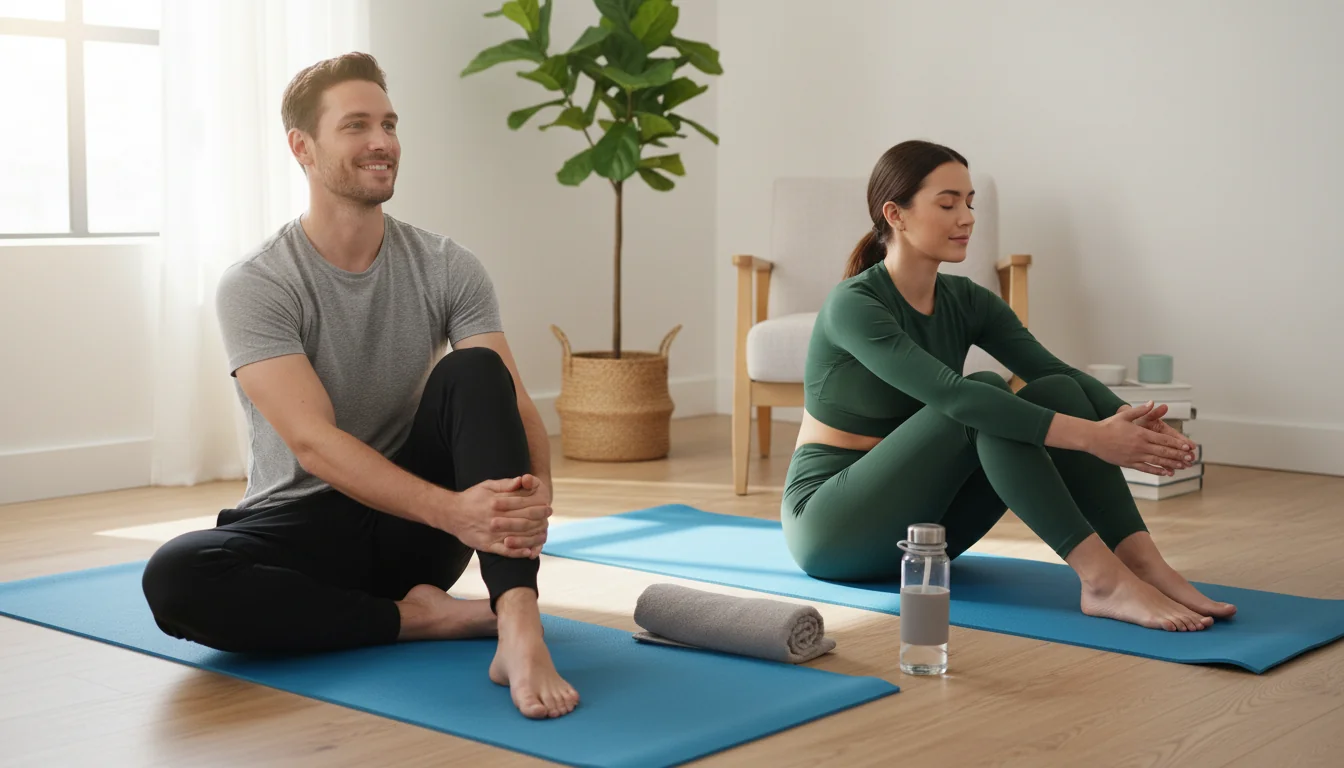
A short warm-up helps prepare your body for the exercises ahead by raising your heart rate slightly and getting your joints moving through a fuller range of motion. It doesn’t need to be complicated or long — 5 to 8 minutes is usually enough.
A simple beginner warm-up might look like:
2–3 minutes of easy movement — walking in place, marching, or light jogging in place to raise your heart rate slightly.
Gentle mobility work — arm circles, leg swings, hip circles, and a few bodyweight squats done slowly.
Movement-specific warm-up — a couple of light, slow reps of the actual exercises you’re about to do (like an easy bodyweight squat before your loaded sets), so your body is familiar with the pattern before adding effort.
It’s worth being realistic here: a warm-up makes a workout feel more comfortable and helps you move better, but it doesn’t guarantee you won’t get sore or injured. It’s one useful habit among several, not a safety guarantee.
Optional Beginner Equipment
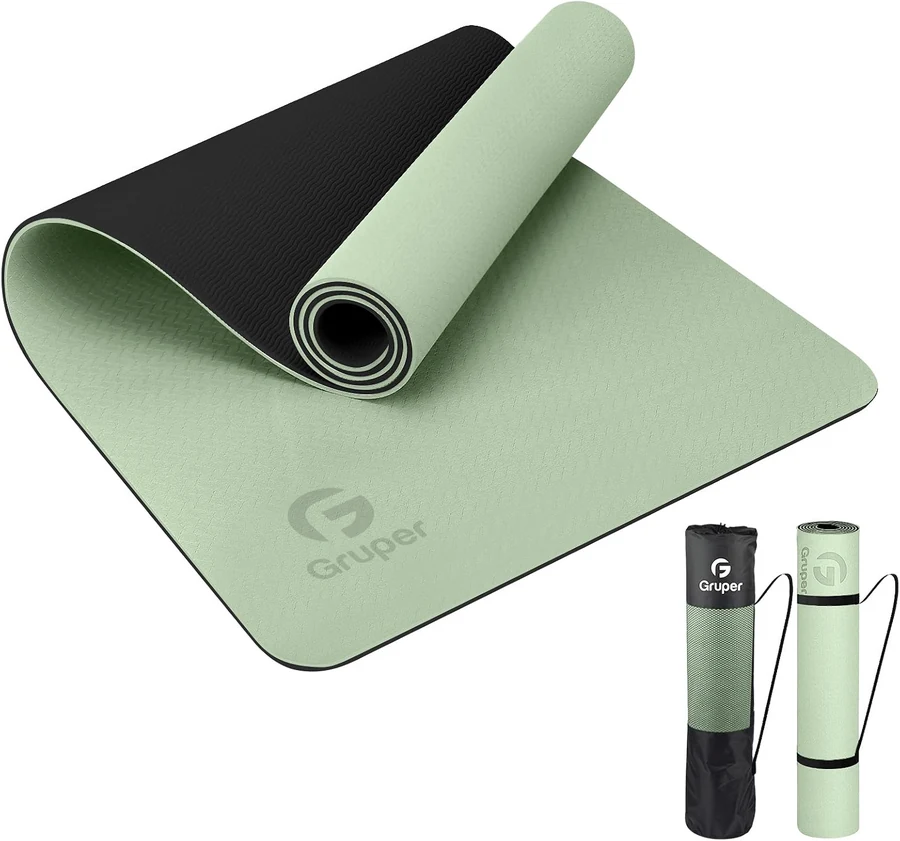
Non-Slip Exercise Mat
A dedicated mat gives you a consistent, cushioned surface for floor-based movements like glute bridges and planks, and can make warm-ups and mobility work more comfortable on hard flooring. It’s a nice-to-have, not a requirement — the exercises in this routine work fine on carpet or any reasonably comfortable surface too.
Both environments can work well for a beginner — the right choice depends on your budget, your schedule, and honestly, which one you’ll actually use consistently.
Factor
Home Workouts
Gym Workouts
Cost
Low to none; optional bands or dumbbells
Ongoing membership fee
Equipment
Minimal — bodyweight, bands, maybe dumbbells
Wide range of machines and free weights
Convenience
No commute, flexible timing
Requires travel and set hours (unless 24-hour)
Exercise variety
Somewhat limited without equipment
Much broader range of options
Learning curve
Simple to start, fewer choices to make
Can feel overwhelming with unfamiliar equipment
Privacy
Fully private
Shared space with other people
Progression options
Requires buying more equipment over time
Naturally available through heavier weights/machines
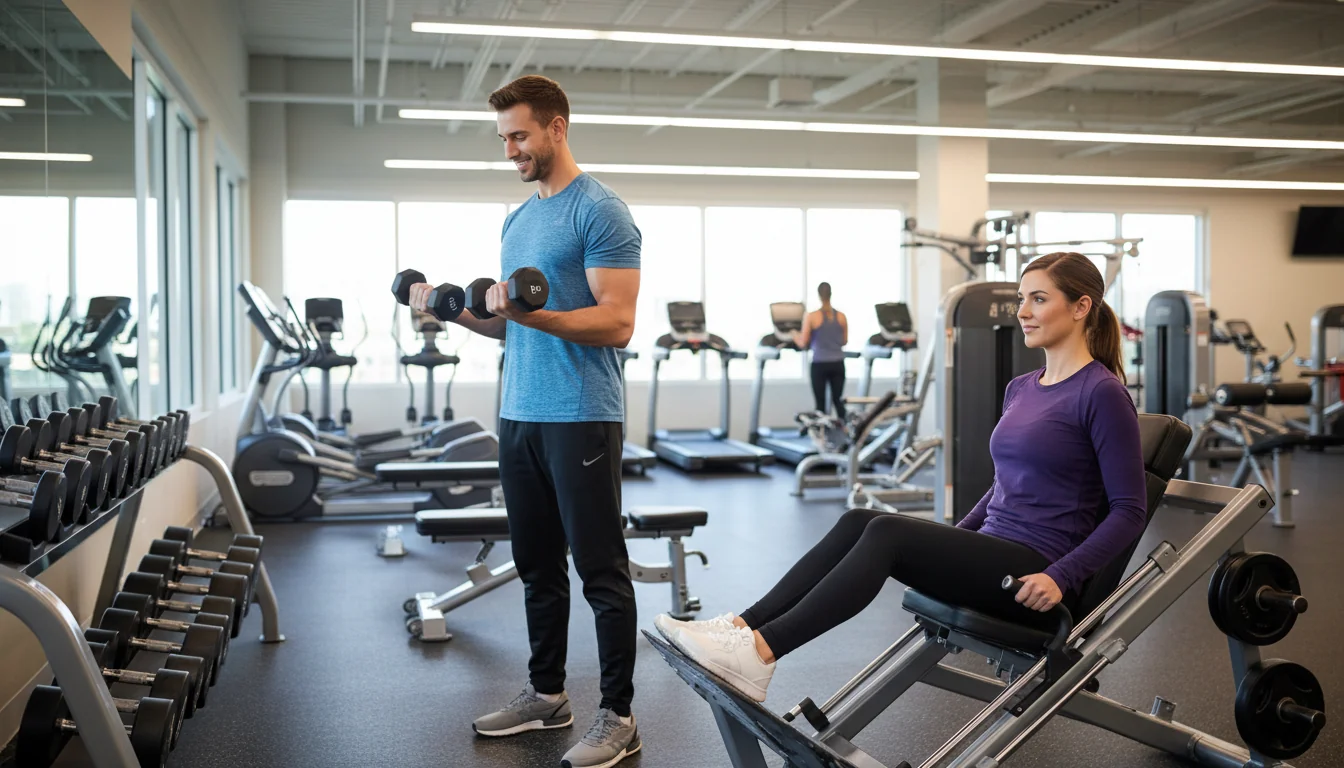
Neither option is objectively better for a beginner. Someone who’s self-conscious about exercising in public, or who has an unpredictable schedule, often does better starting at home. Someone who wants more equipment variety, doesn’t want workout gear cluttering their living space, or finds a gym environment motivating might do better there. The most effective workout routine for beginners is the one in an environment you’ll actually show up to, consistently, without it becoming a source of friction.
How to Progress Your Workout
Progression, for a beginner, doesn’t need to be complicated. In roughly this order, here’s what tends to happen naturally:
1
Technique improves first
In the first couple of weeks, a lot of your “progress” is actually just getting more comfortable and efficient with the movement patterns themselves.
2
Reps become easier to complete
Once you can comfortably complete all your sets and reps with good form, that’s usually a sign you’re ready for a bit more challenge.
3
Resistance increases gradually
This might mean a heavier dumbbell, a stronger resistance band, or (for bodyweight moves) a harder variation — for example, moving from an incline push-up to a full push-up.
4
Reps or sets increase where appropriate
, particularly for bodyweight exercises where adding weight isn’t practical.
The common thread is gradual, small increases rather than sudden jumps. Doubling your weight or reps in a single session because the previous one felt easy is one of the more common ways beginners end up sore or hurt. Small, steady increases add up significantly over weeks and months.
This guide focuses on beginner-level progression — building a foundation of consistent training and basic strength. More structured strength-training programming, like periodized progressive overload, is a separate topic that AvaFitCare covers in more depth in its Strength content.
Rest Days and Recovery
Rest days aren’t wasted days — they’re when a lot of the actual adaptation happens. Training stresses your muscles; recovery is when they repair and get stronger. Skipping rest consistently can leave you fatigued, more prone to poor form, and, over time, more likely to plateau or get hurt rather than progress faster.
A few basics that support recovery:
Sleep — most adults need roughly 7 or more hours a night for the body to recover well, though individual needs vary.
Hydration — staying reasonably hydrated supports general recovery and workout performance.
Light activity on rest days — a walk, light stretching, or casual movement is generally fine and can even help you feel less stiff, as long as it isn’t another hard training session.
It’s normal to feel some muscle soreness in the day or two after a new or harder workout, especially when you’re just starting out. That’s different from sharp pain, joint pain, or discomfort that doesn’t improve with rest — those are signs worth paying attention to rather than pushing through, and worth mentioning to a healthcare provider if they persist.
Common Beginner Workout Mistakes
Doing too much too soon. Jumping straight into daily, high-intensity workouts is one of the most common ways beginners burn out or get hurt in the first few weeks. Start with a manageable frequency and build up gradually instead.
Copying advanced programs. A routine designed for someone with years of training experience isn’t automatically better — it’s usually built around a level of recovery capacity and technique a beginner hasn’t developed yet. Start with something built for where you actually are.
Sacrificing form to lift more. Using momentum or partial range of motion to move heavier weight looks like progress but usually just increases injury risk without much real benefit. Good technique should come first.
Changing programs constantly. Switching routines every week or two doesn’t give your body enough time to adapt to any of them. Sticking with a simple plan for several weeks tends to produce more visible results than routine-hopping.
Ignoring recovery. Treating rest days as optional, or as days to “make up for,” undermines the training you’ve already done. Recovery is part of the process, not a break from it.
Assuming soreness equals a good workout. Muscle soreness isn’t a reliable measure of whether a workout “worked.” You can make solid progress with minimal soreness, and a very sore workout isn’t automatically a better one.
Comparing progress with social media fitness creators. Content online is often selectively shown, sometimes involves years of prior training, and isn’t a fair benchmark for week two of your own routine. Your own consistency over time is what matters.
Expecting immediate results. Meaningful strength and fitness changes generally take weeks of consistent effort to become noticeable, not days. Patience is part of the process, not a sign something’s going wrong.
Sample Beginner Weekly Workout Schedule
Here’s a full weekly layout that puts the routine into a schedule you can adapt to your own life:
Day
Activity
Monday
Full-body workout
Tuesday
Rest or light activity (walk, stretch)
Wednesday
Full-body workout
Thursday
Rest
Friday
Full-body workout
Saturday
Optional light activity
Sunday
Rest
This schedule can move around your life rather than the other way around — if Monday doesn’t work, shift everything a day. If three sessions a week feels like too much at first, two is a completely reasonable place to start, with an extra rest day added in.
When Should You Progress Your Workout?
There’s no fixed number of weeks that tells you when to increase difficulty. A timeframe like four to six weeks can be a useful checkpoint to pause and reassess, but it isn’t a deadline — readiness to progress depends much more on how your training is actually going than on the calendar.
A few things worth checking in on periodically:
Technique — do the movements feel more natural and controlled than when you started?
Comfortable completion — can you get through your target sets and reps without your form breaking down?
Recovery — are you generally recovering between sessions, rather than feeling persistently run-down?
Current difficulty — are your working sets starting to feel easier at the same reps and resistance?
Individual response — some people adapt faster than others, and that’s normal rather than a sign of doing something wrong.
If most of that points toward things feeling manageable, it’s a reasonable time to consider small increases — a bit more resistance, an extra rep or two, or possibly an added training day if your schedule allows. If it’s more of a mixed picture, sticking with the current routine a bit longer is a perfectly good option. Some people are ready to progress sooner than four to six weeks, and others need longer — both are normal.
Final Takeaway
A good workout routine for beginners doesn’t need to be complicated to work. A simple full-body plan — a squat, a hinge, a push, a pull, some glute and core work, done two to four times a week with sensible sets, reps, and rest — covers the fundamentals well enough to build real strength and a sustainable habit. Progress from there by improving technique, then gradually adding reps or resistance, while giving your body real rest days along the way.
The version of this routine that actually works for you is the one you can realistically repeat, week after week, without it feeling like a second job. Start there, be patient with the process, and adjust as you learn how your own body responds.
You can find more beginner-friendly guides like this one in the AvaFitCare Fitness section, including our growing Workouts collection.
Frequently Asked Questions
Yes. Three full-body workouts a week is a common, effective starting point for beginners, and it lines up well with general physical activity guidance to include muscle-strengthening work at least twice a week. Two days can also work if three feels like too much at first.
It’s generally not necessary, and for most beginners it’s not the best approach. Training the same muscles daily without rest can limit recovery and increase the risk of overuse issues. Light activity like walking is usually fine daily; structured strength workouts typically benefit from rest days in between, especially early on.
Full-body workouts are usually a practical choice for beginners because they train all the major movement patterns in each session, work well with a lower weekly training frequency, and don’t require an elaborate schedule. Split routines (training different body parts on different days) tend to make more sense later, once training frequency and volume increase.
Most beginner sessions take about 30 to 45 minutes, including warm-up, exercises, and rest between sets. The exact length depends on how many exercises you do, how much you rest, and your current fitness level.
Yes. Bodyweight exercises like squats, push-ups, glute bridges, and planks can build a complete beginner routine without any equipment. Resistance bands or household items can be added later if you want more resistance options.
Most beginners benefit from at least one rest or light-activity day between strength workouts targeting the same muscles, especially in the first few weeks. This gives your body time to recover and adapt to the new training stimulus.
A practical starting point covers the major movement patterns: a squat, a hip hinge, a push (like a push-up), a pull (like a row), a glute-focused movement, and basic core work. That combination trains the whole body without requiring a long list of exercises.
Let how your training feels guide this more than a specific week on the calendar. If you can complete your sets and reps with good form, you’re recovering well between sessions, and the current difficulty feels manageable rather than challenging, that’s a reasonable time to progress. That can happen sooner or later than any fixed timeframe, depending on the person. Progress gradually — a bit more resistance, reps, or difficulty at a time — rather than in large jumps.
Read our Review Policy for a plain explanation of what our review process does — and doesn't — mean for health-adjacent content.
Sources & Further Reading
This article is for general educational purposes and is not a substitute for personalized medical or professional fitness advice. If you have an injury, a chronic health condition, are pregnant or postpartum, or have been advised to limit physical activity, talk to a healthcare provider before starting or changing an exercise routine.